- Luxury brands discover biodiversity: “There is no champagne without grapes, no ready-to-wear without silk and cotton, no perfume without flowers…”
- What about global food and agriculture companies though? Let’s find out, shall we?
- TV can help where companies won’t.
- Of course, you can set up your own company, as these Tunisian women did.
- Imagine a company helping to move a species to “green status.” Imagine.
- They could sign the Zero Hunger Pledge for the Private Sector while they’re at it.
- But meanwhile, on Ojibwe land…
Featured comment: Using genebanks
Important reminder from Maarten van Ginkel as part of a comment on yesterday’s post about the Australian genebanking publication.
We need strong awareness raising and encouragement to see gene banks not just as final resting places for historic exotic germplasm, but also as portals for highly needed useful genetic diversity for future introgression into modern crops.
Maarten was closely involved in both CIMMYT’s Wheat Genebank and the Australian Grains Genebank.
Nibbles: Food residues, Medieval wine, Phoenician wine
- Useful roundup of the application of modern analytical techniques to archaeological food residues.
- Medieval “greek wine” was not greek wine. No modern analytical techniques used.
- Phoenicians traded wine. Some modern analytical techniques used.
How to genebank, and why
The third edition of “Strategies and guidelines for developing, managing and utilising ex situ collections” from the Australian Network for Plant Conservation is out and it’s nothing short of monumental. Here’s the contents.
Chapter 1: Introduction.
Chapter 2: Options, major considerations and preparation for plant germplasm conservation.
Chapter 3: Genetic guidelines for acquiring and maintaining collections for ex situ conservation.
Chapter 4: Seed and vegetative material collection.
Chapter 5: Seed banking: orthodox seeds.
Chapter 6: Identifying and conserving non-orthodox seeds.
Chapter 7: Seed germination and dormancy.
Chapter 8: The role of the plant nursery in ex situ conservation.
Chapter 9: Tissue culture.
Chapter 10: Cryopreservation.
Chapter 11: Living plant collections.
Chapter 12: Isolation, propagation and storage of orchid mycorrhiza and legume rhizobia.
Chapter 13: Special collections and under-represented taxa in Australasian ex situ conservation programs.
Chapter 14: Risk management and preparing for crises.
Chapter 15: Maintenance, utilisation and information storage.
There are also 50 case studies, focusing on Australian examples, including this on sorghum wild relatives.
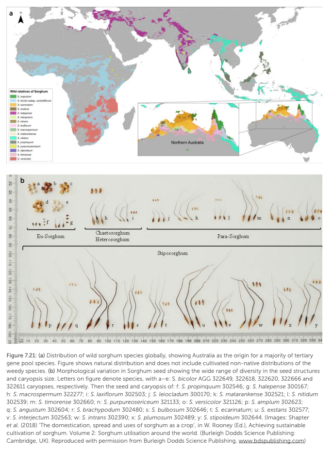
And, given the news about the threats to crop wild relatives and trees, it’s all just as well.
Nibbles: Genebanks in Brazil, Tunisia, Ghana, Ethiopia, Goan rice, Wheat adoption, Peruvian hot peppers & cacao, Amazonian fruits and nuts, Dates, Great Hedge of India, Conservation genetics presentation
- Safety duplicating a chickpea collection.
- Tunisia’s genebank in the news.
- Ghana’s genebank trying to save taro.
- Using a genebank to improve Elephant grass.
- On-farm conservation of rice in Goa.
- Molecular tools show that a couple of varieties account for about half the wheat acreage in Bangladesh and Nepal. Hope all the landraces are in genebanks, and safety duplicated.
- Celebrating Peruvian pepper diversity.
- Peru’s cacao diversity doesn’t need help, apparently.
- However, the Amazon’s wild-extracted fruits (including cacao and a wild relative) could be in trouble. Hope they’re in genebanks, just in case.
- How the date came to the US. Including its genebanks.
- India had a precursor of the Green Wall of Africa but nobody remembers it. Glad it wasn’t used as a genebank of sorts.
- Conservation genetics (i.e., most of the above) explained in 48 slides.