- Final Human Universe episode features Svalbard Global seed Vault.
- GRAIN objects to where Gates Foundation spends its money. Nobody much cares.
- Latest on that UC Davis strawberry breeding programme debacle.
- Yes, bears do shit (apple seeds) in the woods. And some context.
- A conference for the hippy in all of us.
- The dark side of pasture breeding. Super-weed, I am your father!
- World Parks Congress on soon too.
- No access to healthy food? Use your mobile! Watch a video! Grow traditional crops!
- Toyota funds the Millennium Seed Bank.
- ESA supports the ITPGRFA. Speak Up For Seed!
IPK responds on Eurisco
I think it’s only fair to reproduce in full IPK’s response to our plea for clarification on some of the search functionalities of the new Eurisco.
The observation that the current EURISCO has limited functionality is fully correct. Let me explain why we’ll have to cope with this for a little while, for the transition period.
While transferring EURISCO to its new host at IPK, due to technical issues, large parts of the EURISCO infrastructure needed to be revised; this regards both to the EURISCO application (search interface and database structure behind) and to the backend (module for uploading national data sets by the National Focal Points). Thus, it was necessary to find a balance between developments which are visible (search interface) and those which completely take place in the background. For this reason, the search interface currently available is limited in functionality, but this will be improved soon.
Actually we hope to make EURISCO into a sandbox, a playground, where it concerns PGR documentation and interfaces with it. We hope to start experimenting with new and flexible ways of including C&E data and linking to genomic data next year. But first, obviously, we’ll bring the interface for the passport data to an appropriate level. All feedback regarding necessary modifications but also wild ideas regarding possible extensions are most welcome.
We encourage all our readers to take advantage of this request for input. Play around with Eurisco, subscribe to the newsletter, and let your views be known.
The tainted history of rice in the South
The new Eurisco hits a pothole
EURISCO is a search catalogue providing information about ex situ plant collections maintained in Europe. It is based on a European network of ex situ National Inventories (NIs). Currently, EURISCO comprises passport data about 1.1 million samples, representing 5,929 genera and 39,630 species from 43 countries.
Between 2003 and 2014, EURISCO was hosted and maintained by Bioversity International, Rome, Italy. Since 15th April 2014, these responsibilities are being moved to the Leibniz Institute of Plant Genetics and Crop Plant Research (IPK), Gatersleben, Germany. After adapting to a new IT infrastructure, important medium-term actions and objectives will be strengthening the network activities and incorporating phenotypic information about the collection, to name a few.
EURISCO is maintained on behalf of the Secretariat of the European Cooperative Programme for Plant Genetic Resources (ECPGR), in collaboration with and on behalf of the National Focal Points for the National Inventories.
That’s from the welcome screen of the new Eurisco interface. Of course I had to have a go. Bad decision.
First, I just used the “Search” interface, but it turned out that if you want to search on more than one thing at once (say, crop AND country of origin), you have to go to the “Advanced search” screen. I searched for Hordeum landraces from Armenia: No data found.
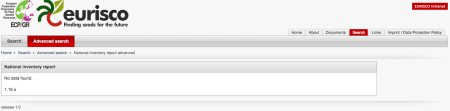
Strange. Try Genesys, which includes Eurisco data: 232 accessions. Ouch. What happened?
To cut a long story short, here’s the problem. The new Eurisco interface forces you to choose “Yes”, “No” or “Unknown” for both “MLS Status” AND “AEGIS” status. You can’t just ignore these descriptors, as you can in Genesys. That means that if you want to just know about barley landraces from Armenia, irrespective of whether they’re in the MLS or in AEGIS, you basically have to do nine searches, i.e. every combination of the three states in each of those two descriptors. Not ideal, I submit.
Over to you, IPK.
Featured: Millet in Uganda
John Mulumba of NARO, Uganda weighs in on that millet controversy:
Sorry to join in this late. Uganda certainly produces far more finger millet than pearl millet. The second map therefore gives a picture close to what is on ground.
Any other views on this?