- Perennial cereal crops: An initial evaluation of wheat derivatives. Early days still.
- Effects of silviculture on native tree species richness: interactions between management, landscape context and regional climate. Encourage mosaics, and don’t harvest everything.
- The global fire–productivity relationship. It’s humped, and will be changed by climate change, though for different reasons for different productivity levels. Wonder about the fire-diversity relationship, though.
- Ancient DNA Analysis Affirms the Canid from Altai as a Primitive Dog. Bit of a judgement call though.
- Genetic structure and diversity of coffee (Coffea) across Africa and the Indian Ocean islands revealed using microsatellites. Just what you would expect, given the “morpho-taxonomic species delimitations and genetic units.”
- Genetic diversity among farmer-preferred cassava landraces in Uganda. Landraces only a bit more diverse than elites overall, but half of them quite different.
- Correspondence between genetic structure and farmers’ taxonomy — a case study from dry-season sorghum landraces in northern Cameroon. Genetic units = farmer-recognized landraces.
- Plant diversity, productivity and nutritive value change following abandonment of public pastures in Japan. The best way to restore productivity (diversity doesn’t change much) in abandoned pastures is to start grazing them again.
- Genetic variability of maize stover quality and the potential for genetic improvement of fodder value. You can improve stover and grain yield simultaneously, in hybrids. In theory.
- Governance regime and location influence avoided deforestation success of protected areas in the Brazilian Amazon. Total protection better than sustainable use. Ouch. Meanwhile, in the USA…
- ICPH 2671 – the world’s first commercial food legume hybrid. Yet another milestone on the road to the complete eradication of farmers’ rights.
- Genetic improvement of grain protein content and other health-related constituents of wheat grain. Need to figure out the genetic control mechanisms, and then exploit “alien” germplasm using MAS. Oh, and GMOs too.
- Quantifying the impacts of bioenergy crops on pollinating insect abundance and diversity: a field-scale evaluation reveals taxon-specific responses. Diversity begets diversity.
- Diversity and geographical gaps in Cajanus scarabaeoides (L.) Thou. germplasm conserved at the ICRISAT genebank. Now collectors know exactly where to go.
- Tree species diversity increases fine root productivity through increased soil volume filling. Below-ground complementarity is good for everyone’s roots, presumably good for the community too.
- Making seed systems more resilient to stress. Foster informal innovation, but also information exchange (presumably including of the formal kind).
Nibbles: Vigna radiata, Brit foods, Botany power, Niche models, Early ag, Fortification, Chicago plants, De-extinction, Kew aroids, Fish farming fail
- WorldVeg fights for the right of Pakistanis to grow mungbean.
- Philosopher thinks the English should fight for einkorn. Oh, and stilton.
- Botanist fights for botany.
- You gotta fight those species distribution models into submission. They don’t come quietly.
- Early farmers made love, not war. Or at least made cultic phallic symbols.
- Indians avoid Golden Rice fight by fortifying their own.
- Chicago fights to save its plants.
- You can’t fight extinction. I mean, once it’s happened.
- Aroids putting up a good fight with showier plants at Kew.
- Aquaculture in a fight for its life as disease looms.
Is this really a Roman mosaic of a pineapple?
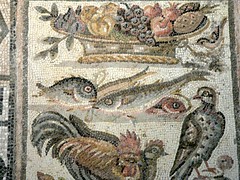
Originally from the environs of the Villa Rufinella. Is it legit? And if truly ancient Roman, what is that in the upper right hand corner if not a pineapple?
LATER: I should add that I was pointed in the direction of that mosaic by a long, but fascinating, talk on “Mapping the Ancient Environment: The Contribution of Manuscripts and Texts,” 1 which in turn came to me thanks to a tweet from @mem_somerville.
Nibbles: Phenomics, Genomes, Indian cucurbits, Argania, Food in history, Sourghum & drought, USDA genebanks, Queenly pear, CIMMYT genebank, Malawi cowpea, Nutrition strategy
- Phenomics is the new genomics.
- No, wait. Peanuts to get a genome. A rice relative’s got one already.
- All the Cucurbitaceae of India, in one handy checklist.
- The paradox of argan oil.
- Couple of things on the history of food. And one on the ethics of food.
- Big push for drought-resistant sorghum. Wait, I thought it was drought-resistant already.
- Ft Collins gets yet another media write-up.
- Telegraph says Queen gets rare pear. Letter writer to Times begs to differ on the whole rarity thing. It sounds like, damn thing being (mostly) behind a paywall.
- If you’re on Facebook, why not like this photo of the CIMMYT maize genebank?
- Canada to help Malawi diversify. Into cowpeas.
- Big report on big nutrition meeting. Big deal?
Nibbles: Quinoazzzzz, Haiti seed bank, Guatemala seed bank, Seed systems, Hybrid wheat, OFSP, Fish characterization, Vanilla
- This quinoa thing is getting tedious.
- Clinton brings a seed bank to Haiti, “which will support efforts to increase agricultural production.” Will be interesting to see how exactly it does that.
- Whereas this seed bank in Guatemala “is empowering the local community to preserve and grow the seeds.” So there you go.
- Of course, those seed banks are going to need seed systems. And vice versa.
- And the next milestone in the continuing disempowering of the farmer is…
- Orange-fleshed sweet potatoes go aquatic. Where they’ll find fish that need to be compared.
- A Tongan vanilla tour.