- National Heirloom Exposition coming up. Any of our readers going? Oh come on, one of our readers must be going!
- Kew head honcho calls for a botanical New Deal.
- WorldFish head honcho calls for an aquacultural New Deal.
- A papyrus of recent botanical literature on ancient Egypt.
- Coffee blogs to follow. Oh gosh, am I blushing?
- Participants “gain more knowledge” at policy workshop. Of the ITPGRFA, that would be.
- A couple of Chinese agricultural systems gain recognition as Globally Important Agricultural Heritage.
Organic farming: what is it good for?
Organic produce and meat typically is no better for you than conventional food when it comes to vitamin and nutrient content, although it does generally reduce exposure to pesticides and antibiotic-resistant bacteria, according to a US study.
Organic farming is generally good for wildlife but does not necessarily have lower overall environmental impacts than conventional farming, a new analysis led by Oxford University scientists has shown.
Time for a meta-meta-analysis?
OFSP steal the show

Urban agriculture gets its 15 minutes
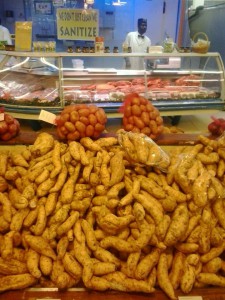
The World Urban Forum is taking place down in my home town this week. That I suppose was what provided at least part of the impetus for the United Nations Standing Committee on Nutrition (UNSCN) to issue a statement on the Nutrition Security of Urban Populations. Not to be outdone, FAO has a publication out too, Growing Greener Cities in Africa, touted as the “first status report on urban and peri-urban horticulture in Africa.” A cursory glance doesn’t reveal much on diversity in these documents, but this is an issue that’s always intrigued me. Could cities act as magnets for crop inter- and intraspecific diversity? After all, they have lots of micro-niches, and have been attracting people from all over for decades, who could have come with their seeds. Is it possible that varieties could still be grown in cities after they’ve disappeared in their native areas? Or at any rate that crop diversity in a city is higher than in the surrounding countryside? Sometime ago we did a small survey of sweet potato diversity in Nairobi roadside verges that seemed to suggest that the menu of varieties was at least somewhat different from what was available in nearby rural areas. Should write that up one day. Anybody know of similar studies?
Cheers
I can’t believe I forgot to include news of the President’s homebrew in the list of my favourite agrobiodiversity stories of the past few weeks. I suppose it was all done by the Obama campaign as part of a complicated social media strategy to deflect attention from the Republican convention, but I don’t care. I like that the hop varieties involved, Kent Goldings and Fuggles, have venerable, and not uninteresting, histories.