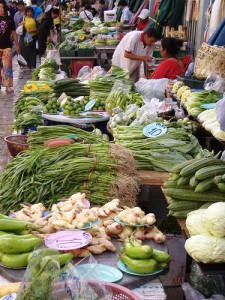
 AVRDC has a nice new website. You can subscribe to a couple different newsletters, and also follow the institute on Facebook and Twitter. You can buy a porcelain coffee mug and donate money. And there’s a decent RSS feed at last. The first thing that popped up when I subscribed to it was, almost inevitably, a fact sheet on the baobab. Yet another fact sheet on the baobab. Incidentally, I know I’ve already nibbled this, but also newly online is CABI’s Plantwise Knowledge Bank, an “online resource with information for all involved in plant health.” Where, almost inevitably, you can get information on the baobab.
ICRISAT’s work on crop wild relatives
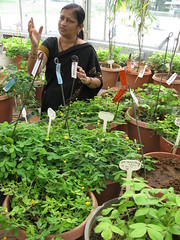
Dr Nalini Mallikarjuna with some amphidiploid peanuts: “Give me time and I’ll give you hybrids.”
Nibbles: Taxonomic search, Genebanks in China, USA, Nepal, Scaling up, Bison
- Discover taxonomic names in files, websites, etc…
- Chinese genebank collecting wild species in Tibet.
- Touring a non-government genebank. And running another one.
- Not a community one, though.
- Everybody talking about scaling up. Here’s how you do it. Probably need the media involved, right?
- Scaling up did for the bison.
Nibbles: Aspergillus domestication, Aurochs resynthesis, Drought resistance, Protected areas, Ford Denison, Ancient diets
- The National Fungus of Japan explains itself.
- The aurochs recreated in fact and fiction. And more.
- Yes, that’s what we need to make good on all those GM drought-resistance promises: a new model system. And now for something a little more serious.
- Some protected areas don’t work terribly well. Here comes the science.
- Darwinian Agriculture explained by the man himself.
- Ancient diets deduced from teeth crap and crap crap.
The CGIAR reform explained
Frank Rijsberman, CEO of the CGIAR Consortium, gave a seminar at IFPRI yesterday on the topic of the CGIAR reform. You can watch it below, but if you want to see the slides properly, you’ll have to go somewhere else. I wonder if there’s a way to intercut the video with still shots of the slides.
You may be intrigued by the statement that the CGIAR now has “15 (+1) programs.” The details are on the CGIAR Consortium and CGIAR Fund websites, though, confusingly, you get different sorts of details in the two places. Anyway, the research portfolio is perhaps most succinctly summarized here. The 15 things Dr Rijsberman referred to are the so-called CGIAR Research Programs (CRP). The “(+1)” refers to the “Long Term Support of CGIAR Genebanks,” 1 which is somewhat different, being described as a “CRP Research Support Program.” I’m not sure that it’s entirely appropriate to relegate what are often described as the crown jewels of the CGIAR system to a bracketed addendum, but we shouldn’t quibble. It’s certainly very good to see some of the world’s most important genebanks properly taken care of.