- Slate puts a fork in, well, the fork.
- Gotta love the Prairies.
- Mysterious Cattle Deaths Caused by GMO Grass: not GMO, not particularly mysterious.
- Gotta love the Spice Islands.
- How scientists can extract impact from their
navel-gazingresearch. - Gotta love online mapping platforms.
- Another journal starts a blog.
- Horses in agriculture, and history.
- Gotta love za’tar. It’s about thyme.
- Sweeter than sugar. Mauritius goes for fair trade and diversification.
- Dying for batik.
Brainfood: Synthetic wheat, Pisum, Maize products, Seed predation, Cajanus, Tripsacum, Horse domestication, Cicer genomics, Cereal vulnerability, Allotments, Conservation units, Chilie diversity, Endophytes
- Sources of resistance in primary synthetic hexaploid wheat (Triticum aestivum L.) to insect pests: Hessian fly, Russian wheat aphid and Sunn pest in the fertile crescent. Domestication do-over continues to show promise. Closest thing to a jetpack?
- Evaluation of seed yield and seed yield components in red–yellow (Pisum fulvum) and Ethiopian (Pisum abyssinicum) peas. Weird pea species show promise in Serbia, of all places.
- Consumer preferences for maize products in urban Kenya. Most still like it white. Not much promise there.
- Bush pig (Potamochoerus porcus) seed predation of bush mango (Irvingia gabonensis) and other plant species in Democratic Republic of Congo. It’s pretty unpromising for seeds, especially right under the tree.
- Phenotypic diversity in Cajanus species and identification of promising sources for agronomic traits and seed protein content. 14 accessions of 8 seem promising (out of a total of 198 accessions of 18 species from the ICRISAT collection).
- Genetic relations among Tripsacum species revealed by genomic variation. They might be promising.
- Reconstructing the origin and spread of horse domestication in the Eurasian steppe. Wild Equus ferus moves out of eastern Eurasian steppe 160 kya, shows promise, gets domesticated in the western part, but continues to introgress with local wild horses as it moves out from there.
- Large-scale development of cost-effective SNP marker assays for diversity assessment and genetic mapping in chickpea and comparative mapping in legumes. What can I tell you. It’s large-scale. It’s cost effective. It’s promising. I’m still waiting for my jetpack.
- The socioeconomics of food crop production and climate change vulnerability: a global scale quantitative analysis of how grain crops are sensitive to drought. It’s the middle income countries that are especially vulnerable, and thus where all that promise needs to come good.
- Deskilling, agrodiversity, and the seed trade: a view from contemporary British allotments. Please promise to keep open-pollinated heirlooms out of the marketplace.
- Harnessing genomics for delineating conservation units. But you need to combine information from neutral and adaptive markers in fancy ways to fulfill the promise.
- Why are not all chilies hot? A trade-off limits pungency. It’s all about how much water is available.
- Endophytic Insect-Parasitic Fungi Translocate Nitrogen Directly from Insects to Plants. Suppose we better promise to conserve these things too then. And here’s the slightly longer short version.
Nibbles: Plant Cuttings, Millennium Seed Bank, ITPGRFA, siRNA, Zoonoses information, Botanical garden, Rio +20, Italian bees, Brazilian coriander, Sri Lankan rice, International Treaty
- “Times are hard; everybody wants more (but seems to be getting less…)…”
- “The panels will produce enough energy to power all of the bank’s seed stores.”
- “One of the Benefit-sharing Fund’s unique features is the transparent process that governs the allocation of funds. After a wide announcement of each call, all the project proposals received for funding are evaluated according to established scientific criteria by international experts in order to fund the best projects.”
- “Basically we’re going to add bullets (siRNA) to the plants’ defense arsenal. It’s science fiction right now, but if it works, then the lengthy, expensive cleanup process could be shortened to two minutes.”
- “A new website provides examples of policies, institutions and stakeholders involved in the management of zoonoses, collated in a meta-database, together with discussion of cross-cutting themes and case studies to illustrate potential approaches.”
- “…the polka-dotted pumpkins were a hit.”
- “We all know this wasn’t the meeting where world governments were going to rise from the ashes.”
- “The tradition of micro-beekeeping has completely disappeared.”
- “No one buys beans, but they do buy cilantro.”
- “Teaming up with Alex Thanthriarachchi, 62, a reformed militant Marxist, Wijertane is on a mission to promote indigenous varieties of rice and other staples as the best way for Sri Lankan farmers to deal with changing climate.”
- “As a metaphor for itself, the treaty is the seed that is there and has been planted. It now needs to be used by all countries in order to keep sustaining life.”
MAPPR responds
A couple of days ago we donned the guise of an investor seeking a site for their cassava processing plant in Tanzania, and ended up expressing some reservations about the advertised ability of HarvestChoice’s MAPPR online mapping tool to help us out with that tricky task. We thus issued a challenge: “You be that policymaker in the blurb that wants to ‘identify regions of a country with high concentrations of both poverty and cropland.’ If you can do that, I promise to host the results here. And apologize to the MAPPR team.” Well, Stanley Wood has risen to the challenge in a comment on that post, which we now reproduce below. He also explains how the team intends to go about improving MAPPR, based in part on user feedback such as this. As for the apology, I’m happy to issue it. But I have one question for Stanley and the team. Do they really think the average policymaker is going to want to fiddle about sorting columns in an Excel spreadsheet to “identify regions of a country with high concentrations of both poverty and cropland”? Especially as they kind of have been promised a nice map in which the answer would just jump out at them… Anyway, we look forward to test-driving future versions of a tool with obviously a lot of potential, but which just isn’t quite there yet, and could obviously do with a bit more attention to the kind of specific use cases Stanley presents here, and we dealt with earlier. Many thanks to Stanley for taking the time to reply, and very best wishes to him and the MAPPR team.
Thanks for a very helpful posting in terms of sharpening our focus on potential MAPPR improvements. That rather long pipeline already includes alleviating some of the frustrations you encountered, particularly the inability to download user-created maps in addition to the table and chart download options. As shown on your screenshots of the Market Shed summary tool it is already possible to download the map in GIS format (the button with the – admittedly arcane – inscription “Download .SHP”), but that feature is indeed absent in the other summary options. What you (and others) have highlighted is also the lack of an option to download the map you created map in a cleanly annotated .png or similar format to put directly into a report or presentation. I think we maybe a month away from adding that capability.
We will follow up with our way more technical folks on the likely causes of the dreaded “404″ and see what that issue might be. I also don’t know what HI is, but I’m sure Chris can enlighten us. We will soon be adding server memory to enhance performance which might be a fix if it proves to be a capacity issue.
On the final comment about poverty and cropland, I went into MAPPR myself and made a map and table in less than a minute highlighting their coincidence at a district level in Tanzania. I saved the map and downloaded the table (and just as you did I had to grab the map with Print Screen for the time being).
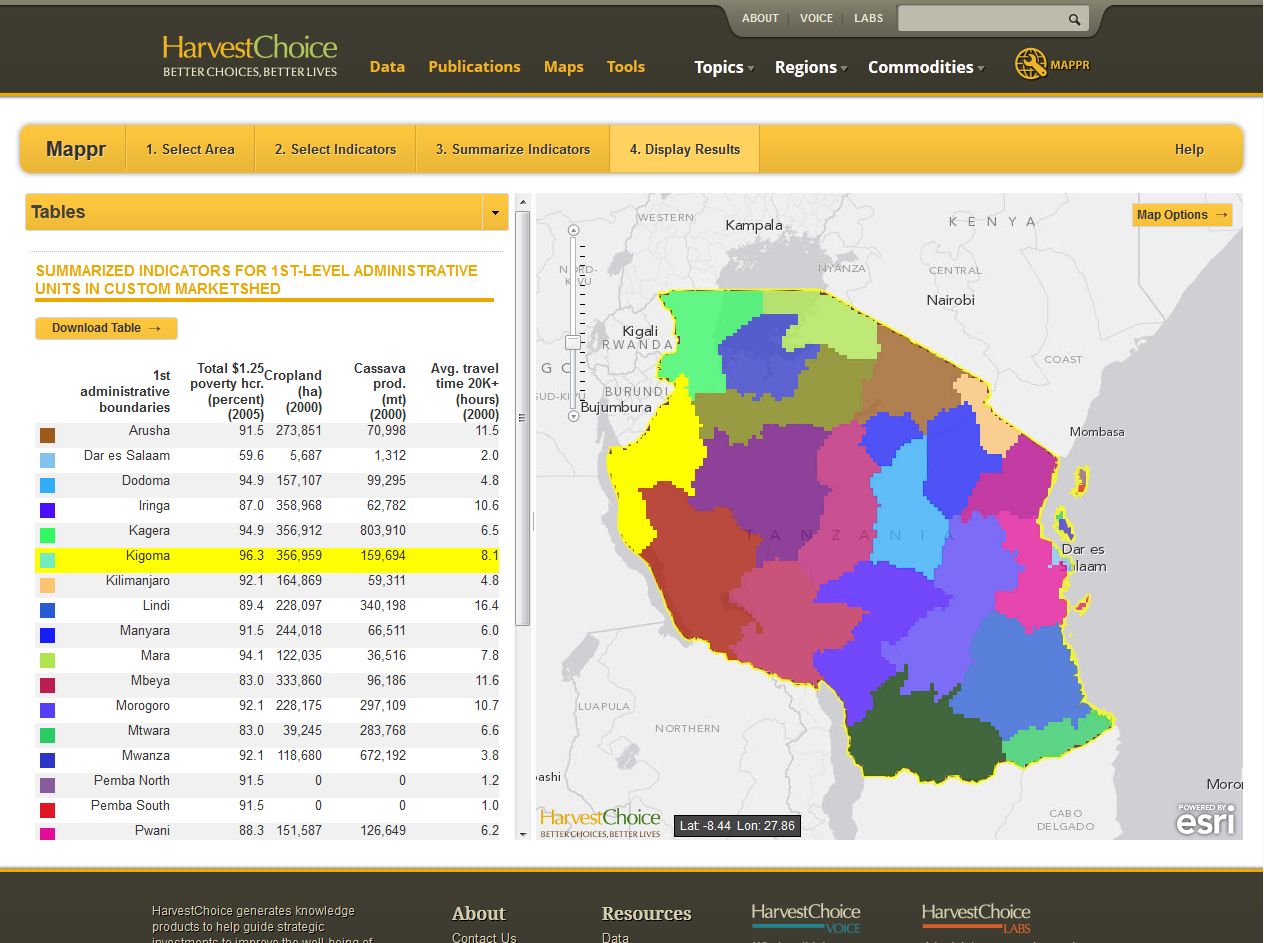
Are some aspects of MAPPR both limiting and a bit kludgy? Indeed so. But feedback like yours and that of other users, in addition to our own pipeline of fixes and enhancements, can only serve to make it better. Indeed, since you’re an investor, we welcome your investment in our data and tools to speed up those improvements!
Meanwhile, please keep the feedback coming.
Stanley Wood
Nibbles: Beef, Dairy, Resilience and vulnerability, Seed systems, Irony beans, Genebanks in the news, Catch a fire, Amazon, Spanish gardens, Conservation, Work exchange
- What is the best beef in Europe?
- When was the first yoghurt of the Neolithic?
- How do you measure smallholder resilience? Or vulnerability, for that matter…
- How does this Kenyan seed story differ from this Malian one?
- How do you address iron deficiency in Rwanda?
- What’s the value of a genebank?
- There’s a downside to plant-derived smoke?
- So what’s the latest paradigm shift on that ancient-people-in-the-Amazon thing?
- How are the Spanish people coping with the crisis?
- How come those transcribed podcasting, medal winning conservationists still don’t get it?
- What are Ethiopians doing in Amazonia?