- Projects I should probably know about but had never heard of, no. 37: Cassava: Adding Value for Africa (C:AVA).
- Projects I should probably know about but had never heard of, no. 38: African Food Tradition rEvisited by Research (AFTER). Mopane left unvisited, though, alas.
- More from the ITPGRFA Secretary Down Under.
- From genebank to farmers: bananas in the Philippines.
- Things are looking up: there’s a new Plant Cuttings out.
- We should all go back to seed school. Hey, just tell me where.
- Family gardens for refugees. And for urban folk in Ethiopia.
- Learning from the past in order not to repeat it, Vol. 88: Sustainble fisheries. Repeating it anyway, Vol. 565543 coming all too soon. No, wait, here it is…
- It’s that time of year again, isn’t it. Spring. Bah, humbug.
Nibbles: Musa, Millennium Seed Bank, Cassava conference & blog
- The banana in the Pacific. Including those orange ones…
- Swapping seeds at Kew. A genebank reaches out.
- Gosh is that all today? Looks like it. You guys out there have anything?
- No, wait, here’s something else. Huge cassava conference coming up, with its biodiversity on the agenda. These guys will probably be there.
Featured: Breadfruit in Ghana
Jeff Marck on why there hasn’t been so much about Ghana’s new breadfruits in the press there (and more):
We didn’t actually make any press releases in Ghana as we wanted to to keep it all a little quiet so as to avoid night watchman costs, etc. Field planting begins in the first week of April. Hoorah! The first new variety breadfruit to reach West Africa since the 1840s.
Ooops, sorry.
Make mine an MLS decaff
There was a nice article recently in Nature reviewing the struggle — and it’s been a mighty struggle, which is still going on — to breed a naturally low-caffeine coffee plant. It’s worth reading in full, if you can get hold of it, but I just want to focus briefly here on this paragraph:
In 2000, Mazzafera teamed up with Silvarolla, a coffee breeder at the IAC. They shifted their focus to a group of C. arabica plants originally collected during a 1964 United Nations expedition to Eritrea and Ethiopia. Seed samples — 620 in total — were divided up and grown in several countries, including Costa Rica. Later, 308 of these lineages were collected in Costa Rica and sent to Brazil. Mazzafera believed it would be much easier to produce marketable coffee by starting with the Ethiopian C. arabica plants than by hybridizing with other species.
What’s interesting about this is that the ORSTOM (now France’s IRD), FAO and IBPGR collections made in the 1960s and 1970s, including the 1964 one alluded to above, still form the bulk of the material maintained in coffee genebanks around the world. Sure, there’s been more collecting in Ethiopia since then, but that material is much more difficult for breeders outside that country to get hold of than the results of these older international collecting initiatives.
That’s at least partly because Coffea is not among the crops which are supposed to be liable to facilitated access under the multilateral system of access and benefit sharing (MLS) being put in place by the International Treaty on Plant Genetic Resources for Food and Agriculture.
Ah, but wait. That reference to Costa Rica in the paragraph above really means CATIE, or the Tropical Agricultural Research and Higher Education Center in Turrialba. And that institute has put all its collections under Article 15 of the Treaty. Yes, including coffee.
If the world is to have its naturally decaffeinated cappuccinos, a good first step might be to put in place a multilateral system for coffee too, which goes beyond the CATIE collection. That would surely help get breeders using as wide a range of diversity as possible. Or at least as is available in existing collections. That these are far from complete, especially as regards wild relatives, is well understood. But that’s something for another post.
Cassava varieties in Ghana
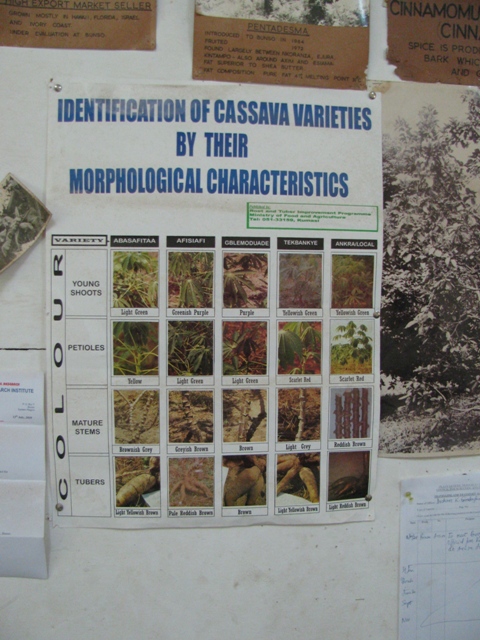 Call me old-fashioned, but I have a soft spot for this kind of poster. This particular example was at CSIR’s Plant Genetic Resources Institute, Bunso, Ghana. Beats an SSR dendrogram thingie any time.