- July issue of CSA News, official magazine for members of the American Society of Agronomy, Crop Science Society of America and Soil Science Society of America, has article on “Crop Adaptation to Climate Change” based on official CSSA position statement, “Crop Adaptation to Climate Change.”
- Factsheet on bacterial diversity and why it’s good for soils.
- FAO guidelines for the In Vivo Conservation of Animal Genetic Resources discussed in Europe.
- Please eat the daisies. Or other flowers.
- Farming chips.
- Never thought I’d get bored of reading about ancient beer.
British Library has online stuff on agrobiodiversity shock
This page is from the tractate Kilayim (which translates as ‘of two kinds’) which deals with the laws regarding forbidden mixtures of species in agriculture, breeding and clothing. It forms part of Zera’im (Seeds), one of the six divisions or orders of the Mishnah. Added to the text is Moses Maimonides’s commentary translated from the original Arabic. The diagrams show ways of dividing up plots of land to grow permitted types of seeds and mixed species. This book itself was printed in Naples in 1492 by Joshua Solomon Soncino, and was the first to contain the complete text of the Mishnah.
One of the many treasures awaiting you at the British Library, this one in the gallery section. And there’s more to come.
Wakehurst Place

This is where Kew’s seed research programme, including the genebank, was housed before they built the Millennium Seed Bank. Pretty cool, eh?
The future of rice in Mozambique
Readers with long memories who had time on their hands back in January may remember a post we did then on IR80482-64-3-3-3, a new rice tailor-made for Mozambique. There was some discussion at the time about the claims being made in the original SciDevNet piece about the new variety on which we based our post, but what really struck me was this statement:
Work began when the International Rice Research Institute (IRRI), in the Philippines, sent Mozambique 11,200 rice varieties for testing.
That just sounded like quite a lot of varieties, and I remember wondering at the time how long it took the Mozambique national rice programme to get through that little lot. But anyway, I bring this up now not only because someone from IRRI has very kindly left a comment on the original post. But also because IR80482-64-3-3-3 is back in the news, cannily renamed Makassane. The IRRI press release has been widely picked up.
Following the approval of Makassane for release by the Mozambique Variety Release Committee earlier this month, IRRI provided government agencies and farmers “foundation seed” to use in bulking up the seed so that more can be produced and distributed to more farmers.
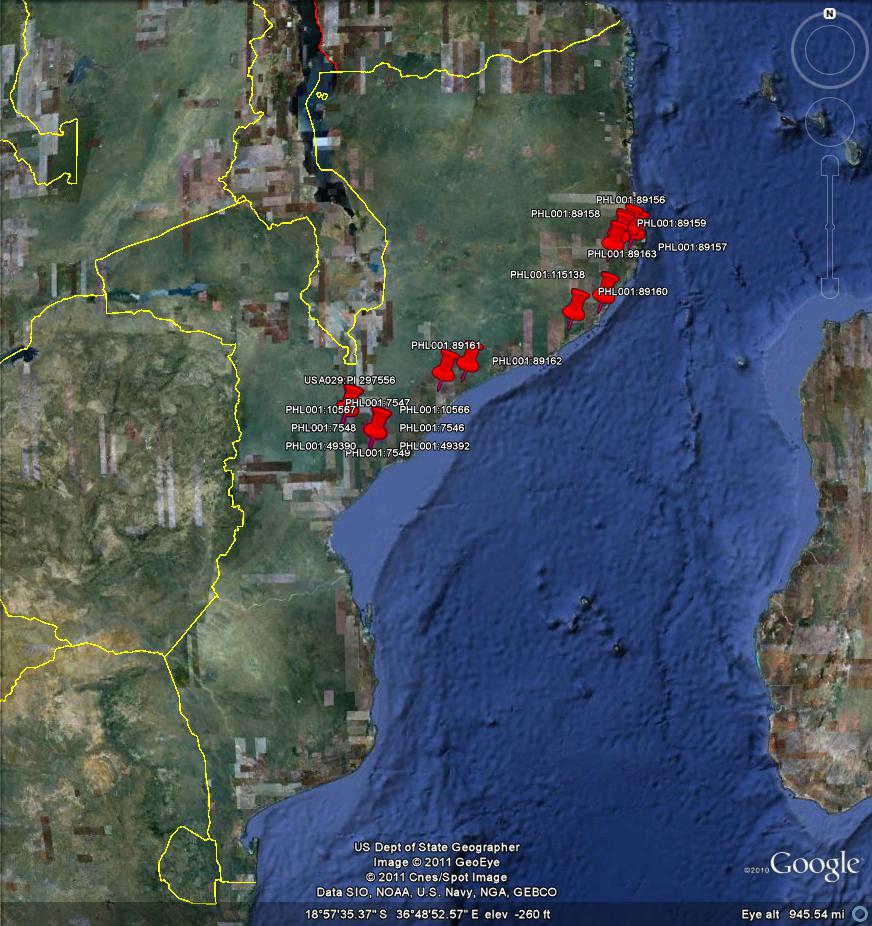 Two things about this. First, I look forward to regular updates on Makassane’s uptake by farmers. And second, I hope the IRRI and Mozambique national genebanks are confident that they already have good representation of the local landraces. Sophie, who left the aforementioned comment, says there are 76 rice types from Mozambique at IRRI. Genesys gives us just over 120 worldwide, between landraces and wild species, but only a few are geo-referenced (see map).
Picking a good agrobiodiversity beach
My apologies to Robert Hijmans, the developer of DIVA-GIS. I had forgotten how awsomely awesome his software. It was really only the work of half an hour to export a shapefile of the distribution of wild and weedy accessions from Genesys, open it in DIVA-GIS, produce a gridfile of taxon richness, export it as a KMZ, and open it in Google Earth, together with The Guardian’s European bathing places dataset, which I had prepared earlier.
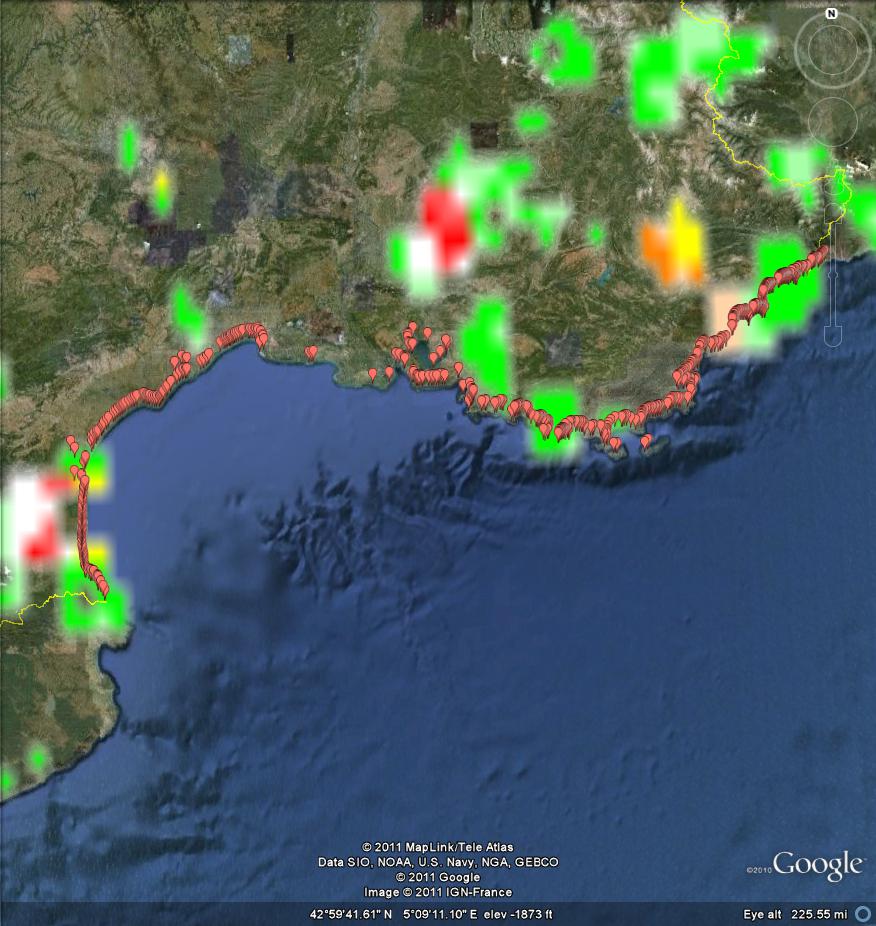
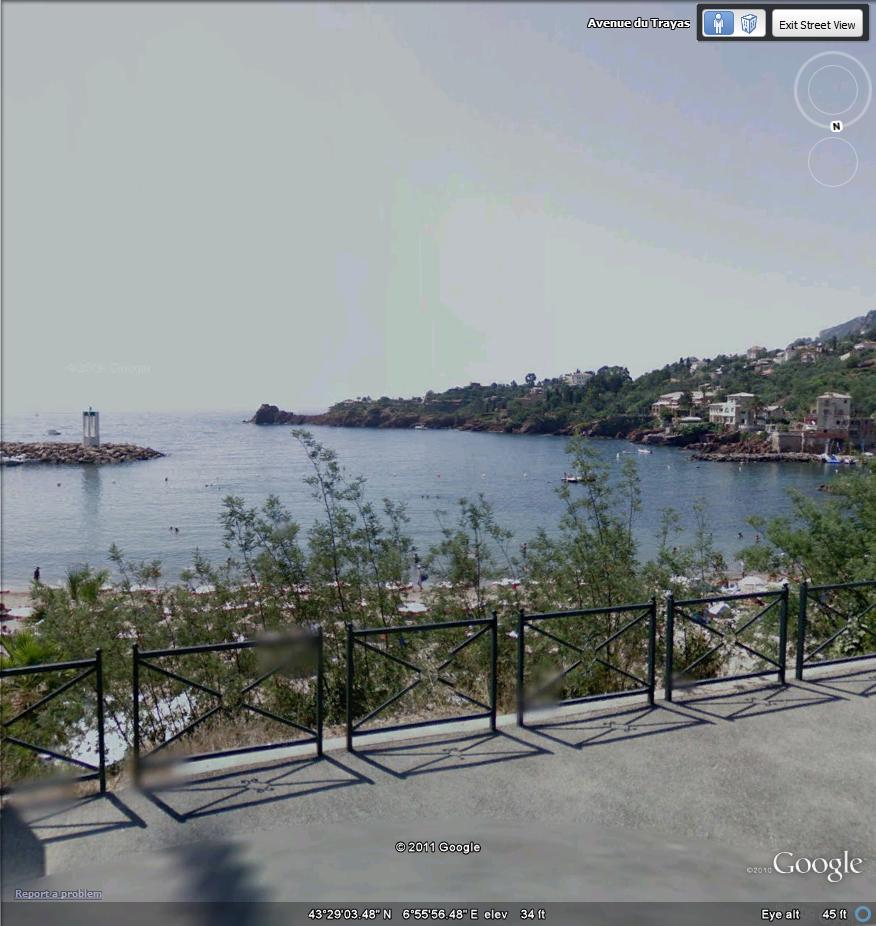
A beach called La Figueirette at Theoule-sur-Mer is right in the middle of that (relative) hotspot of species richness not far from the Italian border shown in light orange on the map above. And the beach doesn’t look too bad either, at least on StreetView.
Now, to check out the lakes…