- Vegetables by Stealth: an exploratory study investigating the introduction of vegetables in the weaning period. Sneaking them into the diet is the most common strategy used by mothers to introduce their kids to vegetables. Reeeeeally?
- Assessment of Iranian chickpea (Cicer arietinum L.) germplasms for drought tolerance. Four out of 150 local landraces showed promise. It really is a numbers game, isn’t it?
- In situ induction of chromosome doubling in vine cacti (Cactaceae). Potentially valuable autopolyploids were produced. Not that it was easy or anything.
- Who brought in the rabbits? Taphonomical analysis of Mousterian and Solutrean leporid accumulations from Gruta Do Caldeirão (Tomar, Portugal). People did, that’s who, but only during the later Upper Paleolithic. Before that it was mainly owls.
- Protected areas in climate space: What will the future bring? Nothing good. Both novel and disappearing climates are over-represented in current protected areas, at least in California.
- Progress in the utilization of Cajanus platycarpus (Benth.) Maesen in pigeonpea improvement. Baby steps.
- Classification of pecorino cheeses using electronic nose combined with artificial neural network and comparison with GC-MS analysis of volatile compounds. Wait, there are different kinds of pecorino?
- The need for country specific composition data on milk. Well, you’ve got me convinced.
- Rate-distortion tradeoff to optimize high-throughput phenotyping systems. Application to X-ray images of seeds. So, let me get this straight, basically, gauging the optimal trade-off between speed and accuracy in high-throughput phenotyping systems depends on what you’re measuring? Who writes these grant applications?
- Experimental growing of wild pea in Israel and its bearing on Near Eastern plant domestication. First pea growers were either very patient or very quick workers.
The revenge of characterization data
It is a truth universally acknowledged that characterization data are useless to breeders. Well, universally acknowledged by breeders anyway. Morphological data are all well and good for genebank curators looking for duplicates and old-fashioned taxonomists, they say. But what we need is evaluation data, and lots of it.
As usual, I exaggerate; for effect, as usual. But I think it would certainly be true to say that detailed morphological descriptions of germplasm are not the highest priority thing breeders want out of genetic resources databases. That would probably be information on resistance to biotic and abiotic stresses.
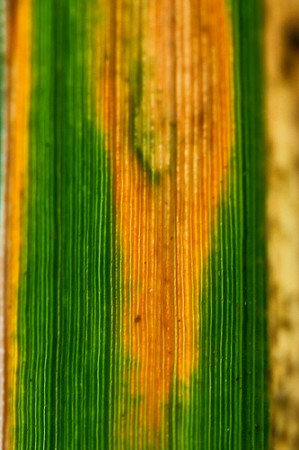 And yet a paper just out in Euphytica shows that the former can be clues to the latter. A team at IRRI 1 looked at the susceptibility of rice to sheath blight, an important disease throughout rice-growing areas, especially under intensive systems. 2 They measured how 200 accessions did when inoculated with Rhizoctonia solani in the field. So far, so conventional.
But because the accessions were very carefully chosen (out of a total of over 100,000 in the IRRI genebank), the team, which included the genebank manager, were able to estimate to what extent differences in disease intensity were due to plant and canopy architecture — in other words, morphology — and how much to genetic susceptibility.
The accessions tested were selected to represent contrasting morphologies (based on leaf length, leaf angle and number of tillers, typical characterization descriptors), different phenologies (number of days to 80% flowering) and all the major varietal groups (indica, aus, aromatic, temperate, japonica and tropical japonica). It turned out that the lowest levels of disease intensity were found on a particular morpho-phenological group, and that this effect of morphology on disease intensity was much greater than any effect of genetic group, although the aus varietal group was markedly superior to the others.
The authors therefore recommend that breeders looking for sources of reduced susceptibility to sheath blight will find it most efficient to select taller accessions with wider leaves. Let us see what the breeders think. I’ll post this on GIPB and report back if there’s any reaction.
Nibbles: Tamil genebank, Econutrition, Sweet perception, Salmon, Texas culinary diversity, Amaranth, Nepal hermarium video, Restoration
- Provincial Indian university gets a genebank.
- Nutritionists go all ecological on us.
- But does that include taking into account human variation in taste perception? I’m betting no.
- The case against GM salmon.
- Going crazy in Austin’s market.
- Amaranth touted in Kenya. Sorghum and local millets unavailable for comment.
- Take a virtual trip around Nepal’s herbarium.
- Society for Ecological Restoration opens online Early Registration for the 4th World Conference on Ecological Restoration, to be held in August in Mérida, Mexico. You guys need a blogger?
Regenerating Iraqi wheat
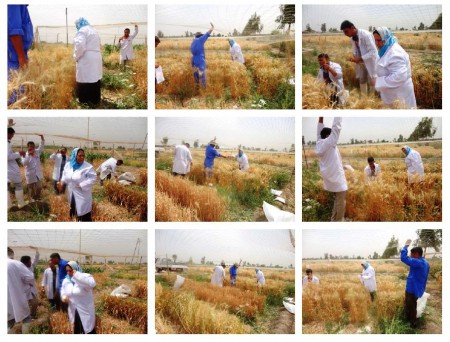
Our friend Mrs Sanaa and her colleagues have been regenerating wheat accessions dating back to before the Iraqi genebank at Abu Ghraib was destroyed in 2003. You’ll remember that she rescued this material by storing it at her house until the genebank got back on its feet. Many thanks to her for the photos.
Poked and prodded, the Ankole await action
I’m not sure that the letter to the editor 3 written by LIFE Network and League for Pastoral Peoples staff and entitled “Efforts to save Uganda’s unique Ankole cattle must be stepped up, so that its keepers can benefit” and recently posted on DAD-Net will be as widely available as it merits, so I’ll reproduce a good chunk of it here.
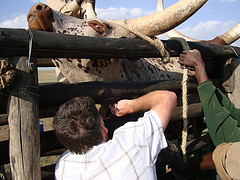
Uganda’s world famous Ankole cow is threatened with extinction unless there is a coordinated effort to prevent its cross-breeding with exotic cattle, and land is set aside for grazing. This is the conclusion of a team of experts of the LIFE Network that recently toured the Ankole breeding tract. The LIFE Network is a group of organisations that support community-based conservation of indigenous livestock breeds…
At a meeting with women dairy producers held in Nyabushozi county, Kiruhura district, it became clear that the cross breeds come with their own set of problems. According to the women, they are very susceptible to diseases and can die quickly without much prior indication. There is a continuous need for medication and treatment. And selling milk, while it generates some much needed cash income, is also fraught with problems, as there is no guaranteed market and prices fluctuate seasonally. During the rainy season, not all milk may be accepted and instead poured away by the dairy company.
There are also fears about environmental damage by the cross-breeds. Their grazing behaviour is different – they crop the grass in a very intense manner. Furthermore, their skins and eyes get easily injured by the thorny bushes, so farmers have started to uproot these, essentially changing the plant cover. Also, the need for frequent dosing with medicines results in chemical residues in milk and meat…
Ms. Katushabe notes that there are a number of efforts to conserve Ankole cattle. The actors involved include “traditionalists”, private entrepreneurs like Dr. Sam Mugasi and some dedicated Ankole cattle keepers that have obtained access to common grazing land. But these efforts lack coordination, and a concerted effort to prevent further uncontrolled cross-breeding. Even the Uganda Wildlife Authority has initiated a project to integrate Ankole cattle into the management of the Lake Mburo National Park; however, here the prime purpose seems to be the enhancement of the attraction of the park for tourists rather than conserving the breed…
“Conservation” may, in fact, not be the key to saving the Ankole cow for posterity. “We need to develop the Ankole breed rather than conserve it”, states Dr. Jacob Wanyama, who coordinates the African LIFE Network. “By means of selective breeding, it would be possible to gradually raise the milk yield while retaining the favourable characteristics of the breed. Such an approach would involve organising the keepers of pure Ankole cattle into a breeders’ association and registering the pure bred animals.” This would also lay the foundation for enabling the livestock keepers to eventually benefit from the unique quality of their animals’ products. For instance the meat is said to be low in cholesterol and extremely tasty. But currently it is marketed generically, and the consumer has no way of knowing what type of meat is on offer. Providing products from pure-bred Ankole cattle with a special stamp or seal that identifies it as such could help generate increased revenues for its keepers, many of whom are poor.
As chance would have it, there’s a paper on the Ankole in the latest issue of Animal Genetic Resources. And the technical complexities that may be involved in developing the breed — any breed — in Africa are outlined in a recent ILRI presentation. The LIFE Network, the League for Pastoral Peoples and the Pastoral and Environmental Network in the Horn of Africa have been working on the Ankole for a while now, and so have ILRI and others. So what now?