The latest on the Haitian seed donation controversy

You may remember a number of posts we did last year on the Monsanto donation of maize and vegetable seed to Haiti in the wake of the earthquake, and what Catholic Relief Services and others thought about it, which was, in a nutshell, not much. Now, via Truthout, comes news of an investigation by Haiti Grassroots Watch of what happened to the seed. The article also usefully recounts the whole story. And there’s a summary, with added video goodness. These three points from the summary probably best describe where Haiti Grassroots Watch are coming from:

  • At least some of the peasant farmer groups receiving Monsanto and other hybrid maize and other cereal seeds have little understanding of the implications of getting “hooked” on hybrid seeds. (Most Haitian farmers select seeds from their own harvests.) One of the USAID/WINNER trained extension agents told Haiti Grassroots Watch that in his region, farmers won’t need to save seeds anymore: “They don’t have to kill themselves like before. They can plant, harvest, sell or eat. They don’t have to save seeds anymore because they know they will get seeds from the [WINNER-subsidized] store.” When it was pointed out that WINNER’s subsidies end when the project ends (in four years), he had no logical response.
  • At least some of the farmer groups interviewed also don’t appear to understand the health and environmental risks involved with the fungicide- and herbicide-coated hybrids. In at least one location, it is quite possible farmers plant seed without the use of recommended gloves, masks and other protections, and – until Haiti Grassroots Watch intervened – they were planning to grind up the toxic seed to use as chicken feed.
  • In at least several places around the country, donated seeds produced no or little yield. “What I would like to tell the NGOs it that, just because we are the poorest country doesn’t mean they should give us whatever, whenever,” disgruntled Bainet farmer Jean Robert Cadichon told Haiti Grassroots Watch.
  • But, as a pithy encapsulation of the Haitian seed donation conundrum, I liked this comment from an interviewee:

    “We love Monsanto seeds,” Farmer said again. Although he noted that the bigger kernels don’t always fit in farmers’ corn mills.

    Farmers! Always wanting more.

    Plant traits analyzed globally

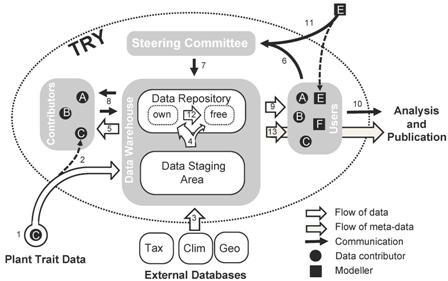
    ResearchBlogging.orgWhen we talk about plant traits here we are usually referring to things like characterization and evaluation descriptors, and how they vary within crops. But there’s an ambitious initiative underway to document “the morphological, anatomical, physiological, biochemical, and phenological characteristics of plants and their organs” — some 1500 of them — across the world’s entire wild flora. It’s called TRY, and it is described in a new paper in Climate Change Biology. 1 It works by bringing together existing datasets in a data warehouse, like this:

    I think the caption to this diagram (Fig. 1 in the paper) is worth quoting in full, as it may give some ideas to people developing similar systems more aimed at agrobiodiversity, like Genesys.

    The TRY process of data sharing. Researcher C contributes plant trait data to TRY (1) and becomes a member of the TRY consortium (2). The data are transferred to the Staging Area, where they are extracted and imported, dimensionally and taxonomically cleaned, checked for consistency against all other similar trait entries and complemented with covariates from external databases (3; Tax = taxonomic databases, IPNI/TROPICOS accessed via TaxonScrubber (Boyle 2006), Clim = climate databases, e.g. CRU, Geo = geographic databases). Cleaned and complemented data are transferred to the Data Repository (4). If researcher C wants to retain full ownership, the data are labelled accordingly. Otherwise they obtain the status ‘freely available within TRY’. Researcher C can request her/his own data – now cleaned and complemented – at any time (5). If she/he has contributed a minimum amount of data (currently >500 entries), she/he automatically is entitled to request data other than her/his own from TRY. In order to receive data she/he has to submit a short proposal explaining the project rationale and the data requirements to the TRY steering committee (6). Upon acceptance (7) the proposal is published on the Intranet of the TRY website (title on the public domain) and the data management automatically identifies the potential data contributors affected by the request. Researcher C then contacts the contributors who have to grant permission to use the data and to indicate whether they request co-authorship in turn (8). All this is handled via standard e-mails and forms. The permitted data are then provided to researcher C (9), who is entitled to carry out and publish the data analysis (10). To make trait data also available to vegetation modellers (e.g. modeller E) – one of the pioneering motivations of the TRY initiative – modellers are also allowed to directly submit proposals (11) without prior data submission provided the data are to be used for model parameter estimation and evaluation. We encourage contributors to change the status of their data from ‘own’ to ‘free’ (12) as they have successfully contributed to publications. With consent of contributors this part of the database is being made publicly available without restriction. So far look-up tables for several qualitative traits (see Table 2) have been published on the website of the TRY initiative (http://www.try-db.org). Meta-data are also provided without restriction (13).

    How far has it worked?

    As of 31.03.2011 the TRY data repository contains 2.88 million trait entries for 69,000 plant species, accompanied by 3.0 million ancillary data entries15. About 2.8 million of the trait entries have been measured in natural environment, less then 100.000 in experimental conditions (e.g. glasshouse, climate or open top chambers).

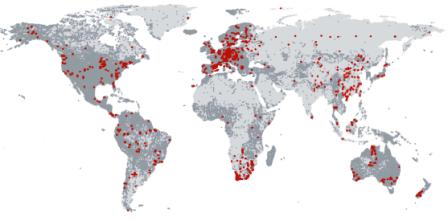
    Here’s the distribution of the 3458 geo-referenced sites where leaf nitrogen content per dry mass was measured. The grey areas are places where the various species on which the measurements were made can be found, according to GBIF. Not exactly global coverage just yet, but not bad. Interestingly, an analysis of the data available thus far showed that though most of the variation in most traits was at the species level, up to 40% was intraspecific.

    Coincidentally (or maybe not?) there’s also a paper just out in New Phytologist which looks at the global distribution of a particular class of plant traits, those associated with resistance to herbivores. There’s no reference to TRY in the paper, but a couple of the same people are involved, and I think this is one of the datasets that have been contributed to the warehouse. 2

    We worked at 75 study sites, distributed from 74.5°N to 51.5°S… Sites were selected to sample the dominant vegetation types at a wide range of latitudes… [T]he primary criterion [for site selection] was that the levels of herbivory, disturbance regime and plant community composition should be relatively natural (i.e. as close as possible to those with which the plant traits we are measuring are thought to have evolved). At each site, we sampled the four most abundant species…

    The key finding was that despite the long-held belief that tropical plants are in general more resistant to herbivory than those from temperate climes, there is actually little evidence of this in the data. If anything, the trend is in the opposite direction. I wonder whether that will hold within species (or genepools) as well as across them.

    Contributions on sustainable food systems sought

    From our friend and colleague Danny Hunter.

    Farming Matters is the flagship magazine of ILEIA –- the Centre for Learning on Sustainable Agriculture. The September issue of Farming Matters will focus on local and regional food systems and how they can be strengthened to increase food security and build towards food and nutrition sovereignty. For this special issue ILEIA will collaborate with Bioversity International. ILEIA, in collaboration with Bioversity International, welcomes suggestions and contributions as articles and opinion pieces, photographs, contacts of people you think who have expertise in this area or ideas for other topics you think we should address. Contributions from all regions of the world are invited.

    Queries can be directed to Jorge Chavez-Tafur (j.chavez-tafur@ileia.org), Danny Hunter (d.hunter@cgiar.org), Jessica Fanzo (j.fanzo@cgiar.org).

    Nibbles: Coffee, British orchards, Wild foraging, African agriculture, Sesame, Taro wine, African beer, Brazilian pastures, Hemp

    Forests at your service: lessons from Kibale

    We are submitting this post to the ‘Forests: Nature at Your Service’ blogging competition being run by UNEP and Treehugger in celebration of World Environment Day. Wish us luck.

    It must have seemed a no-brainer. Uganda’s Kibale National Park (KNP) is scenic, diverse, important for the largest bit of mid-elevation tropical rainforest remaining in East Africa it contains, with its primates — and short of cash. But it also has wild robusta coffee (Coffea canephora) in its forest, and people in the surrounding areas still harvested it — illegally — for various ceremonies and other traditional uses. And wild coffee is known to harbour resistance to pests and diseases and other traits potentially useful to improve the crop. Why not legalize and control the harvest, and use the proceeds not only to improve livelihoods but also to keep the park running?

    As Julie Craves, a University of Michigan bird ecologist and self-described coffee lover, has said in her blog Coffee and Conservation:

    The idea was a good one, and the concept of providing local communities with opportunities for sustainable use of the land, including agriculture, in the buffer zones of protected areas is not novel. It’s a typical management strategy in the biosphere reserves of Mexico. An example is the organic, shade-grown coffee produced in the buffer zone of the El Triunfo Biosphere Reserve in Chiapas, which by and large been a great success. While it was not without problems or detractors, a lot of this success can be attributed to the commitment in the region by Starbucks, which uses the coffee for its organic shade-grown Mexico variety. I wrote about the project and coffee in this post.

    It was such a good idea that USAID put up the money for project development, and the World Bank’s Global Environment Facility and the Ford Foundation paid for the project itself, starting in 2000. Some enabling policies were already in place. Since 1995, the national park legislation had allowed “revenue sharing and collaborative management with local communities, with provision for the creation of multiple-use zones within parks for sustainable resource use.” It was all very promising.

    And yet by 2005 the project had collapsed. Why it did is explained in an instructive paper in Conservation Biology by some of the people involved. 3

    The Kibale Forest Wild Coffee Project got off to a pretty good start. A non-profit foundation was established to “oversee harvests, pay harvesters, and return profits from the sale of wild coffee to harvesters, KNP, and local communities through the funding of jointly agreed upon projects.” A sustainable harvest system was devised. Wild coffee distribution was carefully mapped. An internal control system was put in place to set and monitor sustainable levels of coffee harvest. Organic certification was achieved.

    But then things started to go wrong. Blending of the wild coffee with the local arabica didn’t work so well. Initial harvests were low, and world prices fell. Increasing insecurity didn’t help. Alternative markets for extracts (inspired by “Ben and Jerry’s Rainforest Crunch ice cream, and The Body Shop’s Brazil nut oil hair conditioner”) failed to materialize. Alas, “[b]y 2005, …funds for efforts to market Kibale’s wild coffee were exhausted and project funding, originally envisioned to be replaced gradually by sales revenues, fell to levels insufficient to maintain staff.”

    Bummer. But can we salvage something from the debacle? The authors think so.

    Despite these setbacks the search for self-sustaining and market-based conservation models is likely to continue in Kibale and elsewhere. Given the project’s innovative approach and significant level of effort and support, a review of its successes and failures provides useful lessons for other attempts to sustainably market wild-grown products to serve both conservation and development goals. The lessons include (1) fostering the creation of collaborative partnerships, (2) controlling the high costs of monitoring and certification, (3) carefully planning for the periodicity of wild harvests, (4) avoiding commodity pricing through the creation of new products and markets, and (5) maximizing the value of indigenous knowledge.

    The most difficult thing, according to the authors, was “gaining a foothold in the international coffee market.” Which might perhaps have been predicted. It was certainly a bit of a surprise to me that the local market was not more thoroughly explored. Surely there are plenty of tourists in Kampala (and perhaps even Nairobi) who might be tempted by local wild coffee drinks and the like? Why not start with them before venturing into the shark-infested waters of the international markets? Anyway, the failure to crack these markets led to perhaps the key insight, which is that…

    …”the story” of Kibale coffee was potentially of far greater value to consumers than the actual product itself. This recognition, likely to hold true for other ecoproducts, may better place the product within more-specialized and less-competitive markets. Moreover, maximizing the value of the story, instead of the quantity of the harvest, decouples market-driven pressures to increase revenues through unsustainable harvesting.

    And the story includes the rich knowledge that local people have about the wild coffee and its habitat, and the role they have played in managing that and other resources within the park, and outside it. It seems that for Kibale’s wild coffee, and perhaps other wild-harvested commodities, it is the message that is the product.