 One of the Grand Old Men of plant genetic resources conservation, Professor Gian-Tommaso Scarascia-Mugnozza, died today at Viterbo. It is perhaps indicative of his stature and influence that there is a Scarascia Mugnozza Community Genetic Resource Centre at the M.S. Swaminathan Research Foundation, in Chennai (Madras), India. He was 85.
Nibbles: Flora, Agronomy podcasts, Stats, GFAR, Horses, Lettuce, Churst forests, Brazil nut, Grassland diversity, Baobab, Flotation, Botanic gardens and invasives, Nutrigenomics
- Picture guide to West African plants. Includes agrobiodiversity!
- Iowa State Agronomy podcasts. Some cool stuff. Check out the one on “Modeling Seed Germination Over Time to Decide When to Regenerate Seed Lots in Long-term Storage.”
- A “formal global program to develop subnational agricultural land-use statistics“? Riiiiight.
- GFAR meeting on sustainable use of agrobiodiversity says “[w]e need to initiate solid and inclusive actions to build concerted and practical actions on sustainable use.” Well they do say actions speak louder than words.
- Researcher “trying to remove the perception that hackneys are ‘half-crazed.'” I’d rather pay to save them if they were crazy, but that’s me.
- Romaine: germplasm to breeding lines. But to cultivars? Private sector to pick up the slack.
- Crops not mentioned among species that save our lives.
- Saving sacred groves in Ethiopia. By building pit latrines. Well why not?
- Brazil nut spread by people.
- A trade-off between species and genetic diversity? Say it
ain’t so! - Today’s iconic species threatened by climate change is the baobab.
- An Egyptian archaeobotanical blog.
- Botanic gardens can threaten biodiversity.
- Nature has (or had, it’s a couple months old) a supplement on nutrigenomics.
Weird coconuts for sale
We briefly blogged about the rare horned coconut before. But I didn’t know you could actually buy one. Or other strange coconuts for that matter. Talk about adding value to agrobiodiversity.
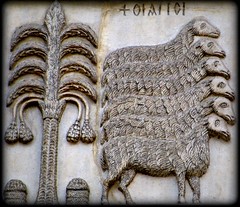
Venetian agrobiodiversity bas relief
Animal Genetic Resources reminder
The newsletter of the IUCN Species Survival Commission and the IUCN Species Programme has just alerted me to a (fairly) recent edition of FAO’s international journal Animal Genetic Resources which I think we missed. It contains, among many other interesting things, a paper on “Conservation status of wild relatives of animals used for food” by P.J.K. McGowan.