A Pavlovsk lifeline

You’ll remember that the Russian Housing Development Foundation wants to build a luxury housing project on the site of the Vavilov Institute of Plant Industry’s (VIR) unique fruit and berry germplasm collection at the Pavlovsk Experimental Station near St Petersburg. And that the conservation community has been trying to assist VIR’s staff via a petition in their attempts to stop this wanton destruction. Well…

…mounting pressure from scientists has now resulted in at least partial success. The RHDF has announced to ask an independent international expert commission to evaluate the situation at Pavlovsk before proceeding with its plans. Moreover, the Russian Accounts Chamber, a body controlling federal budgets, has announced to inspect the station on 15 September.

Great news indeed. But we’re not out of the woods yet. 1 It’s undoubtedly a victory, but we need to keep that pressure up.

Nibbles: Cattle nutrition, Maize, Freshwater biota, Modeling maize, Rice, Book, Veg, Urban ag

Daniel Debouck honoured

Daniel Debouck, a world expert on Phaseolus and the manager of CIAT’s genebank, 2 is to be awarded the Frank N. Meyer Medal for Plant Genetic Resources. This is well-deserved recognition of three decades of painstaking work on the conservation and use of agrobiodiversity. Daniel’s latest paper in on Lima beans.

Daniel Debouck, CIAT's genebank manager and proud recipient of the Meyer Medal. Pic by Neil Palmer (CIAT). http://www.flickr.com/photos/ciat/4904981253/

Is there really no downside to Brazil’s agricultural miracle?

It’s not easy to explain the Brazilian agricultural miracle to a lay audience in a couple of magazine pages, and The Economist makes a pretty good fist of it. It points out that the astonishing increase in crop and meat production in Brazil in the past ten to fifteen year — and it is astonishing, more that 300% by value — has come about due to an expansion in the amount of land under the plow, sure, but much more so due to an increase in productivity. It rightly heaps praise on Embrapa, Brazil’s agricultural research corporation, for devising a system that has made the cerrado, Brazil’s hitherto agronomically intractable savannah, so productive. It highlights the fact that a key part of that system is improved germplasm — of Brachiaria, soybean, zebu cattle — originally from other parts of the world, incidentally helping make the case for international interdependence in genetic resources. 3 And much more.

What it resolutely does not do is give any sense of the cost of all this. I don’t mean the monetary cost, though it would have been nice for policy makers to be reminded that agricultural research does cost money, though the potential returns are great. The graph shows what’s been happening to Embrapa’s budget of late. A billion reais of agricultural research in 2006 bought 108 billion reais of crop production.

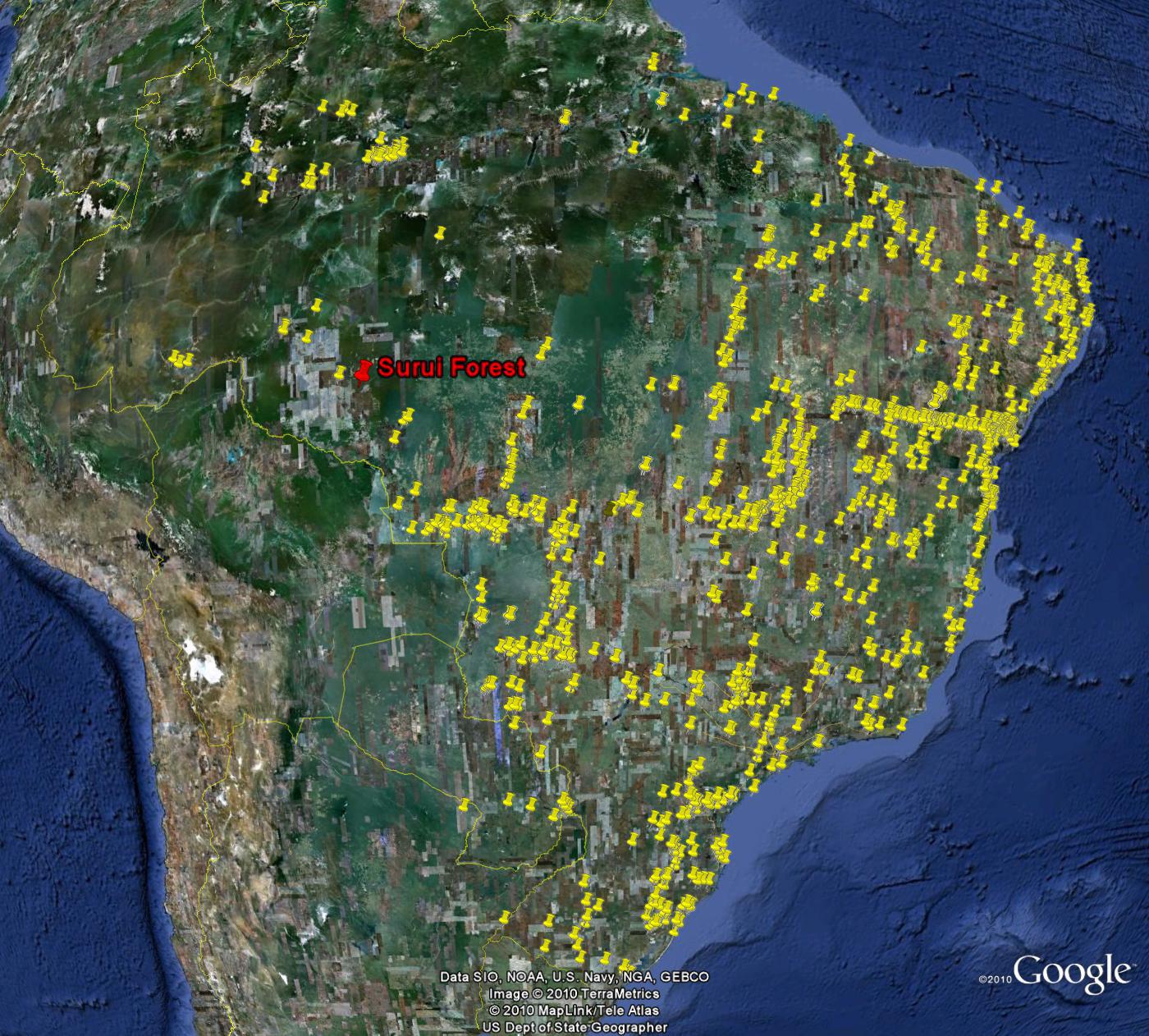
But I was really thinking of environmental and social costs. The Economist article says that Brazil is “often accused of levelling the rainforest to create its farms, but hardly any of this new land lies in Amazonia; most is cerrado.” So that’s all right then. No problem at all if 50% of one of the world’s biodiversity hotspots has been destroyed. 4 After all, it’s not the Amazon. A truly comprehensive overview of Brazil’s undoubted agricultural successes would surely cast at least a cursory look at the downside, if only to say that it’s all been worth it. Especially since plans are afoot to export the system to the African savannah. And it’s not as if the information is not out there.

A final observation. One key point the article makes is that the success of the agricultural development model used in the cerrado is that farms are big.

Like almost every large farming country, Brazil is divided between productive giant operations and inefficient hobby farms.

Well, leave aside for a moment whether it is empirically true that big means efficient and small inefficient in farming. Leave aside also the issue of with regard to what efficiency is being measured, and whether that makes any sense. Leave all that aside. I would not be surprised if millions of subsistence farming families around the world were to concede that what they did was not particularly efficient. But I think they would find it astonishing — and not a little insulting — to see their daily struggles described as a hobby.