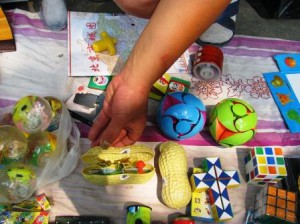
Literally, I mean. In China, the peanut (huasheng 花生) is an auspicious symbol because its second character (sheng 生) means “to give birth.” That’s why you can buy cute plastic peanut-shaped toys which open to play a jingle.
Agricultural Biodiversity Weblog
Agrobiodiversity is crops, livestock, foodways, microbes, pollinators, wild relatives …
Literally, I mean. In China, the peanut (huasheng 花生) is an auspicious symbol because its second character (sheng 生) means “to give birth.” That’s why you can buy cute plastic peanut-shaped toys which open to play a jingle.
Literally, I mean. The Chinese characters for pak choy, or Chinese cabbage (白菜), can also be pronounced to mean “100 types of prosperity and luck.” Which explains why this vegetable is a favourite of Chinese jade carvers, though their creations are usually somewhat smaller than the metre-long specimen pictured below.

That’s what Botanical Garden Conservation International asks you to do as part of their new Plants for the Planet campaign. Our friend at BGCI tells us that the aim of the campaign “is to gather signatures from people around the world in order to ensure that governments adopt the updated Global Strategy for Plant Conservation at the next Conference of the Parties to the Convention on Biological Diversity (CBD). Support for the campaign will help us to send a strong message to the Conference that countries must act now to halt plant extinction.” Well worth spending a couple of minutes signing up. The Global Strategy for Plant Conservation was highlighted recently as one of the most significant achievements of the CBD.
Sorry about the light blogging recently: both Jeremy and I are travelling. But fear not, I for one am working hard for our readers, studying the local agricultural biodiversity. Why, just last night I spent some hours sampling agrobiodiversity products of both the avian and fermented liquid sort. And I am happy to report that both were highly acceptable. For the record, I’m at a meeting of a regional plant genetic resources network.
The EU-funded operation will improve food security of more than 860 000 rural households, over 6 million people. The aim is to boost food production by making improved seeds available to needy farmers and to promote sustainable seed multiplication and certification.
Difficult to argue with the aim of this FAO project in Burkina Faso. One could perhaps offer alternatives as to the methods, but it is difficult to argue with the aim, and with the urgency of the situation. So the only observation I’ll offer — and not for the first time — is that it would be nice if projects of this kind also included a little bit of money for a rapid assessment of whether local landraces are adequately conserved ex situ in the national and international genebanks, and for their rescue collecting as necessary. FAO has a Global Information and Early Warning System on Food and Agriculture which identifies problem situations such as that currently unfolding in Burkina Faso. But it also has a World Information and Early Warning System on Plant Genetic Resources for Food and Agriculture. One sometimes has to wonder whether the two talk to each other.