Bob is healthy

Via Lois Englberger comes news of Bob Festival Day in the Marshall Islands last Saturday, 24 April. Bob is not some guy, but rather the Pandanus tree. Lois shared Lydia Tibon’s description of the event, which we reproduce below. Pandanus is very important throughout the Pacific, where it has multiple uses. Lois is particularly interested in its beta carotene content. Our thanks to both her and Lydia.

KIJLE (Kora in Jiban Lolorjake Ejmour), meaning “women assisting to promote good health,” participated. We wanted to remind everyone that Bob is better than eating processed foods.

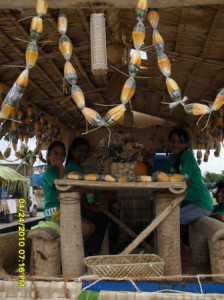
As you can see, the table, chairs, everything hanging and inside our float were pandanus-made. Our kids, grannies were chewing and throwing bobs to everyone. Our billboard message was to promote both education and health.

Our motto is Bob Dikdik Kejadikdrik, the translation is something like “Bob is so fruitful.” It produces so much, it gives us so much knowledge that we use the leaves by weaving the mats, making hats, use to drink medicines, also gives Vitamin A that is very rich to protect our skin, vision, bones and many more….

Our T/shirt that day was “Bob is healthy.”
Gulf oil spill not much of a threat to one crop wild relative

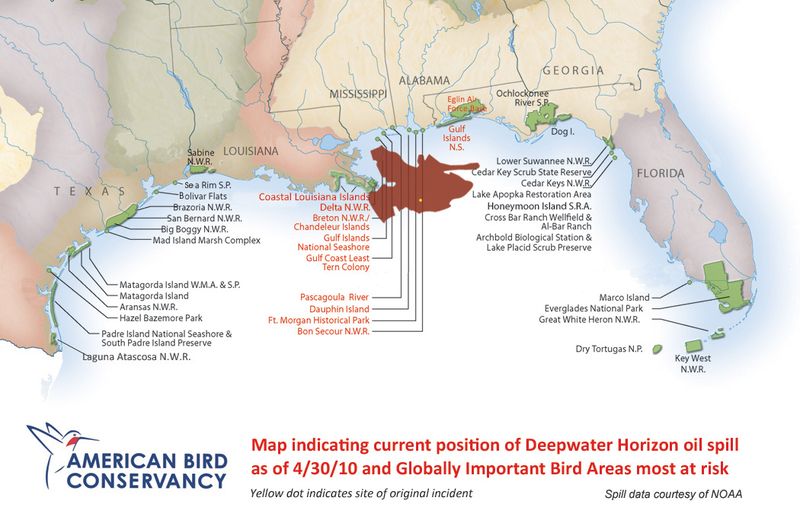
The Gulf oil spill is threatening some Globally Important Bird Areas, according to the LA Times:

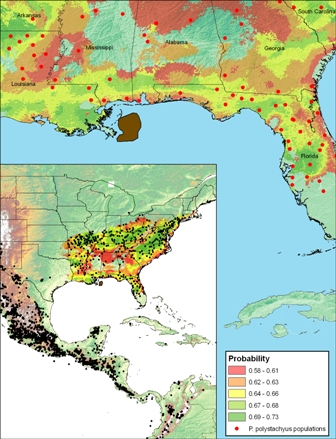
And other protected areas too. Unfortunately, we don’t have a similar map for crop wild relatives, at least not just yet, at least not so easily available. So it’s hard to estimate the overall threat posed by the oil spill on these genetic resources — which are arguably of greater importance than most birds, but there you go. What we can do — just about — is look at the distribution of individual species. And that is what our friend Julian at CIAT has done for a wild bean, Phaseolus polystachyus.

Not in any particular danger, though one or two coastal populations may be affected, I suppose. But I just wonder if one day the LA Times will publish a map showing the Globally Important Crop Wild Relative Areas threatened by some calamity or other.

Nibbles: Figs, strawberries, seed bombs, micronutrients^2, conservation, saffron

Deconstructing the spread of agriculture

Did agriculture move in the hands of people, or with the words of people? Or, somewhat more prosaically:

Two alternative models have been proposed to explain the spread of agriculture in Europe during the Neolithic period. The demic diffusion model postulates the spreading of farmers from the Middle East along a Southeast to Northeast axis. Conversely, the cultural diffusion model assumes transmission of agricultural techniques without substantial movements of people.

Actually not just Europe. And the jury is still out. Two recent paper both tilt towards cultural diffusion, both in Europe (which is where the above quote comes from; but not everybody agrees) and Island SE Asia. This sort of work is mainly done by anthropologists and human geneticists. Sometimes the genetics of livestock or crops are brought into play, but only rarely both at the same time. A grand synthesis of human, livestock and crop genetic data, archaeology and anthropology remains to be done…