- Supersizing crops.
- Using tree rings to study past Asian droughts. I guess it’s just me, but I find this much more intersting than the thought of tinkering with the Calvin-Benson cycle.
- The mother of all soil data sites.
- That ancient Egyptian aphrodisiac: brassica or lettuce?
- The Sheep is Life Celebration is coming. Wish I was going.
Crossing the Wallace Line
Dienekes’ Anthropology Blog has an intriguing map from a paper on human genetic diversity in island South East Asia showing a sharp cline across Wallace’s Line.
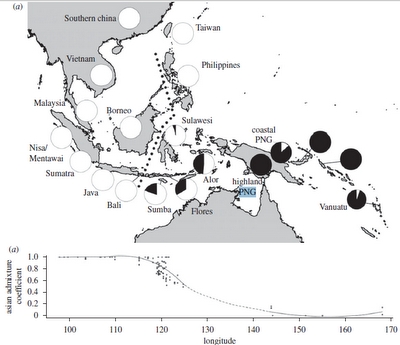
The genetic cline corresponds to a cline in phenotype which was actually recognized by Wallace himself. 1 The authors…
…conclude that this phenotypic gradient probably reflects mixing of two long-separated ancestral source populations—one descended from the initial Melanesian-like inhabitants of the region, and the other related to Asian groups that immigrated during the Paleolithic and/or with the spread of agriculture. A higher frequency of Asian X-linked markers relative to autosomal markers throughout the transition zone suggests that the admixture process was sex-biased, either favouring a westward expansion of patrilocal Melanesian groups or an eastward expansion of matrilocal Asian immigrants. The matrilocal marriage practices that dominated early Austronesian societies may be one factor contributing to this observed sex bias in admixture rates.
There’s a map of the same region in the recent paper on pig domestication that’s been in the news lately.
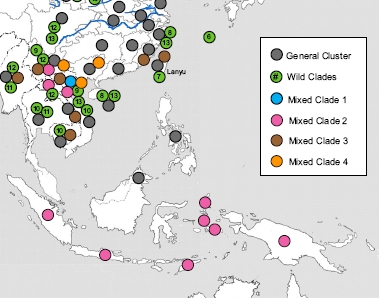
Compare and contrast. Still two quite distinct populations, but the placing of the line of demarcation is somewhat different. This is what the authors have to say about the Pacific pigs, after their main discussion, which is of their separately domesticated Chinese cousins:
This genetic evidence also supports separate domestication pathways (however independent) of one population in India and three wild boar populations indigenous to Peninsular Southeast Asia. Given the relative geographic proximity of the Southeast Asian clades, it is possible that the domesticated haplotypes were all present in a single population of wild boar, as is the case for modern Yaks. Regardless, only the Pacific Clade domestic pigs were transported out of Southeast Asia (to ISEA and the Pacific) before they were replaced in their homeland by domestic pigs derived from nonindigenous populations of wild boar.
So, people and pigs moving together across Wallace’s Line. How about crops? There are also distinct Pacific and Asian genepools in taro, though I could not find a nice map to compare directly with the above. However, the consensus seems to be — as also for crops such as bananas, yams, breadfruit, sugarcane and yams — that domestication happened southeast of the Wallace Line, in Sahul (Melanesia to be exact). As my friend and colleague Vincent Lebot said of these crops a few years back 2:
We now have biomolecular evidence to suggest that most cultivars were not brought by the first settlers from the Indo-Malaysian region, but rather were domesticated from wild sources existing in the New Guinea and Melanesian areas… In other words, the first migrants that went across Wallacea did not embark major domesticated plants if any, in their adventure.
Pigs, in other words, and maybe chickens, but not taro or yams. Banana went in the opposite direction. I wonder why. Or did people bring them on their adventure, and abandon them when they found better varieties?
Incidentally, coconut also shows a bit of a Wallacean dividing line, but of course it doesn’t need humans for its dispersal, at least not everywhere.
Hairy pig hits limelight
They don’t say whether it is the famous Lincolnshire Curly Coat, but it looks like it might be. 3 Now, if only they could make them pocket-sized…
Thanks, Cary.
UPDATE (17 Fe. 2016): Well, “they” were the LA Times, and both the story and video to which we linked back in 2010 are no more. But the “sheep pig” in question probably was the Mangalitza, and the story of how it was rescued from oblivion is actually pretty cool.
Nibbles: Consortium?, Sheep diversity, Sustainable biofuels, Agroforestry, Almonds, Chicken breeding, Restoration, More tree management, Vegetable gardening, Wheat domestication
- IRRI tries to raise $300 million for rice in Asia. Including for that genebank of theirs?
- Sheep phylogeographic genetic structure weak, but not completely absent, thank goodness.
- Examples of sustainable biofuels. No snickering at the back there.
- How to manage tree genetic resources under climate change. By some friends.
- Almonds 101.
- “…testing the genetic and immunological limits of poultry.” And then eating the results.
- Grassland restoration needs to take into account functional diversity. And DNA?
- Presentation on community forestry management in Niger. Nice story.
- Senegalese vegetable farming project uses terra preta but modern seed. Go figure.
- Ancient farmers off the hook for loss of key wheat gene. Plant breeders to blame, apparently.
Quibbling while the world burns
The Soil Association has an ax to grid, sure. But it seems also to have a point — sort of. In a report out a couple of days ago it notes that people have been saying that people have said that food production needs to double by 2050, because of population increase, westernization of consumption patterns and climate change. It then goes on to suggest that people have not said that at all, and that other people should stop saying they had.
Research into the doubling figure shows it doesn’t actually exist in the stated source — and that it is based on a number of incorrect assumptions. The scientific basis for the claims are based on a report which on close inspection actually says production would need to increase by around 70%, not 100%. As the Government states this is a significant difference. The closest the report comes to the doubling claim is projecting that meat consumption in developing countries, except China, could double. The scientific paper that the 50% by 2030 claim is based on appears to have been withdrawn by the authors.
So, first, is this a straw man? It seems not. People really have been quoting the doubling-by-2050 figure.
Second, is it true that the key document usually cited as the source, FAO’s 2006 publication World Agriculture: Towards 2030/2050, does not make the doubling claim? Well, you can check for yourself, but I did some rapid searching and found no such claim. The only reference to a doubling or 100% increase by 2050 came in the context of meat consumption in developing countries (minus China) on page 5.
Some of this growth potential will materialize as effective demand and their per capita consumption could double by 2050, i.e. faster than in the past. It is unlikely that other major developing countries will replicate the role played by China in the past in boosting the world meat sector.
The Soil Association report says that the “only specific statements [in the FAO document] about large percentage increases in demand are focused on the developing world (where the increases in population will be) and concerned only with meat and cereal production, not all food.” In particular:
The largest projected increases in food demand are for cereals and for meat and dairy products. For cereals, there is a projected increase of 1 billion tonnes annually over the 2 billion tonnes of 2005, a 50% increase in cereals by 2050.
Which seems an accurate enough precis of the statement on page 5 of the FAO document:
…an increase of world production by another 1.1 billion tonnes annually will be required by 2050 over the 1.9 billion tonnes of 1999/01 (or 1 billion tonnes over the 2 billion of 2005).
But. FAO also says that “the absolute increases involved should not be underestimated” and “[a]chieving it should not be taken for granted, as land and water resources are now more stretched than in the past and the potential for continued growth of yield is more limited.”
So, sure, a 50% increase in cereal production in developing countries is not the same as a doubling of food production globally, and we should not use figures for which the evidence is thin at best. But it still represents a significant challenge, in particular to breeders. I hope the Soil Association is going to help the world meet it, and not just snipe from the sidelines.