Crop Science is publishing papers from the CGIAR Science Forum 2009. Lots of interesting stuff, including on biofortification and diet diversification, perennial favourites here of course. And all open access! Thanks, Jeff.
Historical photographs of Peru botanical expedition online
The Field Museum joined Flickr Commons in April 2009, inviting the public to help describe a selection of our historic photographs.
And that includes some incredible photos from botanist J. Francis MacBride’s expeditions to Peru in 1922 and 1923. Like this one, for example.
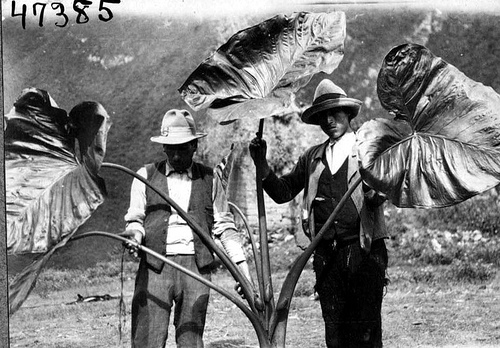
There’s some agrobiodiversity in there. If you can help out with describing any of the photos, leave a comment on its Flickr page.
Nibbles: Biocultural diversity, Maasai, Organics, Amazon ag
- IUCN publishes “Biocultural Diversity Conservation, a Global Sourcebook.”
- And here’s an example of the application of the above, I suppose.
- UNEP looks to boost organic farming in Eastern Europe and the Caucasus.
- Why don’t they just import organics from West Africa, like the rest of Europe?
- Wired does history of ag in Amazonia.
Rethinking paper on Thai government rethinking of sustainable agriculture
Don has kindly sent us a quote from that paper about the Thai government rethinking agricultural sustainability that Jeremy nibbled earlier today. He suggests it might be more interesting than Jeremy made it out to be.
The Department of Agricultural Extension (DOAE), created under the MOAC with assistance by the World Bank, played a direct role for disseminating Green Revolution innovations, including new high-yielding varieties, pesticides, chemical fertilizers, and associated labor-saving machineries, in every subdistrict through the staff stationed in the district center… Yet, except for Central Thailand, where rice yields have risen considerably with developed irrigation systems, the widespread adoption of Green Revolution technologies has resulted in stagnating market prices and yields throughout most areas of the country (Pasuk and Baker, 1995), persisting poverty of small-scale farmers in many rain-fed areas (Apichai, 1997), recurrent pest resistance and resurgence to pests (Sathorn, 2000), health hazards related to farmers’ inefficient use of pesticides (Nipon, Ruhs and Sumana, 1998), among others. Furthermore, a rapid expansion of export cash crop cultivation in the uplands of the North and Northeast, promoted by the MOAC during the 1970, with crops such as maize, cassava, kenaf, and cotton, resulted in rapid deforestation and massive displacement of the poor from the paddy tracts as dependent labor on agribusinesses with no secure titles to land (Pasuk and Baker, 1995).
May well be worth chasing down after all, behind its paywall.
Featured: Whole system genomics
Susan MacMillan tells us more about the new direction of genomics science at ILRI.
A few years ago, with the tremendous advances in gene technologies, a new kind of geneticist began to appear at ILRI, one that more resembles Hans Solo than Indiana Jones. These researchers are taking ‘whole systems’ approaches to the ‘livestock genetics’ field (a branch of knowledge that, like those temples Indiana Jones obsesses about, can appear of largely historical interest). These new geneticists are ambitiously adding environmental genetics (soil microbes, wildlife species…) to their livestock, parasite and human targets of interest. They’re interested in the WHOLE picture—and they claim they have the tools to productively investigate this brave new world of ‘landscape genomics’.
Much more where that came from…