- Rhubarb safe at long last. Rejoice! The BBC does, sort of.
- Biodiversidad Mexicana website lists plants with centres of origin/diversity in that country, with references.
- Sometimes agrobiodiversity is downright bad for you.
- And here’s today’s story on the “organic” urban vegetable gardens of Havana.
- But China?
- Oh, and, apparently, the US midwest too. And they just had a conference there.
A coffee journey
Sometimes you come across a story that illustrates so many of the themes of agrobiodiversity conservation that it’s almost too good to be true. I have it on very good authority that the one I’m about to tell you is indeed true, though. The authority is the former head of the genebank at the Centro Agronómico Tropical de Investigación y Enseñanza in Costa Rica (CATIE), who is now the head of the genebank at The World Vegetable Centre (AVRDC) in Taiwan.
He told me the story over coffee at the Trees Wind cafe in Tainan City, a short ride from AVRDC’s headquerters. The story is about the coffee he was drinking. I was drinking a very superior arabica from the highlands of Taiwan. But that’s another story, or at least a different aspect of the story. The coffee my host was drinking is called Geisha and it comes from Hacienda Esmeralda in Panama.
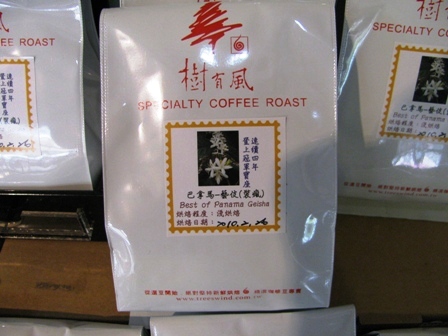
He discovered it by chance at Trees Wind when he first moved to AVRDC a year and a half ago and was exploring the surroundings. The name jumped out at him from the menu because he knew it from his days managing the CATIE coffee collection. The owner of Esmeralda had visited the CATIE genebank some years back, looking for coffee germplasm to try out. He’d been growing coffee for decades, having originally got his material from CATIE, but he was now expanding into a higher altitude plantation and wanted new varieties to try. He settled on an accession called Geisha. Nothing to do with Japan, though: this is an Ethiopian landrace, very low yielding, but very high quality; and from the right sort of altitude.
My host didn’t hear much after that about how the material he sent out to Panama fared. Not until, that is, he sampled a cup of the stuff in Tainan some years later. And an expensive cup it is too: 225g of beans will set you back TWD 1800 (USD 56). Coffee is now also grown in Taiwan, along with tea. The stuff I had was great, and about a third of the price of Geisha from Panama, though on a par with interesting brands from Ecuador, Ethiopia and Indonesia.
So, material collected in Ethiopia probably back in the 70s by an international FAO mission, conserved at a regional research institute in Costa Rica, grown in Panama, marketed around the world, and finally sipped in Taiwan by people whose stimulant of choice was quite different until fairly recently, in competition with material from a dozen other countries on three continents. Quite a journey. Quite a lesson in agrobiodiversity interdependence, conservation and use.

Mexico builds a genebank
INIFAP has photos of progress in building Mexico’s new National Genetic Resources Centre. It’s about a third finished, and needs to be ready in time for this year’s celebrations of the bicentenary of Mexican independence. Total cost is about US$ 30 million, if I interpret the figure in the text correctly. I hope the recurrent costs necessary to keep the place running once it’s built will also be forthcoming with similar generosity.
Nibbles: Community genebank, Traditional medicine, Agarwood, Radish introgression, Kentucky bluegrass, Frison, Vavilov, Pollinators, Collecting strategy
- Bamboo microscope used to document rice varieties at Indian village genebank. Want one.
- And more documentation and conservation of traditional knowledge in India: this time it’s medicines.
- Nigel Chaffey’s latest botanical buffet table at the Annals of Botany has stuff on nomenclature and genomes. Always worth following.
- Latest on saving agarwood. And more. Thanks to twittering by @AsiaForestry.
- Biofortified blogs research on geneflow between crops and their wild relatives.
- Kentucky bluegrass pix. Botany Photo of the Day is also worth following. You guys all use Google Reader, right?
- “Any serious discussion of biodiversity conservation must include the diversity of crops and livestock…” Right on.
- Vavilov hits Abyssinia. Another one for Reader.
- Pollinator trends in Europe and the world. It ain’t good.
- Your botanic gardens needs at least 15 individuals of that palm.
Where the (European) buffalo roam
Again from Michael Kubisch.
The European bison or wisent, like its North American counterpart, has faced near extinction during its recent history. Both species have been brought back from the brink starting with relatively small populations — in the case of the European bison perhaps with fewer than 50 individuals. The wisent population now numbers somewhere over 3000, but these animals suffer from low genetic diversity and are furthermore separated into a relatively large number of often very small and isolated herds. This is problematic because it is thought that the survival of a species depends on a minimum number of breeding individuals, although there isn’t necessarily much agreement on what that number needs to be.
There is consensus, however, that the fractured nature of the European bison population is unlikely to guarantee its long-term survival. What is needed is a larger breeding population containing perhaps as many as a thousand individuals. Fortunately, it isn’t necessary for these animals to belong to a single contiguous population, as long as smaller populations exist on stretches of connected land that enable them to come into contact with each other. But even that requires suitable land and lots of it — not an easy quest on a crowded continent.
But there is hope. In a recent study described in the journal Conservation Biology, a multinational group of researchers has determined that the Carpathian Mountains could provide a possible habitat for a wisent metapopulation. This area already contains a number of smaller herds, has the type of vegetation wisent seem to like and (in part thanks to a decrease in human population pressures), and consists of relatively large tracts of suitable land. Implementing this idea would obviously require both existing herds to be enlarged and new ones to be established. Whether the means can be found to accomplish this is hard to predict, but there is no doubt that it would constitute a significant step towards preserving one of Europe’s most magnificent herbivores.