SciDev has a blitz on The Challenge of Improving Nutrition. It looks like it might repay closer scrutiny.
Nibbles: Sequencing, Agricultural origins, Mating systems, Tomato shelf-life, Beer vs Tea, Soy, Carrot, Seed processing, Screw-pine, Yams, Salicornia, Pollinators
- Second generation sequencing on the one hand. First generation methylation mapping on the other. What’s a poor bitechnologist to do?
- Site of the birth of MesoAmerican agriculture pinpointed.
- Meta-analysis says mating system does not affect magnitude of local adaptation. Ok, I really need to understand this one, because it’s kinda counter-intuitive..
- Boffins produce longer-lasting tomato. Which, however, still tastes like water. Those pesky biotechnologists are all over this.
- A tale of two brews. And here’s why I prefer beer. Well, one reason. Meanwhile, a hero probes how the amber nectar comes to be.
- Another slightly dubious use for soy. Aren’t you glad its genome has been sequenced? Thanks, Jacob.
- Evidence for cultivated carrot from medieval Poland. I’m sure this is REALLY important.
- CIMMYT video of seed processing.
- Pandanus photo for all my Pacific friends.
- Yams to have their day? I hope so, but we have been here before. Repeatedly.
- Salicornia the new hope for saline regions? I hope so, but we have been here before. Repeatedly.
- FAO manages wild biodiversity to manage pollinators.
What did the Nabateans grow?
You know how the internet is. Endless rabbit holes down which to lose oneself. Some questions answered. Others, not so much. New ones arise. Here’s an example. It all started with the Mosaic of the Seasons in the 5th century Byzantine church at Petra in Jordan. I visited the site last week and thought the agrobiodiversity-themed mosaics wonderful.
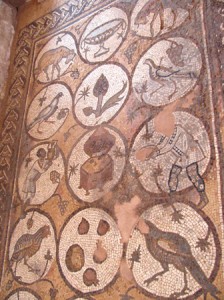
That got me thinking about Nabatean crops more generally. What did these people grow in the middle of the desert? Did it include the plants depicted in these mosaics? The Nabateans were known as spice (and incense) traders, but more as middlemen rather than actual producers. Why, indeed, did they find it necessary to grow anything at all in such a harsh environment? Couldn’t they have traded for everything they needed, sitting astride a major trade route from the East to Rome?
So I googled a bit, and it turns out there’s a book called Nabatean Agriculture. Or Al-Filahah al-Nabatiyah in fact, written by a 9th century Mesopotamian scholar called Ibn Wahshiyah. Unfortunately, though the Arabic text is online, I could not find anything that I could actually read on the contents of the book beyond that it includes “a wealth of knowledge on the preparation of basic foods from the agricultural products mentioned throughout the book.” Frustrating.

However, I did find an enormous amount on the sophisticated water management practices of the Nabateans, for example in the supporting document to Israel’s proposal for inscription of the “Desert Cities of the Negev” as a World Heritage Site. It’s a huge pdf, so watch out, but it does have great descriptions, starting on page 108, of the channels, damns and cisterns these communities built to save and manage water in a region with less that 100mm of annual rainfall. Some of these practices are in fact being revived. One consists of enigmatic piles of rocks called tuleilat el anab in Arabic, which means “grape mounds.” 1
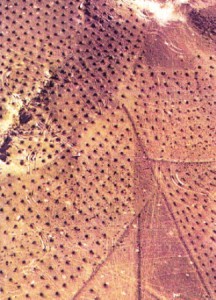
They measure 1 m in diameter by 30 cm in height and in some places extend for several square kilometers. So it’s not just pleasure gardens we’re talking about. The prevailing view seems to be that the grape mounds were intended to enhance the flow of run-off water into agricultural terraces. Their name is the only clue to the crops grown by the Nabateans that I’ve been able to find 2, apart maybe for those mosaics. There must surely be some archaeobotanical evidence somewhere? More rabbit holes beckon.
Tying up some Amman loose ends
You’ve been wondering about those as yet unanswered questions from the Amman conference, haven’t you? Ok, here goes.
Jose Cubero asked why there are no commercial faba bean hybrids. He had no answer. The yield gain is considerable. BTW, did you know that protein content in faba bean is not negatively correlated with yield potential, as is apparently the case in other pulses? And that you can have totally selfing varieties, with closed flowers? I need to learn more about this crop.
Raj Paroda asked if aeration might be the answer to decreasing methane emissions from paddies. Well, it’s possible. Work in Japan is showing that prolonged mid-season aeration can cut methane emissions down to zero. But what will this do to yield? And what will it cost? Of course, “[m]any rice varieties can be grown under much drier conditions than those traditionally employed, with big reductions on methane emission without any loss in yeild. Additionally, there is the great potential for improved varieties of rice, able to produce a much larger crop per area of rice paddy and so allow for a cut in the area of rice paddies, without a cut in rice production.” See? Even when it’s not about germplasm, it’s really about germaplasm.
Theib Oweis wondered whether we shouldn’t measure — and select for in breeding programmes, by implication — productivity on the basis of unit of water consumed rather than of land used. Indeed we should, certainly in the dry areas. Potatoes had the highest yield per cubic meter of water of the crops on his list, and olives the highest economic return per cubic meter of water. You can get 8 t/ha of wheat, but the highest water productivity is actually at 6 t/ha. You need 1000 kg of water to grow 1 kg of wheat. I could go on and on, he had lots of figures like this.
And would you believe it, Ken Street did indeed think of a better way of identifying germplasm for evaluation, and it’s called FIGS.
How many did you get?
Specializing on salinity in Abu Dhabi
Is the future of genebanks the sort of trait or adaptation specialization exemplified by the International Centre for Biosaline Agriculture in the UAE? Makes more sense than having national genebanks, doesn’t it?