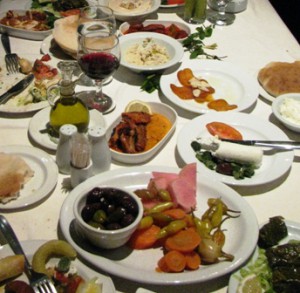
Has a more joyous culinary celebration of agrobiodiversity ever been devised than the Levantine مَزة (meze)? Answers on a postcard, please.
Agricultural Biodiversity Weblog
Agrobiodiversity is crops, livestock, foodways, microbes, pollinators, wild relatives …
Has a more joyous culinary celebration of agrobiodiversity ever been devised than the Levantine مَزة (meze)? Answers on a postcard, please.
A map over at Strange Maps seems to suggest that the most diverse place in Europe in terms of drinks traditions is the area where Hungary, Romania and Ukraine — and thus the wine, beer and vodka belts — meet. Check it out:
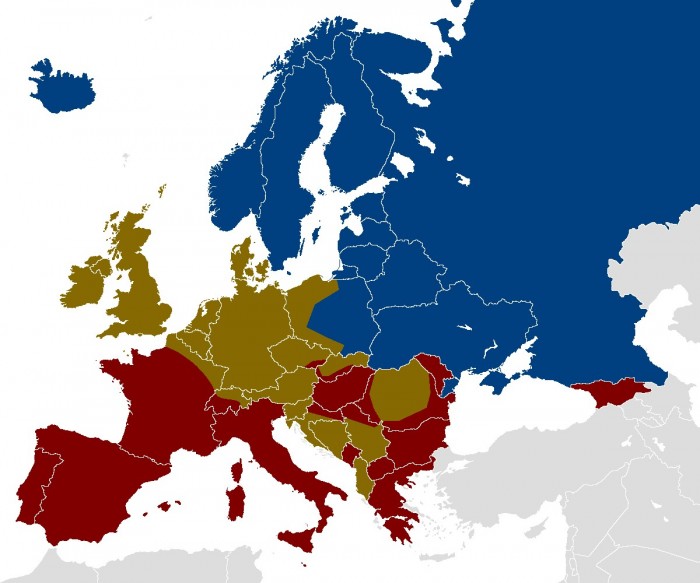
But is it true? Have any of our readers been there? And can they recall anything about the visit?
Another contribution from Michael Kubisch.
Ever wondered why your rat terrier looks so different from your neighbor’s mastiff? Well, eons of selective breeding, of course, which have resulted in genetic differences between these two and other dog breeds. Man’s best friend was undoubtedly among the very first animals to be domesticated, although the huge variety of breeds found today is probably a much more recent phenomenon. Which part of the dog genome, or more pertinently which genes, were involved in generating this diversity remains largely a mystery — but one that many geneticists would like to solve.
A first glimpse has now been provided by a group of scientists who compared genomic data from dogs belonging to ten different breeds using what is called single-nucleotide polymorphisms or SNPs for short. SNPS are very helpful because the presence of a particular SNP sometimes is indicative of the presence of a specific allele at a nearby gene. Similarly, if there are SNPs that differ between two dog breeds it is possible that nearby genes may be different as well and that those genes may have played a role in what sets these breeds apart.
The study revealed 150 areas of the dog genome containing more than 1000 candidate genes that appeared highly variable between those breeds that were examined. Not surprisingly perhaps, several of these genes are known to determine things like coat color, size, skeletal morphology and behavior. However, interestingly, several candidates included genes that are known to act as regulators of other genes, suggesting that some evolutionary changes are not the result of variant alleles of genes but changes in how these genes are controlled. More interesting insights are sure to follow.
The finalists of the Improved Nutrition Solutions Through Innovation competition are up on Ashoka’s Changemakers site. One project promises that a “native rainforest food for school lunches improves child health while motivating reforestation.” And another wants to produce nutritional supplements from Moringa. It may not be enormously innovative, but I personally like Gardens for Health best, because it has the least of the silver bullet about it, and the most agrobiodiversity.
Gardens for Health enables people living with HIV/AIDS to improve their nutrition, health, and treatment adherence through sustainable agriculture. GHI provides access to land and patient capital for community gardens, seeds and tree seedlings for family home gardens, technical assistance in sustainable agriculture and nutrition, and market linkages
Go vote. You have until 8 February.