The No-nonsense Guide to World Food is not just an interesting book by community food activist Wayne Roberts, it’s also a Facebook page. Looks like it could be a good way to learn about the world’s street food trends, among other things. The latest post links to an article on worm-based dishes. Yummie.
Does germplasm documentation need a social networking makeover?
The story so far:
John Cho is a plant pathologist and taro breeder at the University of Hawaii. A few days ago he posted a youtube video on his Facebook wall. It shows some very successful trial results from the Dominican Republic. The experiment in question is the evaluation for taro leaf blight resistance of some hybrids from Dr Cho’s breeding programme. Unfortunately, the interview with pathologists Drs Graciela Godoy and Miguel Martínez of the Instituto Dominicano de Investigaciones Agropecuarias y Forestales (IDIAF) is in Spanish, and John doesn’t speak that language. So he asked his Facebook friends to help, and one of them, an agronomist from Puerto Rico, sent him a translation.
But it doesn’t stop there. A discussion develops. Here it is, reproduced verbatim, time stamps and all, with the kind permission of the participants:
John Cho – Muchas garcias, looks like 3 of my taro hybrids are very tolerant to taro leaf blight in the Dominican Republic. That is great! Let’s hope that IDIAF will start breeding for tolerant materials with Bun Long attributes.
January 22 at 4:44amJohn Cho – Carlos, I checked to see what hybrids corresponded to the tolerant ones mentioned by Miguel and they are the following: H2 is 2002-21f, H4 is 2000-109, H6 is MS3. I think that I also sent those 3 to you for trials as well.
January 22 at 4:54amCarlos Emilio Ortiz-Malavé – 21f did well here, MS3 grew too slow to be considered in the afirmative. 109 was not among the ones we received in the the first lot. Ill b checking If I have it among the ones you sent May 2008. I ran out of $$ for evaluations, but Im asking for permition to continue. I let you know on the results of these actions.
John Cho – Carlos, the genetic background are the following: H2 or 2002-21f = India x [Pwetepwet x Maui Lehua]; H4 or 2000-109 = [Red Moi x PH15-11] x Maui Lehua; H6 or MS3 = Maui Lehua x Sushi. Background for the parents are the following: India = a variety collected by Vincent Lebot in 1991 from the marketplace in India; Pwetepwet = a Micronesian line tolerant to TLB; Maui Lehua = a hybrid variety selected from a cross between 2 Hawaiian varieties (thought to be a cross between Piialii and Lehua Maoli); Red Moi = a Hawaiian variety; PH15 = a TLB tolerant variety from Papua New Guinea; Sushi = a TLB tolerant variety from Micronesia.
Yesterday at 3:36amCarlos Emilio Ortiz-Malavé – Thank you John for the information, part of which you provide me for the Res. Note under evaluation. I should stress that among the Hawaiian Hybrids we tested 19F was by far the best adapted -really the best regarding over all horticultural performance- although 21F did well. Did you sent 19F to de Dom. Rep.? This will be my choice as parent for crossing to Lila-BunLong
18 minutes agoCarlos Emilio Ortiz-Malavé – John; Im wondering if 109 at the Dominican Republic is the same genotype as 19 in Puerto Rico (that is, with an “0” missing between 1 and 9. Thats because this 109-19 wast among the best performers. And because looks to me that we should have the same genotypes. Illl check the original documentation and be back with you.
about a minute ago
And so on. Now, my question is this. What is likely to lead to more use of a germplasm collection: this kind of open-ended discussion, or tables of accession x descriptor results?
Just asking.
The cost of conservation in Africa
Conservation Letters has a paper which estimates how much conservation NGOs have spent in Sub-Saharan Africa. The short answer is about US$160 million a year in 2004-6, but there’s plenty of dissecting of the headline numbers in the paper. What I want to know is: how much of that went on agrobiodiversity. Or maybe just the wild relatives of crops and livestock?
César Gómez Campo RIP
Prof. César Gómez Campo died in Madrid on September 5 last year. I’m sorry we didn’t note this earlier.
In 1966 César established the ‘‘Banco de Semillas de la Escuela Técnica Superior de Ingenieros Agrónomos de Madrid’’ (Seed Bank of the Higher Technical School of Agronomists of Madrid, in short: UPM Seed Bank), the first example ever of gene bank devoted to the conservation of wild species seeds. In César’s idea the long term ex situ conservation of wild taxa was a form of conservation of species endangered of extinction complementary to botanical gardens. In fact, his mind conceived this idea in a very modern way, that is including concepts of the genetic variation, in times when the concepts of nature conservation were at their very beginning.
That’s from the obituary at Genetic Resources and Crop Evolution, which is unfortunately behind a paywall except for the first page; everyone can, however, access Gómez Campo’s “essential” bibliography. He’s been described as a pioneer of the conservation of the Spanish flora, especially crop wild relatives, and that is true. But his work on ex situ conservation had an impact far beyond the Iberian peninsula.
Maize god appears on radio
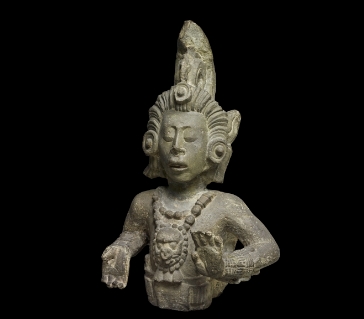
Jeremy has just contacted me from London saying that today’s artifact on the BBC’s A History of the World in 100 Objects series is none other than a Mayan statue of (one of?) the maize god, Hun Hunahpu. 1
In Mayan mythology, the maize god was decapitated at harvest time but reborn again at the beginning of a new growing season.
You can read all about it, and listen to the programme, online. I’m sure this will not be the last agrobiodiversity-themed object to be featured on the programme.