Andre gets to the heart of the Kokopelli spat, I fear:
Humping from one blog to another, you can see that it is very, very personal between former friends, and very ugly.
Do have your say too.
Agricultural Biodiversity Weblog
Agrobiodiversity is crops, livestock, foodways, microbes, pollinators, wild relatives …
Andre gets to the heart of the Kokopelli spat, I fear:
Humping from one blog to another, you can see that it is very, very personal between former friends, and very ugly.
Do have your say too.
Difficult to say anything new about what’s going on in Haiti. It is all sad beyond belief. WWF is rightly encouraging people to give. Seconded. UNEP has announced an environmental recovery effort. There’s no shortage of advice on what must be done. FAO is trying to raise money to support food production in fields and homegardens. The planting season starts in March, so time is short. Meanwhile, CABI’s blog looked at the underlying food security problems.
I haven’t come across any information on what’s happened to the Centre de Recherche et de Documentation Agricole (MARNDR), but I don’t hold out much hope. It housed the national germplasm collection of 513 beans and 54 maize accessions. SINGER lists 233 accessions from Haiti, almost all rice (48), beans (113) and maize (67). GRIN lists 111 (almost all rice, maize, cotton, beans). 1 At first sight it seems that maybe most of the stuff that is in MARNDR should be findable elsewhere, though that’s quite a lot of beans.
LATER: IFPRI DG has his say too.
I don’t know about you, but in my laziness I sometimes catch myself making the assumption that a centre of crop origin is also one of crop diversity. That is of course sometimes the case, but by no means always, as Vavilov himself recognized. A recent open access paper in Diversity makes the point very clearly. 2
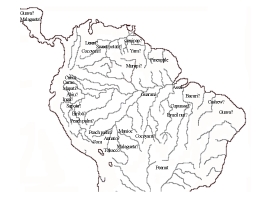
The authors, led by Charles R. Clement of the Instituto Nacional de Pesquisas da Amazônia in Manaus, review molecular studies and also bring in archaeological and other evidence in their discussion of the history of Amazonian crops. They come to the conclusion that these crops originated around the periphery of the region: “All but one of the species examined originated in the periphery of Amazonia (Figure 3), rather than along the major white water rivers where pre-conquest population densities were greatest.” Here’s that Fig. 3:
Now, in contrast, here’s where the pre-Columbian hotspots of diversity were to be found: “The major centers and regions of diversity are along the major white water rivers and in northwestern Amazonia, where ethnic diversity is extremely high.”
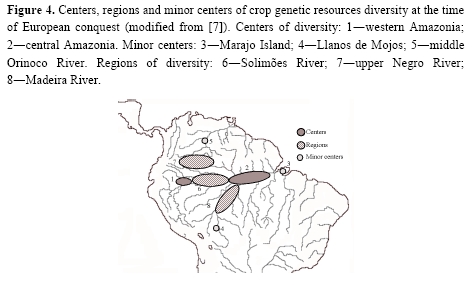
The explanation, according to the authors, is the length of time involved in the development of agriculture in the region.
Because crop domestication began thousands of years before food production systems became important, it is not at all surprising to see a dramatic contrast such as that in Amazonia.
Why was the Amazonian periphery such a focus of domestication?
It is possible that sufficient natural resources were available [in central Amazonia] so that the home gardens were such a small fraction of subsistence that they are difficult to find in the archaeological record. In contrast, in the headwaters of the same rivers in the periphery, less abundant aquatic resources may have increased the importance of home gardens.
Dr Hari D Upadhyaya, head of the ICRISAT genebank, has just been honoured as a Fellow of the Crop Science Society of America (CSSA). Hari has done a huge amount of work on the theory and practice of core collections, among other things. Congratulations, Hari. Richly deserved.