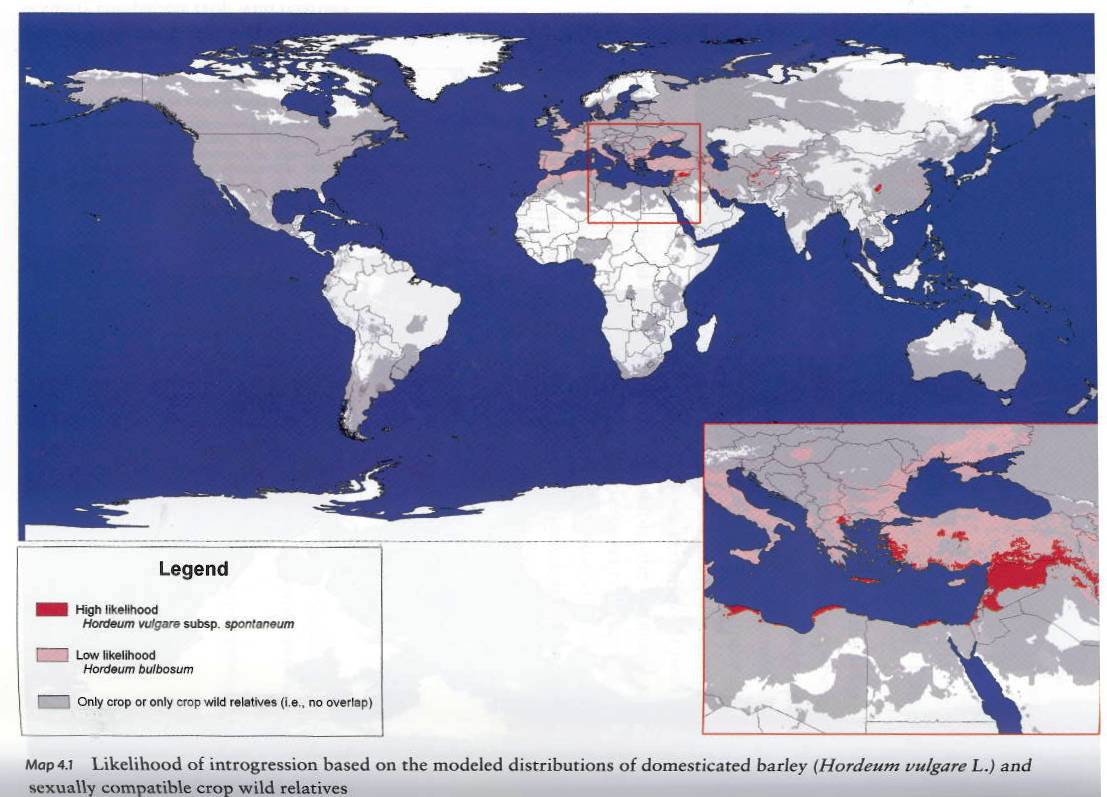
I’ve just received a copy of “Gene Flow Between Crops and Their Wild Relatives” by Meike S. Andersson and M. Carmen de Vicente (Johns Hopkins). This will no doubt become the go-to reference book on the subject. There are chapters on all the major crops, with what look to me like very comprehensive bibliographies on each. Of particular interest are the maps of introgression risk at the end of the book. These will apparently be made available on the Bioversity website in due course. But here’s one (barley) in the meantime to whet your appetite.
Nibbles: Pastoralists, Millennium Village, African agriculture
- “The film showcases Bio-Cultural Protocols highlighting the Raika community of Rajasthan and the Samburu of Kenya. Developing Biocultural Protocols is an important means of implementing both paragraph 8j of the CBD and Strategic Priority 6 of the Global Plan of Action on Animal Genetic Resources.”
- How Ethiopia’s Millennium Village is doing.
- And along the same lines, what Pedro Sanchez has to say about African agriculture and that green revolution nit needs to have.
Nibbles: Indian apples, Taro leaf blight, Pachira
- Video on the effect of climate change on apple cultivation in Himachal Pradesh.
- Video on taro breeding in the Dominican Republic.
- Photos of Malabar chestnut.
Evil locavore Alice Walters destroys California education
When is it a bad idea for children to play around in school gardens?
This notion—that it is agreeably possible to do good (school gardens!) and live well (guinea hens!)—bears the hallmark of contemporary progressivism, a kind of win-win, “let them eat tarte tatin” approach to the world and one’s place in it that is prompting an improbable alliance of school reformers, volunteers, movie stars, politicians’ wives, and agricultural concerns (the California Fertilizer Foundation is a big friend of school gardens) to insert its values into the schools.
Mapping Species Distributions previewed
Dag Endresen introduces Mapping Species Distributions by Janet Franklin, just published by Cambridge University Press.
Species Distribution Modeling (SDM) has really found its way into the scientific literature of late. It has moved from its origin in ecology, to a wider use in life sciences, including also recently data analysis in agriculture. Andy Jarvis, for one, has recently done some excellent studies of crop diversity with MaxEnt. I have not yet read this book, but have ordered it from my favorite online bookshop. Here’s why.
The book introduces the theory and the fundamentals of SDM and proceeds with a deeper description of the many different data analysis methods that has been applied. The list of methods is long (and still growing). However, it seems this book gives comprehensive guidelines for selecting the appropriate method for your own SDM study. I believe that Janet Franklin, the author, teaches species distribution modeling with the free open source R statistical analysis software. We can perhaps hope to find also some few examples of how to apply the described methods with the R package.
The books seems, however, much more focused on the understanding of the ecological principles for SDM and species-environment relationships. The large section on the SDM methods aims to provide us with an understanding of the assumptions and limitations for the models and predictions. I hope this will help to relieve the kind of “black-box” mystery I sometimes feel for many of the SDM methods. We shall see.
Janet Franklin has long experience of biogeography, with appointments as professor of both Geography and Biology.