Around the Carver Center
I’ve just got back from my second trip to the US in three weeks. 1 After Ames, Iowa a couple of weeks ago, last week was the turn of Beltsville, Maryland. Again we were hosted by USDA-ARS, this time at the George Washington Carver Center, so again many thanks to our friends there for the hospitality.
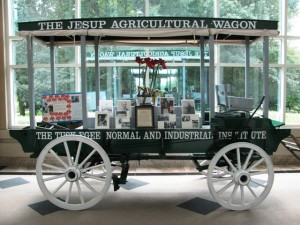
A legendary African-American post-bellum agriculturalist, breeder, botanist and educator, Carver in fact provides a further connection between the two places, as he was a student and then a faculty member at Iowa State University. On gaining his masters degree in 1896, Carver was invited by Booker T. Washington to take charge of the Agriculture Department at the five-year-old Tuskegee Normal and Industrial Institute, later Tuskegee University in Alabama, which he was adamant would “unlock the golden dawn of freedom to our people.” A gifted educator, he took his teaching on the road, by way of the mule-drawn Jesup Agricultural Wagon, built by the students and named after New York financier Morris K. Jesup, who provided the funds for it. Later replaced by a motorized vehicle, the original can be seen in the lobby of the Carver Center.
Another interesting exhibit in the Carver Center is the ARS Science Hall of Fame. This has been honouring ARS scientists for their achievements since 1986. Alas, although a number of breeders have made it, nobody involved primarily in the conservation side of genetic resources science has been elected. Yet.
Nibbles: Wild cassava, Oilseed rape breeding, Byelorussian food
- Wild cassava relatives could be used for nutritional enhancement.
- “…quality improvement did not significantly reduce the genetic diversity of European and Chinese Brassica rapa cultivars.”
- Byelorussian agrobiodiversity bazaar.
The Hungarian Agricultural Museum
So there’s a Hungarian Agricultural Museum in Budapest.
On display are implements of rural handicraft and machines for lightening the load of the farmer, documents about the raising of animals (especially horses, cattle, sheep and pigs), as well as forestry, hunting (there is a fine collection of trophies) and fishing.
Actually it’s supposed to be the “biggest museum of agriculture in Europe.” I personally find that “fine collection of trophies” in the Hall of Hunting ever-so-slightly creepy, but the rest of the museum looks like it might be quite interesting, at least in parts. A little difficult to tell as most of the website is only in Hungarian. Anyone out there been to see it? Via.
Herbaria get it together
Looks like the Paris herbarium (P, to taxonomy geeks), one of the largest in the world at 8,000,000 specimens, is finally sorting itself out. That’s really good news, because Paris is also perhaps the most frustrating herbarium in the world, due to the backlog in processing specimens and the generally sub-par conditions. All that’s going to change.
Once work moving and reclassifying the herbarium is complete, it will also be the world’s largest collection of plant specimens available on the internet. “We shall have 8m images, with a photograph of each plate on the museum’s website,” says the senior curator Jean-Michel Guiraud.
But I was particularly intrigued by this little throwaway final paragraph in the Guardian piece on the catch-up project. 2
International collaboration is under way to avoid duplication between the world’s top herbaria: primarily Kew Gardens and the Missouri Botanical Gardens, the two largest alongside Paris, but also smaller collections belonging to natural history museums or botanical gardens in London, Edinburgh, Berlin, Washington and New York.
I need to find out more about what this really means. You certainly don’t want to avoid duplication of specimens entirely, for safety reasons. Maybe it’s more a question of exchanging information on holdings so that at least herbaria know the extent of duplication. Anyway, I want to know how they’ll do it. Because it will be a cold day in genebank database hell before “international collaboration” will be able to “avoid duplication” in the world’s top genebanks.