- After a year’s travel in search of seeds, Adam Forbes turns in his report.
- The genetics of orange-fleshed cucumbers elucidated.
- Tea and hibiscus booze.
- Video of honey harvesting.
- Maps of sea level rise. All somewhat unsatisfying, somehow.
- “Because we are poor, we shall suffer first but, ultimately, we shall all die together.”
- SADC Plant Genetic Resources Centre (SPGRC) director Paul Munyenyembe does the public awareness thing.
No little houses on this prairie
I promised you more on the Doolittle Prairie, and here it is. But first, thanks to Candy Gardner for arranging the visit, and to Mark Widrlechner for leading the tour.
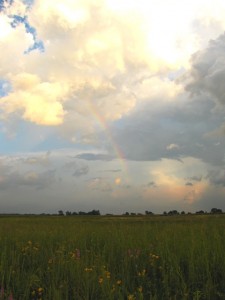
Doolittle Prairie State Preserve, near Story City in Iowa, is a small remnant of native tallgrass prairie. The 26-acre state-owned protected area supports about 220 plant species. 1 About half of the area, the northern part, has never been ploughed or grazed, though hay was cut until the 60s. The southern part has been grazed, and the southwest corner ploughed until 1965 and then replanted with seed from the northern section. All around are fields of maize and soybean. Management is by cutting and burning, to keep down exotics, and encroaching shrubs and trees.
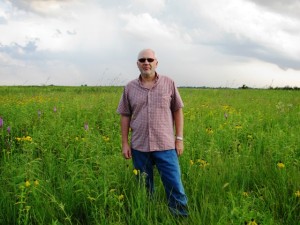
It’s a very evocative place. You can just imagine the deer and the buffalo roaming on it back in the day. There are still deer. Buffalo, not so much. 2 It’s also pretty interesting from an agrobiodiversity perspective, because it’s got quite a number of crop wild relatives for such a small place.
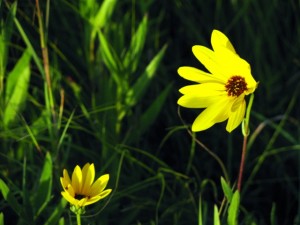
A couple of species of wild sunflowers, for example. This one is Helianthus rigidus:
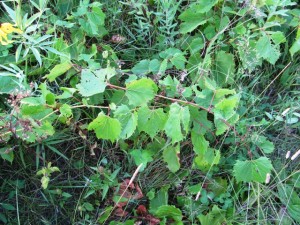
There are also native species of Allium, Elymus, Lactuca, Fragaria, Prunus, Ribes, Rubus, and Vitis:
All in a beautifully colorful setting, at least at this time of the year.
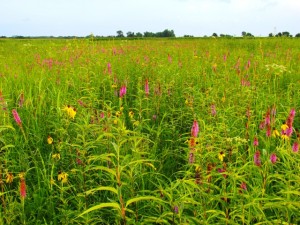
So, a bit of a CWR hotspot, in its own small way, and protected to boot. You may remember the recent global review of the role of protected areas in CWR conservation. I don’t think that CWR have been mapped in the US in the same way as has been done in Russia, however. 3 Once you have geo-referenced CWR locations, you could easily mash the result up with the online map of protected areas to see which national parks and reserves contribute most to CWR conservation. Anybody out there working on this? I bet little Doolittle Prairie would be on that list.
“We have very little data”
That’s Javier de la Torre talking about ecological niche modeling at GeoWeb. Well, I would qualify that by saying we have too little digitized data. Certainly for many crop wild relatives, for example. Javier was involved in a recent online mashup of the global protected area database. His GeoWeb slides are below, catch his talk on YouTube.

Nibbles: Tofu, Pluon, Community gardens, Indian drought, Trees, Chicks, rare breeds
- Tofu, anyone?
- Plumcot, anyone?
- Guerrilla gardening, everyone!
- Green Revolution breadbasket drying up. ICRISAT has the answer. Well, sort of.
- BBC has a different answer. Trees can keep people alive in times of drought.
- More semi-naked chicks, this time in South Africa.
- Naked or otherwise, eat them to save them, with the American Livestock Breeds Conservancy.
Nibbles: Seed Conference, High carotenoid bananas, DIVA-GIS, Protected area map, Pulse domestication, Food policy, Torreya rewilding
- The 2nd World Seed Conference is coming up soon.
- Orange bananas make it big in the Solomon Islands. Thanks, Lois.
- DIVA-GIS website gets a makeover. Watch out for the blog.
- Global protected areas map mashed up.
- Dorian Fuller blogs lentil and bean domestication.
- Bookforum.com does food.
- While people discuss the pros and cons of assisted migration, one group has actually gone out and done it.