- Animal Genetic Resources Information Bulletin 44.
- How the Sheep Trust was born.
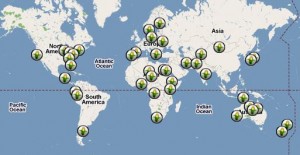
- Map of British gardeners.
10% of world’s plants in the Millennium Seed Bank
…25% by 2020, at $2,800 per species. Not sure I understand the bit at the end about “molecular and genetic markers for the viability of seeds,” but there’s more on the website. And thanks for the plug for Svalbard.
Will climate change make protected areas useless?
Not for birds in Africa, apparently — and surprisingly, at least to me. 1 A recent paper looked at likely turnover of species in Important Bird Areas (IBAs) in Africa under a range of climate change scenarios. The results showed that although there would be significant shifts in the species composition of individual IBAs, overall about 90% of 815 endangered species “are projected to retain suitable habitat by 2085 in at least one IBA where they occur currently.” And some IBAs will become newly suitable for some species. Only a few endangered species will lose all suitable habitat from the IBA network.
Nevertheless, the authors acknowledge the importance of the shifts in species distribution and suggest a number of recommendations. In particular, the results highlight the need for regionally focused management approaches. For example, increasing the number and size of protected areas, providing ‘stepping stones’ between habitats and protected areas and restoring critical types of habitat, as well as ensuring that the current IBA network is adequately protected into the future.
Sensible recommendations, which would apply all the more strongly to any similar network for crops wild relatives, say, which don’t by and large have the mobility of birds. 2 We need to carry out a similar resilience study for CWRs in protected areas, I would suggest. But also, do we know how good the IBAs are at capturing CWR diversity? I suspect when people look at CWR distributions in protected areas, it is mainly national parks and the like that they consider, rather than such specialized things as IBAs, but I could be wrong. 3 Here’s the distribution of IBAs in Africa. I seem to be having a thing about maps of Africa lately.

Yield trial sites mapped
Glenn Hyman has a great map over at AGCommons. It shows the sites in Africa where international crop networks carried out yield trials in the 1960’s, 70’s and 80’s (and some beyond). Here it is:

Would be interesting to compare with the various accessibility maps I posted a couple of days ago, and indeed with agroclimatic maps. No doubt Glen is doing it as we speak, and lots of other stuff too.
Read the interesting comment too: “Africa’s green revolutions will be fundamentally different from Asia’s — because Africa and Asia are fundamentally different, because times have changed, and because we have learnt a few tricks in the meanwhile!!”
Nibbles: Qat, GAIN, Dates, Mandarin, Eucalypts
- Qat not good for water.
- Global Alliance for Improved Nutrition (GAIN) announces Amsterdam Initiative on Malnutrition (AIM), to eliminate malnutrition for 100 million people in Africa by 2015.
- Eating dates dates back over 4,000 years.
- Intercropping with guava may save citrus from greening on Java.
- To identify salinity tolerant eucalypts, use response of height to salinity, rather than mean height.