- Much may be made of a wheat gene-jockey, if he be caught young.
- Or rice gene-jockeys, for that matter.
- Lots of naughtiness going on in blue cheese.
- Hope those reprobate fungi are using sustainable Amazonian rubbers.
- Some wine with that naughty cheese?
- Learning Burmese, researching the deep history of crops. Meah.
- Start planning for the next sustainable diets symposium. Symposium is quite apt, isn’t it.
- Feast your eyes on Feast Your Eyes.
- European agriculture is totally prepared for this climate change whatsit.
The value of ICARDA
ICARDA is deservedly getting much traction with the press at the Doha climate change meeting with the report “Strategies for Combating Climate Change in Drylands Agriculture,” which it has produced in collaboration with the CGIAR Research Program on Climate Change, Agriculture and Food Security (CCAFS). A testament to great research over many years; and an open, active communications policy.
Particularly welcome to see the genebank’s role in climate change adaptation clearly highlighted in the report:
Releases of plant genetic materials from ICARDA’s gene banks, which host wild relatives of barley, wheat and legumes, has led to the development of crops with higher yields and greater resistance to a range of biotic stresses. Some varieties also offer large improvements in bread-making quality, nutritional value and other traits.
The document goes so far as to quantify the return on investment from breeding, which is something that you don’t see as often as you should:
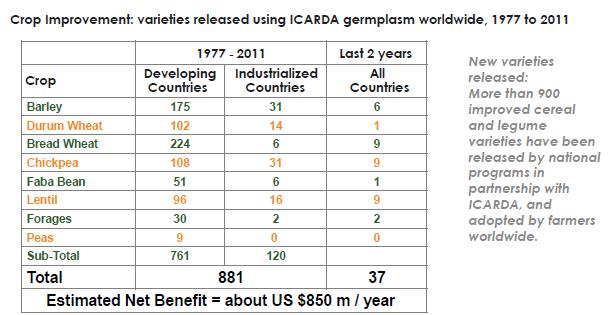
That $850 million figure is not detailed further, but the suggestion is that it is built up from examples such as this, of which there are several more outlined in the report:
A drought tolerant variety of chick pea introduced in Turkey had such strong resistance that it was able to withstand the searing temperatures and rainfall scarcity of the 2007 drought. The ‘Gokce’ variety is now used for about 80% of the country’s chickpea production. With a yield advantage of 300 kg/ha over other varieties and world prices of over US$1000/t, this variety brought in an additional US$165 million for Turkish farmers in 2007 alone.
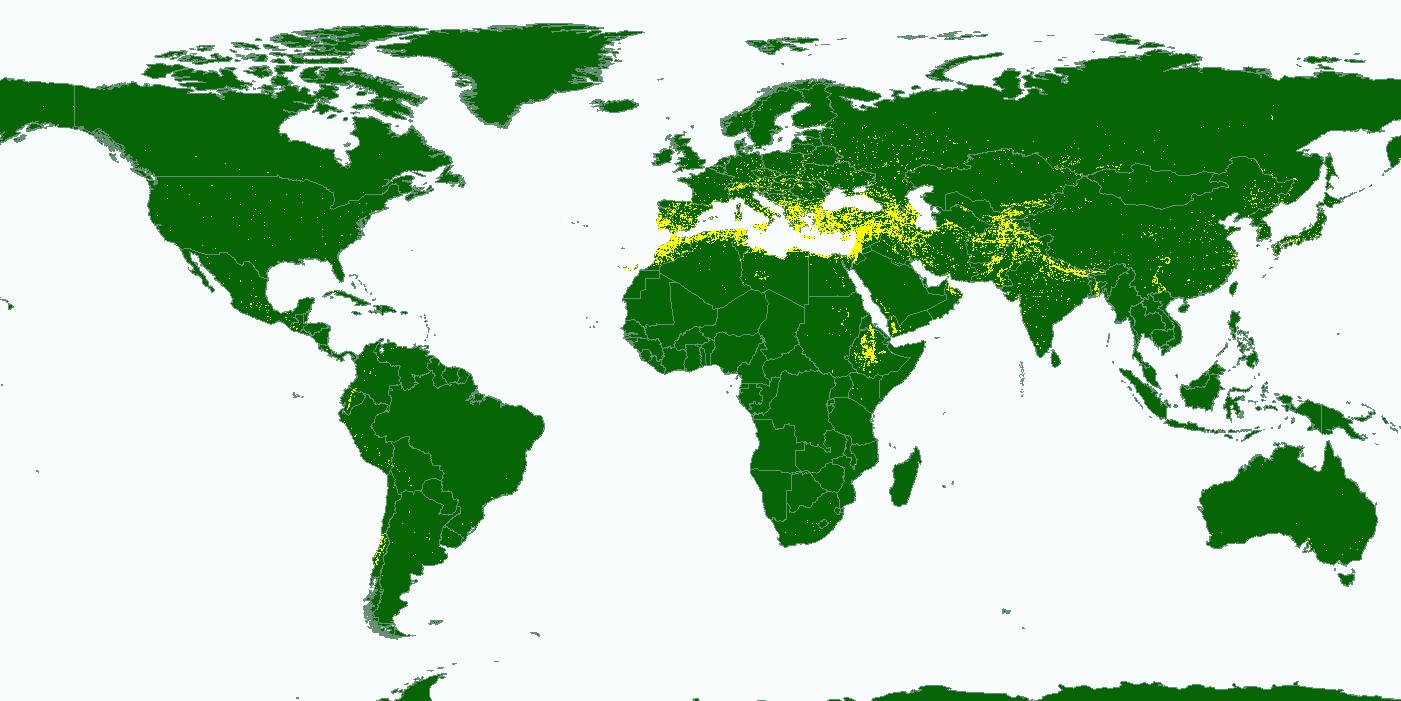
Obviously a significant achievement, and it seems churlish to ask whether it’s entirely a good thing for a country to rely on one variety for 80% of its production of a given crop. Anyway, it seems there are similar impact figures for livestock improvement too. It would be good eventually to see the breakdown by crop, and indeed livestock species, plus of course the level of investment that went into breeding efforts on each species to produce these new varieties and breeds. In the meantime, let’s remind ourselves of what a unique, vital resource the ICARDA genebank is by looking, courtesy of Genesys, at the geographic spread of the material it manages on behalf of the world under an agreement with the International Treaty on Plant Genetic Resources for Food and Agriculture (click to enbiggen), and that it, and the associated data, are, thankfully, safe.
Nibbles: Sesamum publications, Organic China, Melaku Worede biopic, Pre-breeding smackdown, Price of spice, Pineapple breeding
- A bibliography of sesame. Good to have.
- All you want to know about organic farming in China. Who knows when it might come in useful.
- The legacy of Melaku Worede. Proud to know him.
- European pre-breeding meeting. Would be good to go.
- The Spice Trade 2.0. Good gig if you can get it.
- Coconut-tasting pineapple. Why?
Nibbles: Desert afforestation, Breadfruit, Sustainable tea, Biofortification, Cassava breeding, Wheat breeding, Ancient microbrewery
- The Sahara Forest Project: what could possibly go wrong?
- Maybe they should try breadfruit. Or avocados. Or ask this guy for advice.
- Not for all the sustainable tea in China!
- Or all the high-Fe pearl millet in India.
- Or all the wild chickens in South Asia.
- Cassava gets the genomic selection treatment. Maybe wheat too?
- Did someone mention beer?
Nibbles: Old rice, New quinoa, Fishy stuff, Cropland landscapes, Forest landscapes, Old seed, Superdomestication, Intensification
- Youth compiles list of rare and extinct rice varieties of Assam. Maybe he should look at weedy rice too?
- Meanwhile, American farmers are learning to grow quinoa, probably including some rare varieties.
- The smelliest fish in the world. No traceability needed for that one, I guess.
- Cropland getting mapped. Presumably including the Globally Important Agricultural Heritage Systems (GIAHS). Help needed by both, by the way.
- Follow the forest discussions at COP18. High on the agenda: what is a landscape? It’s what you study when you’re being holistic, no? Anyway, there’s got to be a connection to the previous links.
- Boffins find a genetic marker for old seed. Will need to Brainfood this one.
- Pat Heslop-Harrison breaks down superdomestication for you.
- SRI gets a scaling up. What could possibly go wrong?