- Heat takes growing toll on Kansas farm crops. Heat, not drought. Just sayin’.
- Amateur Hour I: watermelons.
- Amateur Hour II: perennial rye.
- Amateur Hour III: red-fleshed apples.
- Bronjenas. An eggplant by any other name is still an aubergine (Solanum melongena).
- Not your average pinoli.
- We need to fix the food system. But how? Answers on a postcard, please.
- Saving traditional rice landraces in India. Of which there are maybe 3,000 in the NE alone. No mention of genebanks.
- Superstar Swedish soybeans
Nibbles: AnGR, Sustainable diets, MDG, Plantwise, Maize in Africa, Lead farmers, Micro-livestock (again), Cows and climate change
- Money for AnGR conservation up for grabs.
- 8th International Food Data Conference: Biodiversity and Sustainable Diets is taking place September 14-17, 2011 at NBI Conference Centre, Norwich, UK.
- So how are we doing with that MDG1?
- More on CABI’s Plantwise. I just hope most of it will be free. They have a blog, natch.
- CIMMYT drought-tolerant maize varieties featured in blog post. I’ll alert the media. No, wait. Seems like only 60% of farmers in Kenya are willing to pay for these varieties anyway.
- No extension workers? No problem.
- A tasty dish of Ugandan grasshoppers. Always a good subject for a subtly xenophobic CNN phtoto feature.
- Cows not so bad after all?
Nibbles: Beetles, Assisted migration, Potato breeding, Chaffey, Malnutrition
- Beetles good for weeds. No news on effect of Rolling Stones on pests.
- When to move species. Acacias, for example?
- A gene to prevent inbreeding depression in potato. I’m kinda down myself today.
- As you were, Plant Cuttings has made me feel a whole lot better.
- Documenting Peru’s success in fighting malnutrition. Did fortification play a role? Hard to say from this, which focuses on policy, and in particular conditional cash transfers.
Taro leaf blight confirmed in Nigeria
We’ve blogged a few times about the emerging threat of taro leaf blight in West Africa, and what could be done about it. In case anyone was still in doubt about this threat, here comes the science.
The sequence analysis, morphological characteristics, and pathogenicity test confirmed the taro leaf blight pathogen as P. colocasiae. There are previous reports of occurrence of taro blight-like disease attributed to P. colocasiae in Ethiopia, Equatorial Guinea (1), and more recently in Cameroon, but comprehensive details on pathogen or disease are not available. To our knowledge, this is the first confirmed record in Nigeria of P. colocasiae causing taro blight. This disease poses a serious threat to the production and biodiversity of this important food crop. Urgent interventions are necessary to halt this emerging epidemic in West and Central Africa.
One possible intervention of course, is introducing resistant varieties, and I believe some of the resistant material from various South Pacific breeding programmes has now arrived at IITA from the in vitro genebank at SPC’s Centre for Pacific Crops and Trees.
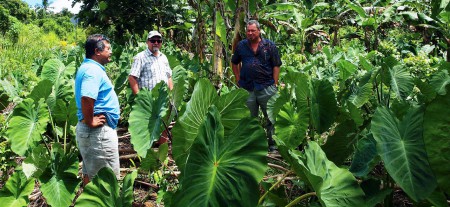
The history of the effort to breed resistant varieties is described in a recent ACIAR publication. Grahame Jackson, who was involved in the early stages of that work, had this to say about the article in a recent exchange of emails:
Interesting article; but it does not ask the hard, and perhaps more interesting questions: why did it take 5 years before there was a concerted effort to take the only route possible to solve the taro blight problem — to breed for resistance? … How many regional meetings were there over 5 years, until the start of TaroGen; how much money was wasted until a concerted effort was made to tackle the problem? … And in the meantime the Samoa farmers had solved their food insecurity: they had diversified into Alocasia, cassava, breadfruit, and rice. … More recently, another donor said of the disastrous epiphytotic of taro leaf blight in West Africa: “We get half a dozen emails a week describing some outbreak or other, mostly exaggerated. And anyway we can’t do anything until the countries ask.”
Shouldn’t be long now…
Brainfood: Chinese landscapes, Agroforestry seed, Italian lentils, Carrot heterosis, Taro in islands, Indian wheat, AnGR ex situ, Woodland shrines, Vitamin A, Caraway, Adansonia, Neotropical blueberries, Yeast genetics, Rotations
- Agricultural landscapes and biodiversity in China. Traditional farming practices good for biodiversity, modern bad. Therefore need intensification, to take pressure off natural habitats. But no, wait, that usually means monocultures and chemicals, which are bad. Oh crap. No mention of genebanks.
- Innovation in input supply systems in smallholder agroforestry: seed sources, supply chains and support systems. Decentralized commercial system probably best for getting quality agroforestry seed to smallholders. Unfortunately, nobody listening.
- Characterization of Italian lentil (Lens culinaris Medik.) germplasm by agronomic traits, biochemical and molecular markers. I object in principle to any paper that says a particular landrace is “the best.”
- The relationship between heterosis and genetic distances based on RAPD and AFLP markers in carrot. It is positive. Was this really not known before in carrots? What am I missing?
- Genetic diversity of taro (Colocasia esculenta (L.) Schott) in Vanuatu (Oceania): an appraisal of the distribution of allelic diversity (DAD) with SSR markers. 10 villages, 344 landraces, 324 distinct multilocus genotypes, genetic pattern reflects social networks. Situation in Andaman Islands not quite so interesting.
- A study of genetic diversity among Indian bread wheat (Triticum aestivum L.) cultivars released during last 100 years. More diversity after Green Revolution than before, but steadily decreasing.
- Ex situ conservation genetics: a review of molecular studies on the genetic consequences of captive breeding programmes for endangered animal species. Restricted access, and you know what? I couldn’t care less.
- Consequences of wooded shrine rituals on vegetation conservation in West Africa: a case study from the Bwaba cultural area (West Burkina Faso). I expect there are some, but with restricted access, what’s the point of even linking?
- Evaluating sweet potato as an intervention food to prevent Vitamin A deficiency. To have an effect, you’d have to replace all the other types with orange-fleshed ones. Well, almost. Wonder whether it will be presented at the “International Scientific Symposium on Food & Nutrition Security Information: From valid measurement to effective decision-making” early next year.
- Evaluation of variability of morphological traits of selected caraway (Carum carvi L.) genotypes. They’re actually breeding this stuff in Poland. But they had to get their germplasm from botanical gardens around Europe.
- Variation in baobab seedling morphology and its implications for selecting superior planting material. There is some.
- Edible Neotropical blueberries: antioxidant and compositional fingerprint analysis. The 5 species involved have different ones.
- Population genomics and speciation in yeasts. There’s a question as to whether yeast species in fact exist in any meaningful sense.
- Cereal–forage rotations effect on biochemical characteristics of topsoil and productivity of the crops in Mediterranean environment. Continuous cereal stressed the soil.