- A rum story from Haiti. And another, though a different sort of rum.
- Quinoa and buckwheat best for coeliacs.
- Video of food crisis in Nepal. In other news, there’s a food crisis in Nepal.
- Forest fruits need markets too.
Geographical indications to preserve Ethiopia’s biodiversity
From André Heitz.
Ethiopia is one of the frontrunners in the use of Intellectual Property to make the best use of its plant genetic and traditional knowledge assets. In the absence of legislation on geographical indications, it has endeavoured to use collective trade marks in the main export markets to add value to its Sidamo, Yirgacheffe, and Harrar/Harar coffees. There is more on the Ethiopian Coffee Trademarking and Licensing Initiative at the Ethiopian Coffee Network and Light Years IP.
The Ethiopian Parliament is now expected to pass geographical indications legislation later this year. This will then provide the legal basis for Ethiopia’s plans to register geographical indications protection, first nationally and then abroad, over emblematic home garden products like coffee, beans, spices and condiments or aromatic plants.
The Home Gardens of Ethiopia project says:
Biodiversity is under threat everywhere, and Ethiopia is no exception.
This country features an exceptional biodiversity, and its gardens, shaped generation after generation by rural populations, represent a unique natural and cultural heritage that must be handed down to future generations.
To preserve this horticultural heritage, Ethiopia has chosen to design and implement an effective institutional and promotional tool: a Geographical Indications system.
The “Home Gardens of Ethiopia” project seeks to promote and develop native horticultural productions, while preserving in situ the biodiversity of the country’s gardens. Its approach is both original and efficient: to offer farmers communities legal protection and help them promote selected native products with new marketing opportunities. Ethiopian farmers will be able to make their traditional modes of production more sustainable, and preserve the biodiversity of which they are the custodians.
We’ll keep fingers crossed.
Nibbles: Kew web, Turkeys, Sugar, Climate, Law
- RBG Kew launches new website. Busy, busy, busy.
- Turkeys domesticated twice, neither time in Turkey. Gobble, gobble.
- Warmer-than-expected weather hits Thai sugar production. Sweet.
- Climate shocks hit poor countries’ exports. Shocked. h/t Cecilia.
- Biodiversity law could stymie research,” and that’s all I know, because the rest is behind a paywall. Access and benefit share THIS!
A banana new to science
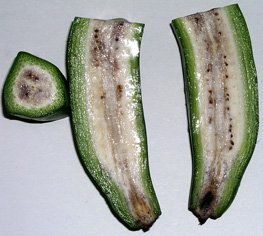 Somewhere this morning I read something silly from a conservation whiner that the mainstream media would pay more attention to Paris Hilton taking a pee in South Africa, or 10 murders, than the loss of 10 wild species. I didn’t even bother to bookmark it, so familiar was the sentiment. To redress the balance, here’s an entirely new banana cultivar, heretofore unknown to science, spotted by Luigi on the proMusa website and shared with the world via Twitter. It was collected in Oman in 2003 or 2004 and grown on in Germany. I’m not sure yet what it is good for, although it is drought resistant. And “[t]he authors speculate that the variety, which they named Umq Bi’r, might have reached Oman many centuries ago via Zanzibar, Madagascar or the Comoros”. More interesting than Paris Hilton taking a pee? You bet!
Nibbles: Biofuels, No-till corn, BBTV, Coffee pest, Air potato, Neolithic, Turkish roses, Cowpea conference
- Science: Biodiversity is good even for biofuels.
- Science: Lack of annual diversity is bad for no-till maize (corn).
- Science: “Dead” bananas can still transmit banana bunchy top virus BBTV.
- Science: Potential biological control identified for coffee berry borer. (Eeeyew warning.)
- Art: Biological control (Lilioceris near impressa) of air potato (Dioscorea bulbifera). (Gorgeousness warning.)
- Science: Farmers brought farming to Britain.
- Science and art: A rose is a rose is a rose.
- Science: Black-eyed peas in Dakar gig.