- Hell of a week in the office again, so catching up on accumulated Nibbles on a Sunday. Because we’re here to serve.
- Cynical, funny take on farmers’ markets: “No, I don’t save seeds. That’s time-consuming nonsense for backyard gardeners. Yes, I’ve heard of Monsanto. I’m a farmer. I know about goddamn Monsanto.”
- Uncynical double from the Pacific: Samoa’s agricultural show and more detail on the aroid breeding work.
- High tech breeding of solanaceous crops. Nothing like this for aroids yet, alas. Yeah, but first you have to collect the little blighters.
- On the other hand, you also need an awareness of the past. Ask the Tibetans.
- And here’s kind of an example of that involving rice in India. Compare with that first Nibble: seed saving not just for backyard gardeners after all? Convinced? Go do it, no, really. Or read Bob Zeigler; you can listen to him too. We could go back and forward on this forever. I know: let’s get some data.
- And another example involving wild not-rice in the US and Canada. Though there are some things that haven’t survived quite as well among Native Americans as those wild rice recipes.
- And speaking of ancient recipes, here’s one from another wetland, far far away from the above.
- Yeah but not all ancient recipes are so resilient, take beetles for example.
- Urban farming is big, needs to be bigger.
- Meanwhile, agricultural land is being bought up all over the place, for what it’s worth, so maybe cities will be all we have to grow stuff.
- International Cocoa Organization calls bullshit on all those chocolate-is-running-out stories.
- Maybe we should chill about wine too? I dunno, I think I’d prefer to play it safe with both. Or get help from above. Or from the Fascists.
- The banana was going extinct too, wasn’t it?
- British apples (and other trees, to be sure) are of course perennially in trouble, but help is on the way, courtesy of Kew. And not just British or apples that get help from that quarter.
- “The potato will not only survive climate change, it will help us to survive it as well.” Good news at last.
- Mapping cassava, all of a sudden an exciting new crop, if you can believe it. No stopping it now that Bill Gates has called it the world’s most interesting vegetable.
- Incidentally, he’s also decided to go totally CC-BY.
- And that’s all she wrote. For now.
Nibbles: Chocolate, MAS, Cash crops, Medicinal plants, Rice domestication, Cat genome, Banana research, Artichoke history, Root vegetables, Diabetes data, eMonocot, Paris herbarium, Appleseed, Seed saving, Potato safety duplication, Seed atlas, Botanical Jurassic Park, Mapping urban fruit, Midwest road trip, Iraqi marshes, World Digital Library, World Parks Congress, Plant demography
- Ok here goes, there’s a week’s work of Nibbles we’ve got to catch up on.
- World running out of chocolate! Tell that to Cologne.
- Yeah well I prefer tea to cocoa.
- Greenpeace: “Smart breeding” will save us, not GMOs. Breeders: All breeding is smart.
- Guess the world’s biggest cash crop. Yeah, that one.
- Alas, it’s not included in the recent strategy for conserving medicinal plants. Not that it would need conserving.
- The domestication of the world’s biggest crop, period. Deconstructed. And if you want to drill down.
- And of the world’s biggest fruit.
- And of the world’s biggest pet.
- And of the world’s most difficult to eat vegetable.
- Root “vegetables” made simple. Because winter.
- And why you must eat your veggies, including the difficult ones.
- Videos on Kew’s monocot database and on the renovation of another famous herbarium.
- The real Johnny Appleseed.
- But you too can save seeds, just like Johnny.
- But don’t forget to safety duplicate, like CIP has done, at Embrapa.
- And this shows you what those seeds can look like.
- You don’t necessarily need seeds to save plants, though.
- Mapping fallen fruit. Because we can.
- Road trip!
- Boat trip!
- Selected Techniques in the Art of Agriculture. From French to Turkish to Arabic. One of many nifty agriculture-related resources in the World Digital Library.
- Oh yeah, the IUCN World Parks Congress has been on and its all over the intertubes. Including with neat visualizations, natch.
- How many of the species in the COMPADRE database of plant demography information are in protected areas? How many are crop wild relatives? I need an intern.
Nibbles: Biological collections, ICT & food security, Pisco battles, Rabbit stew, Afghan silk, ILRI @40, Silicon Valley & livestock, Trade & deforestation, Nexus shmexus, Landscape analyzed, Native potatoes, Botanical herb garden, Plant crime, Cornbread & other indigenous foods, Climate smart ag, Caterpillar fungus, Reindeer poop virus, Rice breeder vid
- Biological collections under pressure.
- And mobile phones probably wont help. Much.
- Chilean pisco? Really?
- The end of cooking?
- Sericulture on the Silk Road.
- ILRI is 40, did we say? Not sure what they do on sericulture. No doubt somebody there will tell us. They’re social networking machines over there.
- Watch out, ILRI, Silicon Valley is coming for ya.
- One of the reasons why we need livestock research: deforestation.
- I like any article with the word nexus in the title.
- The landscape approach meta-analyzed to within an inch of its life. Bottom line: it’s the women, stupid!
- The power of the people’s potatoes.
- A secret herb garden revealed. I hope they install CCTV.
- Kana’tarokhónwe. Yep, clickbait, but worth it, trust me. And then scale the thing up.
- How to do climate-smart agriculture in Latin America and the Caribbean, country by country.
- Oh no, yet another article on that Himalayan Viagra caterpillar fungus thingy.
- Boffins resurrect 700-year-old fungus from reindeer crap.
- Indian rice breeders talk about their cool new basmati.
Fibers on display in Boston
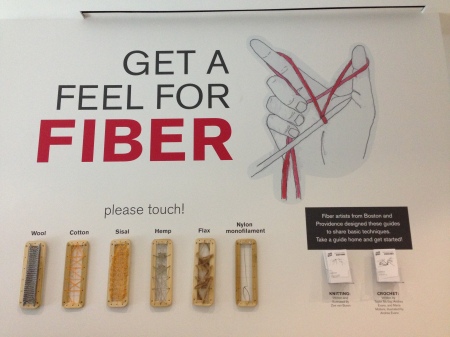
That’s from the “[s]plendid, viscerally engaging … groundbreaking exhibition” called Fiber: Sculpture 1960-Present, now on at the Institute of Contemporary Art in Boston. And it was pretty cool. But would it have killed them to include some pictures, or even live examples, of the plant (and animal) sources of the raw materials for objects such as this? 1
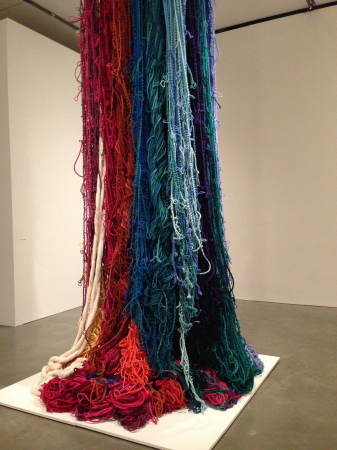
Well, maybe not the animal sources…
Brainfood: Polyculture services, Apple resistance, Clover seed storage, Oil palm diversity, Alternative foods in Italy, Oregano chemicals, Pig diversity, IPR and indigenous people
- Do polycultures promote win-wins or trade-offs in agricultural ecosystem services? A meta-analysis. Yes, at least if the services in question are per-plant yield and biocontrol.
- Susceptibility of apple genotypes from European genetic resources to fire blight (Erwinia amylovora). 3 of 40 were resistant.
- Effect of sulphuric acid scarification on seed accessions of cluster clover (Trifolium glomeratum) stored in a genebank. Potentially disastrous.
- Genetic diversity of the world’s largest oil palm (Elaeis guineensis Jacq.) field genebank accessions using microsatellite markers. 3 groups: extreme W Africa, rest of Africa, Madagascar. Choose parents based on genetic distance, though, not just genetic group.
- Introducing territorial and historical contexts and critical thresholds in the analysis of conservation of agro-biodiversity by Alternative Food Networks, in Tuscany, Italy. Alternative Food Networks can contribute to conservation, but they need context.
- Chemical diversity among different accessions of Origanum vulgare L. ssp. vulgare collected from Central Himalayan region of Uttarakhand, India. 2 chemotypes, the one with higher thymol mainly from higher altitudes.
- Merging Molecular Data for Evaluating Cross Country Genetic Diversity of Pigs. Microsatellite datasets from USA, China and Brazil successfully combined and analyzed together. Should be more of this kind of thing.
- How Are Indigenous and Local Communities’ Rights Over Their Traditional Knowledge and Genetic Resources Protected in Current Free Trade Negotiations? Highlighting the Draft Trans-Pacific Partnership Agreement (TTPA). Indigenous people are generally not given stronger rights over their intellectual property in international instruments compared to non-indigenous people. Rights over IP are in general stronger than over genetic resources.