Catherine Njuguna, a communications specialist at IITA, left a lengthy comment explaining all the work being done to combat cassava brown streak disease. We asked if we could use it as a guest post. She sent this even longer article, which we’re happy to share.
Efforts to save Africa’s cassava from deadly viral diseases
The warning by Food and Agriculture Organization on the viral disease wreaking havoc cassava, an important staple in eastern and central Africa, was spot on and timely. It highlights the challenges posed by this new and not-so new disease, Cassava Brown Streak Disease, which is threatening the food security and livelihoods of over 200 million people who depend on the crop.
Together, the two diseases cause more than 1 billion USD worth of damage to Africa’s cassava. The already poor small-scale farmers bear the brunt of this loss.
On a positive note, a lot of work is being carried out by various the governments, researchers, donors, Non-governmental organizations and the farmers themselves, to combat not only the cassava brown streak disease (CBSD) but also cassava mosaic disease – another disease drastically affecting cassava in the region to avert the looming catastrophe. However, a, lot more still needs to be done as the two diseases continue to spread rapidly through the region.
Some of the activities we are carrying out at IITA in collaboration with our wide range of partners from other Consultative Group on International Agricultural Research (CGIAR) centres, National Agricultural Research Systems, (NARS), Universities, non-governmental organizations (NGOs), Community Based Organizations and Private sector include:
- Breeding for varieties that are tolerant/ resistant to both the Cassava Brown Streak Disease (CBSD) and the Cassava Mosaic disease (CMD) using conventional and molecular assisted breeding: Efforts are under way to develop high yielding varieties resistant to the two diseases. While we have not had any success in CBSD resistant varieties, we have identified and are promoting varieties that are tolerant to the diseases – they show symptoms but still give acceptable yields.
In Zanzibar, the cassava production has been revived by four tolerant varieties developed together with Zanzibar researchers at Kizimbani research institute officially released in 2007. On mainland Tanzania working with researchers from the Ministry of Agriculture, Food Security and Cooperatives, 8 improved varieties for the Lake Zone region and 5 varieties for mid-altitude areas in tolerant to Cassava Mosaic Disease were officially released in 2009. They are also showing acceptable levels of tolerance to CBSD. IITA and partners including FAO, CRS are working to rapidly multiply and get to farmers clean planting material of these tolerant varieties. A further 8 varieties showing tolerance to both diseases for coastal lowlands are at an advanced trial phase.
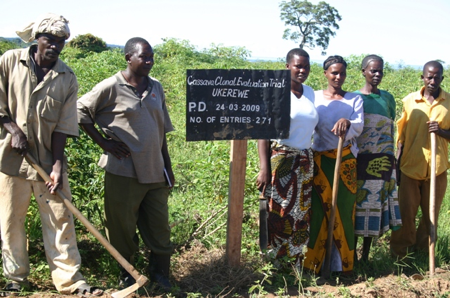
Breeding efforts are also underway in Uganda where varieties, crossed with tolerant varieties from Tanzania and showing acceptable levels of tolerance to the diseases under the harshest of disease pressure conditions are in the pipeline for release in a year or two after further testing.
Scientists are also using advanced technologies such as molecular marker-based breeding (MAB) for faster and more effective breeding of resistant cassava as conventional breeding takes between eight to twelve years to come up with the improved varieties.
However, as a vegetatively propagated plant, getting enough planting materials to meet the demand is a tremendous challenge. A lot of support is needed to devise rapid and efficient ways of getting healthy planting material of improved cassava varieties to needy farming communities as rapidly and efficiently as possible.
- Understand disease epidemiology – Although cassava brown streak had been known in East Africa for many years, it had always been confined to lowland coastal areas. The new outbreaks defied existing research wisdom as rapid new spread was reported from the relatively high altitude regions (over 3000 feet above sea level) of Uganda, Kenya, and Tanzania around the shores of Lake Victoria. Research efforts are under way to understand what is driving this new spread. A lot of knowledge has now been generated on the virus (CBSV), developing diagnostic tools and basic technologies to manage the disease. However, a lot of research is still needed as the virus is very diverse.
- Surveillance systems to track the spread of the diseases: Under the Great Lakes Cassava Initiative (GLCI) funded by the Bill & Melinda Gates Foundation, a regional surveillance program was set up in 2009. It was made up of national agricultural research systems of Burundi, DRC, Kenya, Rwanda, Tanzania, and Uganda, IITA, Catholic Relief Services (CRS) and the UK’s Food and Environment Research Agency (FERA) among others to track the extent and speed of spread of CBSD and CMD in the five countries. This will assist in detecting when the disease spreads to new areas and help to identify areas of priority.
- Whitefly vector: A lot of research is underway to understand the whitefly, Bemisia tabaci – the tiny insects transmit the viruses that cause the CMD and CBSD- how it spreads the disease and the relationship between it and the disease. Research is also underway to find a biological control to sustainably reduce its population.
Overview of IITA work on combating CBSD.
A brief of the two diseases
CBSD was first reported from Amani, Tanzania in 1936 but was mostly confined to the low lands of Eastern Africa and around Lake Malawi. However, from 2004, the disease, which causes a dry rot in the roots rendering them inedible, started spreading to mid-altitude areas and has drastically affected cassava production in Central and South-Western Uganda, North Western Tanzania, Western Kenya, and North Western DR Congo.
The disease damages the most economically important part of the crop, the roots. Furthermore, the symptoms are not always clear. A field of cassava looking healthy and vigorous up to the time of harvest can conceal the grim reality of rotten useless roots, revealed as the farmer digs up her long-anticipated crop.
CMD, on the other hand, also has a long history in Africa and was first reported in 1894 and the earliest management work initiated in 1930s in Tanganyika. However, an unusually severe form was first reported in Uganda in the late 1980s. The country experienced a severe epidemic that reduced national cassava yields by a third within three to four years severely affecting the food security. Efforts to develop disease resistant varieties were successful. CMD resistant varieties were developed, clean planting materials widely distributed and education in sound agronomic practices. By the early 2000s, major increases in cassava production were being realized in many affected countries, as resistant varieties spread. Many farmers who had stopped growing the crop in despair started growing it again. The work of disseminating the new varieties to farmers was supported through large-scale campaigns to raise awareness about the disease, its symptoms and measures to stop its spread
However, the emergence of CBSD has become an additional challenge for breeders and researchers to grapple with as crops that were developed and resistant to Cassava Mosaic disease were susceptible to the new disease.