- Performance of 50 Lebanese barley landraces (Hordeum vulgare L. subsp. vulgare) in two locations under rainfed conditions. 47 individual plants were as good or better than the 2 checks in terms of grain yield per plant.
- Phylogenetic analysis of Aceh cattle breed of Indonesia through mitochondrial D-Loop region. A specific haplotype, mainly indicus but with some taurus.
- Genetic diversity assessment of in situ and ex situ Texas wild rice (Zizania texana) populations, an endangered plant. Diversity is dynamic in situ, and some of it is missing ex situ.
- Genetic Diversity, Population Structure, Parentage Analysis, and Construction of Core Collections in the French Apple Germplasm Based on SSR Markers. 2163 accessions divide into Old Dessert, Old Cider, and Modern Cultivar subgroups.
- Community Food Security: Resilience and Vulnerability in Vanuatu. High population pressure associated with shorter fallows but higher yields, not associated with purchasing of imported foodstuffs. Not clear what high crop diversity associated with.
- Using genomic repeats for phylogenomics: a case study in wild tomatoes (Solanum section Lycopersicon: Solanaceae). Repetition can be useful.
- The cocoa bean fermentation process: from ecosystem analysis to starter culture development. It takes a microbial community.
- Wild harvest: distribution and diversity of wild food plants in rice ecosystems of Northeast Thailand. There’s much more to rice than rice.
- Free seeds and food sovereignty: anthropology and grassroots agrobiodiversity conservation strategies in the US South. Activist anthropology for better food systems.
- Comparative Study of Hulled (Einkorn, Emmer, and Spelt) and Naked Wheats (Durum and Bread Wheat): Agronomic Performance and Quality Traits. Will need to fiddle with classic baking techniques.
Nibbles: Svalbard, Fish tissue, Homegardens, Mothers’ seeds double, Citrus diversity, Paul Smith, Pulses, Hohokam, Nutrition profiles, Zulu cattle poetry, Cereals & CC, Soil biodiversity
- Svalbard on the BBC.
- Fish biorepository in Penang.
- Kitchen gardens in Kenya.
- Mothers transmitting seeds and knowledge to their daughters.
- Challenges faced by female farmers in preserving seeds after harvest: leave your suggestions. Maybe they could talk to the above?
- Trying to save citrus.
- Paul Smith of BGCI wins the Fairchild Medal. Congrats!!!
- The Washington Post has its finger on the pulses.
- “…a peaceful, multi-lingual, multi-ethnic economic system stretching from New Mexico to California that persisted for 600 years…”
- Country Nutrition Profiles: the infographics.
- The most beautiful cattle in the world.
- Extreme weather has been bad for cereals. Well I never.
- Threats to Europe’s soil biodiversity.
The most valuable fruit introduction yet
The Sacramento Bee has a nice piece by David Boulé 1 about the history of the ‘Washington’ Navel Orange in California, the world’s second most common orange variety (after ‘Valencia’).
Navel oranges have been known in Spain and Portugal for centuries. They made their way from there to Brazil, where, in Bahia, a seedless and easy-to-peel variety of great taste and color was discovered. It was probably a sport (mutant) from the Portuguese variety ‘Umbigo’, which is said to be described in the Histoire naturelle des orangers by Risso and Poiteau (you can get your own copy). I could not find it in that book, but I did enjoy Poiteau’s botanical drawings, like this one 2:
From Bahia the tasty navel went to Australia in 1824 and to Florida 3 in 1835, and from Australia to California. But the introduction that led to adoption of the name ‘Washington’ and to its commercialization in California and around the world occurred in 1870, when William O. Saunders of the USDA received twelve trees from Bahia (twigs in an earlier shipment had been dead on arrival). They were planted in a greenhouse in Washington D.C. and propagated for distribution 4.
On 10 December 1873, Eliza Tibbets of Riverside, southern California, traveled by buckboard to Los Angeles to pick up two of these trees, delivered by stagecoach from San Francisco 5. Their fruits won first price at a citrus fair in 1879, and the ‘Washington’ navel spread rapidly after that — there was a citrus gold rush going on after the recent completion of the transcontinental railroad, which allowed selling to markets back east. Oranges were commonly propagated by seed in California, but the seedless ‘Washington’ had to be grafted. The Tibbets sold cuttings at a dollar each, earning as much as $20,000 a year.
In 1903, one of the original trees was transplanted to a location in front of the Glenwood Hotel in central Riverside, with president Roosevelt shovelling some of the dirt. 6
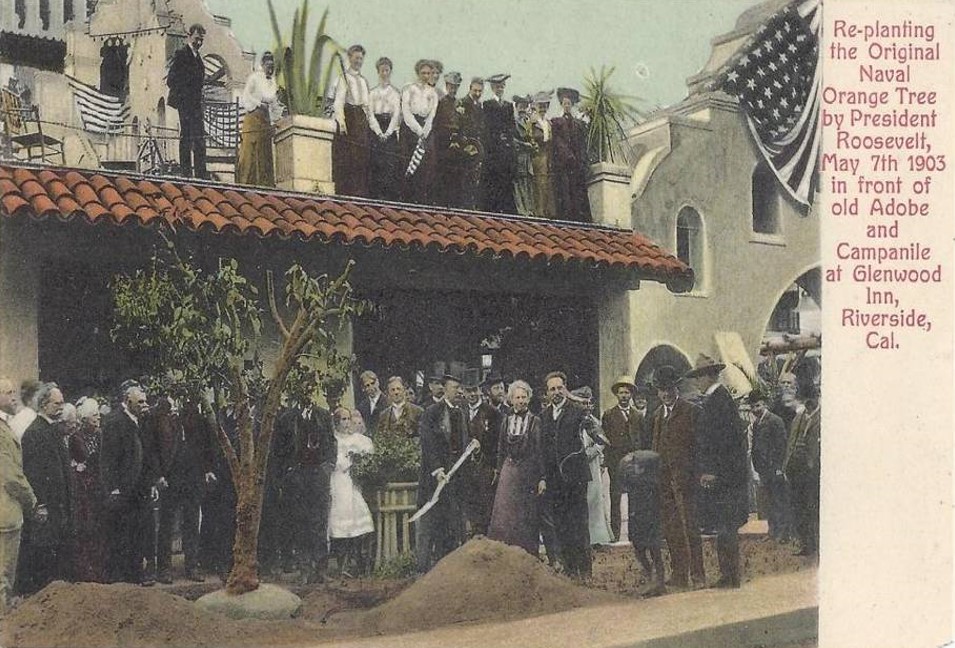
That must have been about here (the name of the hotel was changed to Mission Inn). Alas, the tree died after a couple of years. But it was there long enough to be used in marketing:
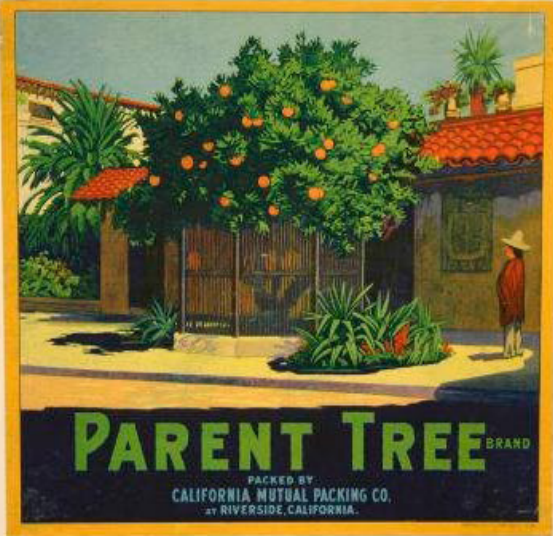
The other ‘parent tree’ was planted a couple of miles south of the Glennwood Inn, in Low Park. It is still there, see for yourself, about 145 years old, despite its dire state 50 years ago:
for some years past it has been declining in vigor, and in 1967 seemed unlikely to survive much longer.
The tree is a ‘California historical landmark’ and has this plaque in front of it:
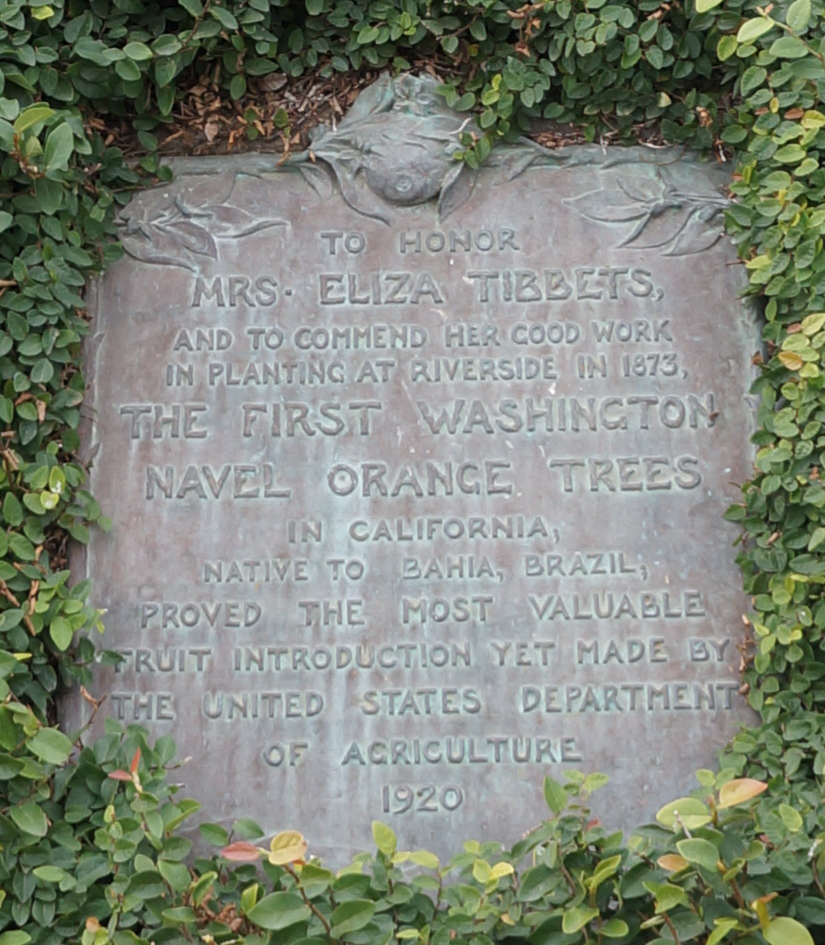
which states that, as of 1920, this was the
most valuable fruit introduction yet made by the USDA.
Was that a fair claim back then? And if so, is it still true? There is some economic analysis here and here.
Riverside does not boast only that tree, it also has the California Citrus State Historic Park. And after you visit that, drive east to the Coachella Valley to see the dates that were introduced a few decades later. 7
Nibbles: Canadian genebank, Indian women farmers, Coconut videos, Willow catalog, Crop models & CC, Next GR, Caviar of Cantaloupes, Wild Bactrian, Dog history, Top 100 development questions
- Video of the Canadian genebank.
- First video in series on Indian women farmers: Bowing to No One, by Sarah Khan.
- Whole bunch of coconut videos. See what I did there?
- Good news for cricketers: willow variety catalog out.
- The skinny of what crop models say about the effects of climate change. Spoiler alert: it ain’t good.
- The latest call for a new Green Revolution.
- Safe to say cantaloupes won’t feature much in that, which is a pity.
- Maybe some other weird plants will, though.
- Wild camels are pretty tough. And since we’re on the subject, what’s a heritage animal breed?
- Wait, they solved dog domestication?
- Top 100 development research questions for our SDG world, including ten on food security and agriculture.
Brainfood: Grazing, Dung beetles, Intensification, Pineapple diversity, Grassland N
- Behavioural Response of Pure Ankole and Crossbred (Ankole x Holstein) Cows to Seasonal Pasture Variations in Southwestern Uganda. The cross-bred cows have to eat for longer than the local breed, which makes for problems during both wet and dry seasons.
- Functionally rich dung beetle assemblages are required to provide multiple ecosystem services. It’s not just about the dung removal. No word on whether cross-bred dung tastier.
- Swiddens under transition: Consequences of agricultural intensification in the Amazon. Intensification without diversification is going to be a problem.
- Developing single nucleotide polymorphism markers for the identification of pineapple (Ananas comosus) germplasm. High redundancy in the USDA collection, and little correspondence between horticultural classifications and genotyping.
- Grassland biodiversity bounces back from long-term nitrogen addition. Pollution bad for grassland biodiversity, stopping pollution good for grassland biodiversity.