- Peak hops? Say it ain’t so.
- Day-long plant-breeding-for-the-masses course at Oxford in April.
- Botanists of the twenty-first century: Roles, challenges and opportunities. An e-book for the ages.
- Genes to beans: polyploidy on a plate. A Royal Society lecture by Kathy Willis.
- Some naughty people have been collecting plants in India without permits.
- IPBES tells it like it is on pollinators. In a press release. You try to find the actual report online. Oh and here’s FAO getting in on the act. Though at least for this the report is easy to find.
- Great interactive map of the work of the Rainforest Alliance. Check out the agriculture tab.
- Italian researchers build a time machine. A phytotron, really, but let them have their little fun.
- Speaking of fun, GCARD3 Youth Agripreneurs Projects on “Climate Resilient Indian Cattle” and “fake seeds.” Lots more too, all interesting.
Proposals wanted to host Harlan III International Symposium on Domestication, Evolution, and Uses of Biological Diversity
The International Committee is seeking proposals to host Harlan III and requests that interested groups consider the above factors in preparing a prospectus for the symposium, giving special attention to the potential financial requirements and sources of funding. For consideration for a symposium to be held in 2017, the prospectus should be received at UC Davis by April 15, 2016.
The Harlan Symposium is a very prestigious, not to say blog-worthy, event, and I’m sure people will be falling over themselves to host it.
Citrus is well-endowed
Givaudan, “a Swiss-based company that is the global leader in the creation of fragrances and flavors” has provided a $1 million endowment towards maintaining the Citrus Variety Collection at the University of California, Riverside. Both that collection and a famous tomato collection are owned and managed by the University of California, and affiliated with the USDA/ARS National Plant Germplasm System, which does not have the flexibility itself to explore unusual funding mechanisms. It’s not clear from the article in URC Today what the cool million buys exactly, but at least part of the proceeds must go on on the Givaudan Citrus Variety Collection Endowed Chair. And Tracy Kahn, curator of the collection, has just been appointed to it. But surely a $1 million endowment can’t cover all the costs of maintaining multiple trees of a thousand different citrus accessions? There must be other revenue streams. Interesting to speculate whether a similar model could cover the costs of a more global effort, such as is being proposed in a recent strategy document.
Nibbles: Canadian genebank, Indian women farmers, Coconut videos, Willow catalog, Crop models & CC, Next GR, Caviar of Cantaloupes, Wild Bactrian, Dog history, Top 100 development questions
- Video of the Canadian genebank.
- First video in series on Indian women farmers: Bowing to No One, by Sarah Khan.
- Whole bunch of coconut videos. See what I did there?
- Good news for cricketers: willow variety catalog out.
- The skinny of what crop models say about the effects of climate change. Spoiler alert: it ain’t good.
- The latest call for a new Green Revolution.
- Safe to say cantaloupes won’t feature much in that, which is a pity.
- Maybe some other weird plants will, though.
- Wild camels are pretty tough. And since we’re on the subject, what’s a heritage animal breed?
- Wait, they solved dog domestication?
- Top 100 development research questions for our SDG world, including ten on food security and agriculture.
Genebank questions in Parliament
So I spent yesterday afternoon in somewhat unusual surroundings, at least for me. I was in the House of Lords, of all places, helping to make the case for genebanks to a joint meeting of All-Party Parliamentary Group on Agriculture and Food for Development together with All-Party Parliamentary Group on Agroecology.
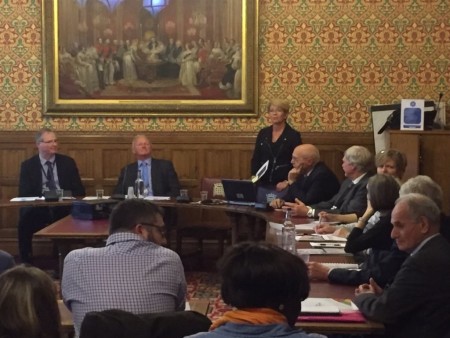
Sitting under the painting are the chairs, Ewen Cameron, Baron Cameron of Dillington and Jeremy Lefroy MP, who both seemed very receptive to the arguments. 1 It was actually a very knowledgeable and engaged audience all round, with astute questions on how genebanks can help farmers directly, on whether breeders are ever satisfied with the service they’re getting, and on the role of the private sector in ensuring the conservation of crop diversity, among others. Let’s see to what extent the interest, of which there is plenty at the highest level in the UK, translates into financial support for the cause of genebanks.