- Developing Chloroplast Genomic Resources from 25 Avena Species for the Characterization of Oat Wild Relative Germplasm. Not many people hurt.
- Genetic diversity among cultivated beets (Beta vulgaris) assessed via population-based whole genome sequences. Genetic groups follow crop type, but with added complexity.
- Phenotypic Parent Selection within a Khorasan Wheat Collection and Genetic Variation in Advanced Breeding Lines Derived by Hybridization with Durum Wheat. That would be Triticum turgidum subsp. turanicum (Jakubz.) Á. Löve & D. Löve. These Italian researchers like the cut of its jib.
- The Fate of Deleterious Variants in a Barley Genomic Prediction Population. Avoiding the cost of domestication.
- Reframing the sustainable seafood narrative. Sustainability is about more than just ocean health, and more than just producers.
- Maize agro-food systems to ensure food and nutrition security in reference to the Sustainable Development Goals. Focus on nutritional value.
- Net Gain: Seeking Better Outcomes for Local People when Mitigating Biodiversity Loss from Development. Participation is the key.
- Determinants of breeders’ participation to an indigenous cattle breeding program. Social, family and institutional relationships are as important as distance or production systems.
- A global-level assessment of the effectiveness of protected areas at resisting anthropogenic pressures. Not very effective on average, but somewhat more effective in rich countries, and in forests.
- A Return to the Wild: Root Exudates and Food Security. The next frontier?
- Exploring the Genetic Diversity of Wild Cranberry Populations in the Upper Midwestern United States. Still work to do on the old frontier.
- Evaluation and Identification of Promising Introgression Lines Derived From Wild Cajanus Species for Broadening the Genetic Base of Cultivated Pigeonpea [Cajanus cajan (L.) Millsp.]. Some made it into the all-India initial varietal trials, no less. Take that, root exudates!
Brainfood: Livestock cryo, Yeast evolution, PAs & CC, Genomes, Trifolium ambiguum, Earthworm map, Photosynthesis double, RCTs, Brown rice, DH maize, Breed performance maps
- Genetic Cryopreservation of Rare Breeds of Domesticated North American Livestock: Smithsonian & SVF Biodiversity Preservation Project. 106,109 “units of germplasm” from 39 breeds.
- Interspecific hybridization facilitates niche adaptation in beer yeast. Chimerization is not a word I thought I would ever see in a beer context. Anyway, thank goodness for feral yeasts and their propensity for miscegenation.
- Predicted climate shifts within terrestrial protected areas worldwide. PAs in temperate and northern high-latitude will have high area proportions of novel climate conditions by the end of the century.
- Crop Genomics Goes Beyond a Single Reference Genome. Looks like we’ll always need another genome.
- Morphometric approaches to promote the use of exotic germplasm for improved food security and resilience to climate change: A kura clover example. Fancy maths used to describe the hell out of a small collection of an underused clover.
- Global distribution of earthworm diversity. Peaks at higher latitudes, but higher overall in the tropics.
- Natural genetic variation in photosynthesis: an untapped resource to increase crop yield potential? Sounds like it.
- Increasing Photosynthesis: Unlikely Solution For World Food Problem. Ok, maybe not.
- What role should randomized control trials play in providing the evidence base for conservation? A bigger role that currently, but watch out.
- Brown Rice, a Diet Rich in Health Promoting Properties. Mill less.
- Loss of diversity and accumulation of genetic load in doubled-haploid lines from European maize landrace. DH not a panacea.
- Maize agro-food systems to ensure food and nutrition security in reference to the Sustainable Development Goals.
- Using phenotypic distribution models to predict livestock performance. Niche models + performance.
One-man root and tuber breeding show comes to town
Welcome to Cultivariable! My name is William Whitson and I breed plants. Cultivariable is my business, where I sell the plants that I breed and, miraculously, seem to be making a living at it. I breed plants for fun, because I am interested in discovering the possibilities. I’m not changing the world here. My discoveries are not going to feed the starving masses, save us from climate change, or expand the frontiers of science, but they might feed you if you grow them. This is mostly a one-man show, meaning that I do everything from weeding to stuffing envelopes alongside the actual breeding work.
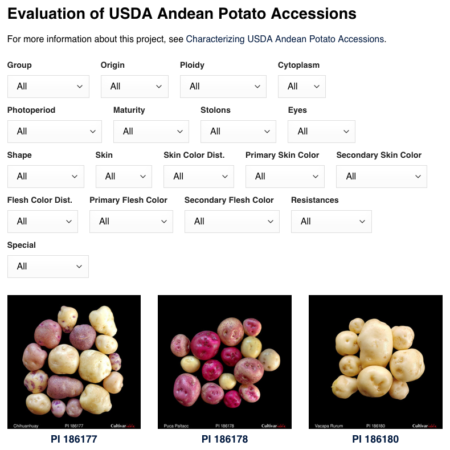
William also put together a pretty nice website, from which you can order his stuff. Particularly impressive is his single-minded determination of fully characterize the USDA potato collection. Well worth supporting.
Nibbles: Root & tuber breeding, Potato fun, Melon domestication, Maize conservation, Millet diversification, Business as usual
- A backyard breeder evaluates USDA’s potato accessions. Among other things.
- The Onion roasts potatoes.
- How melons got sweet.
- Mexican Senate considers in situ/on farm conservation areas for maize.
- Millets for climate change resilience in India.
- Business for biodiversity. Yeah, right.
Brainfood: Tree SDM, TR4 in Colombia, Genebanks double, Pacific ag, Gums, Defaunation, Oil palm, Agroforestry, Moldy cheese, Ecosystem services, Meat, Desert ag, Maize evolution
- Species distribution modelling to support forest management. A literature review. Embrace the uncertainty.
- First report of Fusarium wilt Tropical Race 4 in Cavendish bananas caused by Fusarium odoratissimum in Colombia. Inevitable.
- Seed Banking as Future Insurance Against Crop Collapses. “Although the basic technology of seed- (gene-)banking is relatively simple, there are nonetheless significant costs involved in effectively managing seed- (gene-)bank collections.” Elevator pitch desperately needed.
- Rapid loss of seed viability in ex situ conserved wheat and barley at 4°C as compared to −20°C storage. Colder the better.
- Origin and Development of Agriculture in New Guinea, Island Melanesia and Polynesia. Maybe 5-6 distinct stages since 7000 BP.
- Exotic eucalypts: From demonized trees to allies of tropical forest restoration? Maybe.
- Quantifying the impacts of defaunation on natural forest regeneration in a global meta-analysis. Forests need vertebrates. No word on where eucalypts stand.
- Market-mediated responses confound policies to limit deforestation from oil palm expansion in Malaysia and Indonesia. Bans are not enough…
- The ‘Capitalist Squeeze’ and the Rise and Fall of Sumatra’s Krui Agroforests. …you need active forest conservation too.
- Rapid Phenotypic and Metabolomic Domestication of Wild Penicillium Molds on Cheese. Wild molds adapt to cheese, can eventually make camembert.
- A global synthesis reveals biodiversity-mediated benefits for crop production. Need species richness for pollination, biological pest control and final yields.
- Animal source foods: Sustainability problem or malnutrition and sustainability solution? Perspective matters. Let them eat meat.
- The vitality of fruit trees in ancient Bedouin orchards in the Arid Negev Highlands (Israel): Implications of climatic change and environmental stability. Recycling centuries-old infrastructure in the desert.
- The Genomic Basis for Short-Term Evolution of Environmental Adaptation in Maize. Significant shift in adaptation of tropical landrace to temperate conditions in 10 generations with little loss of genetic diversity.