- Phylogeny and genetic structure in the genus Secale. The perennial species is different from the annuals, which are divided into an Asian and a non-Asia group and show all kinds of introgression.
- Consumers’ acceptance of a local landrace: the case of purple carrots. Sure, if produced locally.
- Saving the breeds: German Farmers’ preferences for Endangered Dairy Breed conservation programs. Sure, if they get paid.
- Analysing innovations among cattle smallholders to evaluate the adequacy of breeding programs. Intensification will need more than selection within the local breed. But it’s a start.
- Genetic diversity and population structure of the USDA sweetpotato (Ipomoea batatas) germplasm collection using GBSpoly. 4 clusters: Central American, North American, South American, and others.
- Updated review of potential medicinal genetic resources in the USDA, ARS, PGRCU industrial and legume crop germplasm collections. 22 species have potential.
- Apple (Malus spp.) Breeding: Present and Future. It’s bright, apparently.
- Strategies for Olive (Olea europaea L.) Breeding: Cultivated Genetic Resources and Crossbreeding. There’s an International Olive Council, and it has a Network of Germplasm Banks.
- Genetic flow among olive populations within the Mediterranean basin. Separate Syrian and Algerian genepools.
- Traditional farmers’ varieties: a valuable source of genetic variability for biofortification programs. Back to the future.
- SDG 2.5: How Policies Affecting Trade and Markets Can Help Maintain Genetic Diversity. It’s possible, but not automatic.
- Concept and protection of traditional knowledges in agricultural heritage system: a case study of Pu’er Traditional Tea Agrosystem. Based on 269 pieces of traditional knowledge, and in trouble.
- Mining alfalfa (Medicago sativa L.) nodules for salinity tolerant non-rhizobial bacteria to improve growth of alfalfa under salinity stress. They work even on their own.
- Frozen fungi: cryogenic storage is an effective method to store Fusarium cultures for the long‐term. I guess will also work on the above?
- DNA barcoding to promote social awareness and identity of neglected, underutilized plant species having valuable nutritional properties. Familiarity breeds contentment.
Conservation accreditation scheme for botanical gardens launched
BGCI Conservation Practitioner Accreditation recognises excellence in plant conservation policy, practice and education, and accredits botanic gardens carrying out plant conservation activities of local, national or global importance.
What’s in it for the potential recipient?
BGCI accreditation ensures that gardens adhere to international standards, results in tangible benefits for participating gardens – such as recognition, peer review, creating standards for excellence, and funding – and acts as a motivator for botanic garden leadership.
Compare and contrast with the quality management system being put in place by the international crop genebanks.
Saving trees
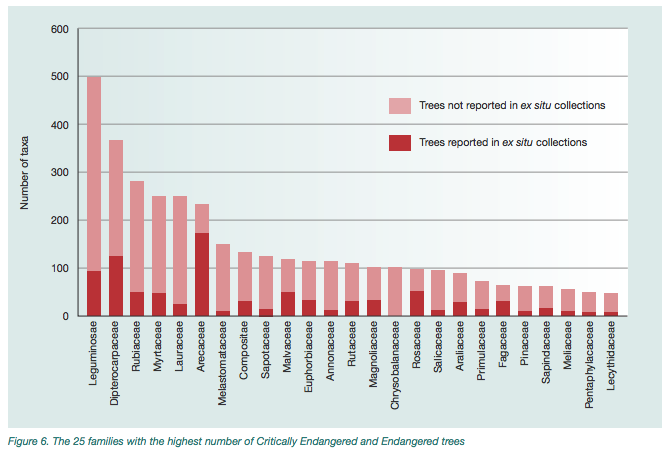
I’m not sure we have ever pointed to the Global Trees Campaign’s set of surveys of ex situ collections. There are individual surveys of ebony, Betulaceae, conifers, Zelkova, Rhododendron, maple, oak and Magnoliaceae, plus “Conserving the World’s Most Threatened Trees: A global survey of ex situ collections.” This came out in 2015 and includes a bunch of crop wild relatives.
Absolutely clear about ABS
Are you a germplasm user? Are you confused about which ABS arrangement applies to you? The International Seed Federation has got you covered, with its Genetic Resources Interactive Tree (GRIT).
Unfortunately, it will only take you so far:
Please note that the Genetic Resources Information Tree (GRIT) does not provide a turnkey solution, and each user will have to check the national legal requirements accessing a genetic resource in a given country.
But I guess it’s a start.
Incidentally, one of the possible sources of germplasm on GRIT is the CG Centres, and most of their distributions are done with the SMTA of the International Treaty. Most, but not all, as a new paper makes clear. ISF, please take note…
Nibbles: Carrot breeding, BIEN, Protected areas databases, Brazilian genebanks, Endangered coconut genebank, DSI, ABS, Climate pix, Botanical pix double, Potatoes galore, Pandanus language, Archaeological double, Palestinian seed saving
- Putting the polyacetylene back into carrots.
- The Botanical Information and Ecology Network gets an upgrade. Any CWRs among its 18,844,855 more observations?
- And any is protected areas? This will tell how well they’re managed. Mash up with this spatial database on indigenous lands?
- Otherwise, there are genebanks, though not enough in Brazil, apparently.
- And not always safe.
- What to do with Digital Sequence Information? Would be nice to be clear on what it is.
- ABS broken down by ISF. And the CGIAR. Not DSI though.
- Need climate visuals? Well, who doesn’t.
- The Columbian Exchange has visuals also.
- And the Royal Horticultural Society too.
- Speaking of Columbian Exchange: frites. And Vavilov, chefs, etc.
- Speaking about nuts in PNG. Comment by Jim Croft, who would know: “Except the species illustrated is the widespread oceanic strand species, Pandanus tectorius, not the endemic highland crop ‘karuka’, Pandanus julianettii.”
- 5000-year-old brewery in Egypt.
- 14,000-year-old bread.
- Fast forward 14,000 years.