Nice little video from CGN on collecting the wild relatives of asparagus and other vegetables.
Nibbles: CBD, NPGS, Greek celery, Rodomiro Ortiz interview, Amazonian fruits, In vitro, Maize archaeology, Asian seed companies, Victorian root
- Courtesy of Bioversity, useful summary of agricultural biodiversity events at the CBD COP, starting in a few days.
- The USDA National Plant Germplasm System, justified.
- The ancient symbolism of celery. Spoiler alert: death.
- A breeding professor calls for a major change in breeding. Spoiler alert: productivity is not enough.
- What’s the next açaí? And will it save the Amazon?
- Saving threatened species. Spoiler alert: seeds are not enough.
- 9000 years of maize history, decoded.
- The Access to Seeds Index 2019 report for South and Southeast Asia is out. Spoiler alert: I feel a guest post coming on.
- UK supermarket to stock salsify.
Brainfood: Emmer & drought, European legumes, Sainfoin, Alpine nomads, American domestication, Cereal domestication, Tree plantations, Garlic breeding, African veggies, African staple breeding, Sugarcane genome
- Genetic contribution of emmer wheat (Triticum dicoccon Schrank) to heat tolerance of bread wheat. It’s considerable.
- Warm Season Grain Legume Landraces from the South of Europe for Germplasm Conservation and Genetic Improvement. Ok ex situ, in situ not so much.
- Onobrychis viciifolia; a comprehensive literature review of its history, etymology, taxonomy, genetics, agronomy and botany. The fall and rise of an orphan forage.
- Interstitial but Resilient: Nomadic Shepherds in Piedmont (Northwest Italy) Amidst Spatial and Social Marginalization. Truly a vale of tears.
- Parallel vs. Convergent Evolution in Domestication and Diversification of Crops in the Americas. Still can’t tell which is more prevalent.
- Whole-Genome Analysis of Candidate genes Associated with Seed Size and Weight in Sorghum bicolor Reveals Signatures of Artificial Selection and Insights into Parallel Domestication in Cereal Crops. 63 seed size genes selected during domestication in sorghum, a significant number of which in maize and rice also.
- A systematic review of the socio-economic impacts of large-scale tree plantations, worldwide. Not a good idea.
- Recent Advances in Sexual Propagation and Breeding of Garlic. Restoration of flowering ability has done wonders for diversity. With diversity poster goodness.
- Core collection of two important indigenous vegetables; Gboma eggplant (Solanum macrocarpon L.) and Jute mallow (Corchorus olitorius L.) in Africa: An important step for exploitation of existing germplasm and development of improved cultivars. Interesting, of course, but I wouldn’t call these core collections. But I won’t complain again if it gets the stuff used more.
- Measuring the impact of plant breeding on sub-Saharan African staple crops. High ROI for the usual suspects. How about the traditional veggies et al., though. Anyway, do readers want more on this paper? Let me know in the comments if you want a full post on the main findings.
- Allele-defined genome of the autopolyploid sugarcane Saccharum spontaneum L. A lot of the good stuff is in wild-cultivated rearranged chromosomes.
Who feeds Africa?
I thought I’d share the summary poster from that GRAIN paper on African farmers’ seed systems that I just Nibbled.
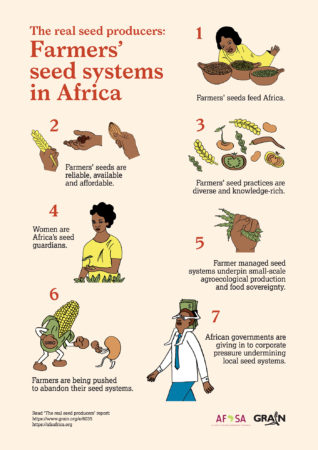
I may blog in more detail about this, but for now let me just say that even if you fully agree with all this it’s still possible to see a role for “formal sector” genebanks, as back-ups and facilitators of (especially long-distance) germplasm exchange. Why doesn’t the paper recognize this? Even if farmers’ seed systems do feed Africa, do they necessarily have to do it on their own?
NIbbles: Banana collecting, Perennial staples, Gender myths, Biodiversity on farm, Farmers’ seeds
- Collecting bananas in Bougainville.
- More about breeding perennial versions of staple crops.
- Surveys and statistics are not enough to better understand respective roles of women and men in food production and security.
- There are diverse farms in California too.
- GRAIN paper says farmers’ seed systems feed Africa. But surely all those community seed banks could do with support and back-up, not to mention new, additional diversity, from formal sector genebanks?