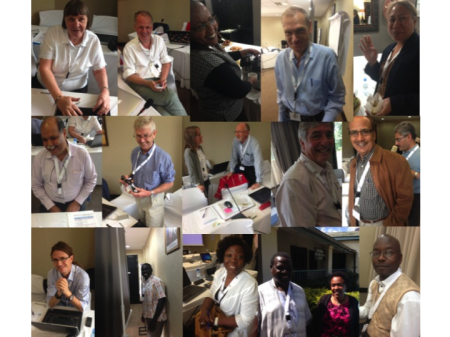
Cary Fowler receives William L. Brown Award

Congratulations to Cary Fowler for receiving the 7th William L. Brown Award for Excellence in Genetic Resource Conservation.

The William L. Brown Award recognizes the outstanding contributions of an individual in the field of genetic resource conservation and use. It is administered by the William L. Brown Center (WLBC) at the Missouri Botanical Garden and is made possible through a generous endowment from the Sehgal Family Foundation, in cooperation with the family of Dr. Brown.

Dr. Brown was a distinguished, internationally-recognized scientist, businessman, and humanitarian. Over the course of five decades, he devoted himself to the collection, preservation, understanding, and sharing of plant genetic resources in order to help meet the global demand for food. The William L. Brown Award recognizes an individual whose efforts and achievements reflect a concern for those issues that were so important to Dr. Brown.

Cary was presented with the award yesterday during his keynote lecture at the 9th BGCI International Congress on Education in Botanic Gardens, hosted by the Missouri Botanical Garden.

Richly deserved.

Setting genebank data free

There’s a strange little article on SciDevNet about the petition lodged with the UN by Norman Warthmann, of the Australian National University, and Claudio Chiarolla, of the Institute for Sustainable Development and International Relations in France, “to create a legal framework requiring governments to make data from the genetic sequencing of plants freely available.”

Strange for three reasons. One, why not make more of an explicit connection with DivSeek, which is trying to work through exactly these issues and was the subject of another article on the same website a few months ago?

Two, why link to a pdf of the text of the International Treaty on Plant Genetic Resources for Food and Agriculture, when said instrument has a perfectly nice website?

And three, somebody should really have checked this chart of germplasm transfers under the International Treaty, because most of the “countries” listed are not countries at all, but in fact the international centres housed by Mexico (CIMMYT), the Philippines (IRRI) etc.

Screen Shot 2015-04-28 at 5.15.02 PM

The international genebanks managed by the CGIAR Centres are by far the largest contributors to germplasm flows under the International Treaty, which is not something you’d be able to gather from this without a lot more background and context.

Asian PGR networks redux?

FAO says that “[r]epresentatives and scientists from 15 countries in Asia have agreed the establishment of a regional network to exchange information on conservation, preservation and utilization” of plant genetic resources for food and agriculture. Now, I like regional PGR networks, I really do. I even helped coordinate one for a few years. But this has been tried before in Asia. What will be different this time? Hard to say from the press release, but there’s a full report on the way, and we’ll blog about it when it’s out.

The rough value of genebanks

In 2012, The NPGS [the US National Plant Germplasm System] budget was approximately $47 million. Funding for the NPGS has been relatively stagnant over time. In real terms, agency funding peaked in 2003, at approximately $53 million in 2012 dollars (fig. 1). While direct comparisons between costs of a genebank and its benefits are not possible, 1 for context, we note that U.S. farmers paid $20.3 billion for seed in 2012 (USDA\National Agricultural Statistics Service, 2013). Thus, the costs of public ex situ plant conservation in the United States are a small fraction—under half of 1 percent—of the value of the eventual seed market. At the same time that budgets have decreased, demand for NPGS germplasm has reached historic highs (fig. 2).

Gotta love it when economists give up on quantitative data, and settle for qualitative comparisons.

When compared to the rather large benefits of genetic enhancement, the costs of genebank operation appear relatively small.

But do read the whole of USDA’s Using Crop Genetic Resources To Help Agriculture Adapt to Climate Change: Economics and Policy by Paul W. Heisey and Kelly Day Rubenstein. There is some data in there, and that perennial fall-back of economists, a model. The main findings, if you just want to just skip to the bottom line, were that genebanks are worth it, but that better data and some pre-breeding would help.