- Touring the world’s coffee processors.
- Liquorice next? Starting in the UK?
- India has 30% of the world’s cattle. Which you might not be able to guess from these very cool ILRI maps. Including one on chickens, in which the Nordic countries feature perhaps less than they should.
- The Global Nutrition Report will have these indicators at country level. Some stuff there on fruit and vegetable consumption, but why nothing specifically on dietary diversity? Anyway, if you’d like to make suggestions, you can.
- Wait, why is there nothing on alcohol consumption? And is diversity in alcohol-producing plants a good thing? I mean, nutrition-wise.
- Uhm, nothing on urban agriculture either. I bet you that’s an indicator of something or other, nutrition-wise.
- Maybe Amy Ickowitz of CIFOR will suggest some indicators. She has interesting data on forest cover and child nutrition.
- How to make cacao cultivation more sustainable.
- Andy Jarvis on how to scale up climate-smart agriculture without necessarily sacrificing goats. Nor, presumably, nutrition.
- Model says environment can support subsistence hunting and agriculture only up to a point, and no more. Still no cure for cancer. But did someone tell the Mapuche?
- Well, what do you know, genes come, and genes go.
Nibbles: Millet festival, Seed eBay, Fonio frenzy, Kenya mangoes, Barbed wire, Potato diversity, Peruvian cuisine, Feeding Haiti, Shea paradox, Prosopis review, Nigerian genebank, COGENT meeting, IRRI genebank, Big Data on diseases, Genomics at UBham
- There’s a millet festival in Chennai on 20 July. Any of our readers planning to go?
- “…the first ever, non-profit “eBay” of seed…” And you can contribute, if you like. With money, that is. I wonder if there will be a festival at some point.
- Fonio gets the Mail treatment (but no festival). Will it ever recover? Maybe this will help. For the record, it may have been the The Guardian that started this fonio frenzy. Anyway, here are the collections, if you think you’d like to contribute to the revolution. Like by organizing a festival. But why stop at fonio…
- Sometimes, however, exotic is better: like mango in Kenya. There’s plenty of mango festivals (and a new genebank too) in India, but not in Kenya, as far as I know.
- BBC radio programme on the history of barbed wire. Fascinating.
- Not to be outdone, DW on potato agrobiodiversity, including the CIP genebank. Wow, in Spanish too. Ah, but do any of them have high levels of B-9 vitamin? No? I know someone who can change that.
- More to Peruvian cuisine than potatoes, though. I feel a festival coming on.
- Food aid vs agriculture in Haiti. Nothing to celebrate there.
- Someone mention hard choices? Shea harvesting in Ghana presents a conundrum too.
- What can I tell you about Prosopis? Some are good, others not so much.
- I guess the same could be said for Solanums.
- Around the world in 20 food photos. No festivals? Well, I think Ramadan qualifies.
- “I have told you that NACGRAB would have been in a mess without the support of WAAPP.” Head of Nigerian genebank tells the world like it is.
- Coconut genebank managers tell each other like it is.
- Rice genebank makes an impression, visitor tells the world.
- I suppose we should have at least one Big Data thing, right? Make that two. But that’s all you get.
- Ok, then, one last one: diseases, genomics and, of course, football.
Brainfood: One Thai rice landrace, Adding value to coffee, Dairy cattle in Mexico, Sugarcane core, Bermudagrass salinity, Developing the Tibetan plateau, Amazon oil palm, Pollinator diversity
- Natural and human-mediated selection in a landrace of Thai rice (Oryza sativa). There is selection, but that’s counteracted by exchange and diverse agronomic practices. The result is diversity, but structured.
- Trademarks, Geographical Indications and Environmental Labelling to Promote Biodiversity: The Case of Agroforestry Coffee in India. Adding value locally is the only way to stop a really lucrative cash crop destroying the forest.
- Characterization of dairy cattle germplasm used in Mexico with national genetic evaluations in importing and exporting countries. Bringing in diversity from another country is not always the best approach.
- Phenotypic characterization of the Miami World Collection of sugarcane (Saccharum spp.) and related grasses for selecting a representative core. 300 accessions will do. That’s a bit more than 10% of the total.
- Genetic variation of salinity tolerance in Chinese natural bermudagrass (Cynodon dactylon (L.) Pers.) germplasm resources. There is some. Good for all those golf courses.
- The sustainable development of grassland-livestock systems on the Tibetan Plateau: problems, strategies and prospects. There are 19 things to do, and genetic resources are important across the board.
- Status and prospects of oil palm in the Brazilian Amazon. On already deforested land, for biofuel. What could possibly go wrong?
- Bee Species Diversity Enhances Productivity and Stability in a Perennial Crop. That would be the highbush blueberry (Vaccinium corymbosum). Can we take this for granted now?
Searching Genesys: The Video
Genesys is trialling an improved data filtering mechanism. Say you want to find Aegilops tauschii from Armenia with frost tolerance. Go to Browse and play around with the Filter button. If you have trouble, see if this little video helps you figure it out. The answer, by the way, is that there are 14 accessions that satisfy those requirements, all at ICARDA. Here’s where they are:
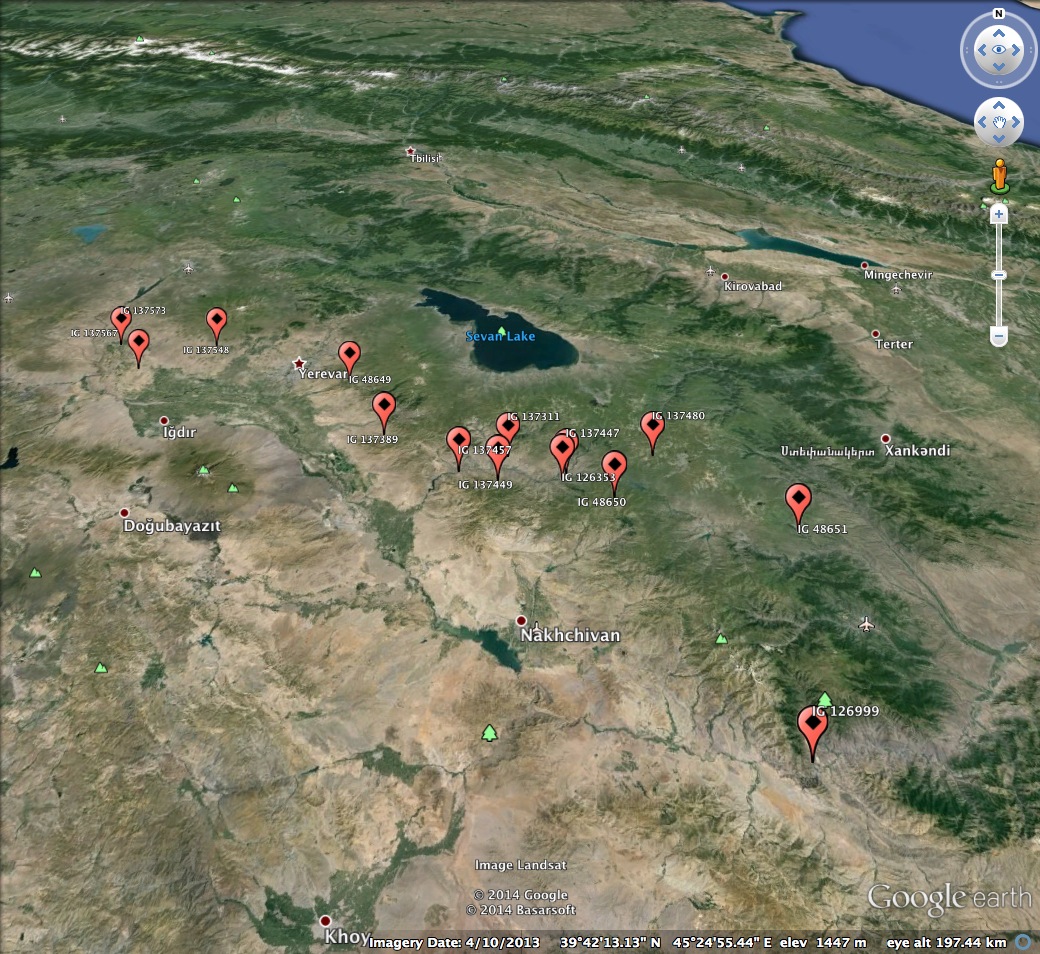
Did you get the same answer? Any suggestions for improvements?
Nibbles: Tree drought tolerance, Whisky history, Barley drought tolerance, Old veggies, Old potatoes, Llamas vs goats, Sustainable ag, Chinese herbaria
- Drought tolerance? It’s the carbs.
- Whisky 101.
- Coincidental mashup of the above. Barley used in whisky production provides clue to drought tolerance.
- Pre-hispanic veggies.
- Pre-hispanic carbs.
- Pre-hispanic livestock.
- Sustainable agriculture deconstructed.
- GBIF scores Chinese specimens.