- Nature has new Plants journal. With blog.
- More from the randomized trials backlash frontlines.
- World Bank sets up internal task force on climate smart agriculture. Oh good.
- No word on whether spiritual values on agenda.
- Hacking the school lunch.
- Indian flour mills winding down. Implications for crop diversity unknown.
- Big Australian writeup of CIMMYT genebank.
- Big CIP writeup of CIP genebank. And other collections, to be fair.
- It’s the regeneration, stupid.
- Gardens save plants.
- Sustainable diets defined to within an inch of their lives. Common factor is less animal products. But, as Susan McMillan of ILRI points out, for whom, and where?
- Traditional Maori use of weird fungus.
ICARDA seeds safe
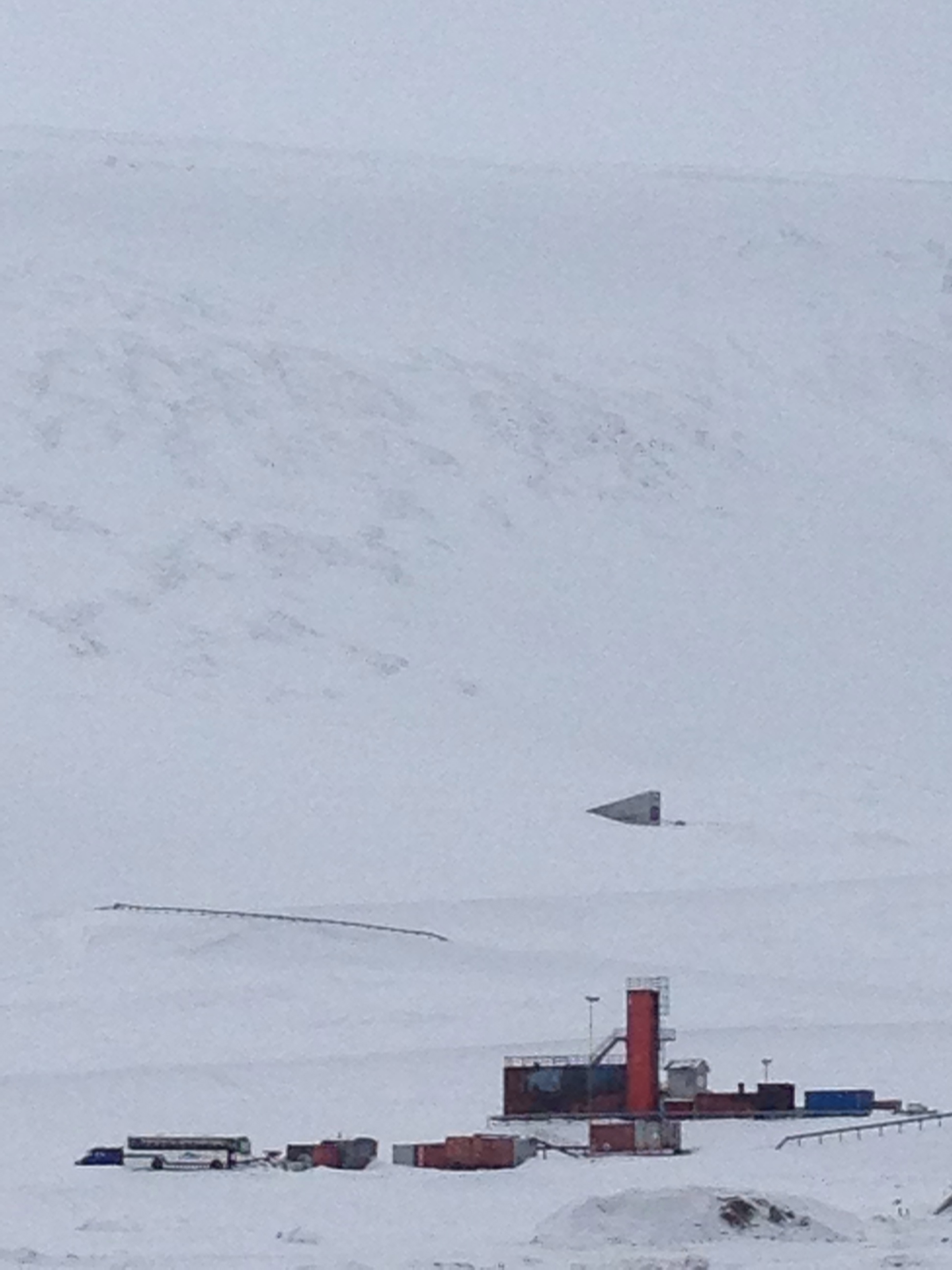 As we again hear about fighting in and around the headquarters of ICARDA near Aleppo, 1 it is at least some measure of consolation that a further consignment of seeds from the genebank has made it to Svalbard. Our thoughts are with the staff that remain, and that managed, in the face of incredible odds, to make this latest shipment.
Nibbles: Tomato colour, INBio demise, Specimens, Plant lore, Ancient chickens, Edible flowers, Urban veg, Trees & nutrition
- Deconstructing the colour of tomatoes. h/t @kctomato
- INBio folds? Or (h/t Jacob) government takes responsibility?
- Discussion on whether natural history specimens are necessary.
- So there’s a place where you can record your plant lore. No word on whether that’s linked to specimens.
- Yellow skin in chickens is a recent trait. Specimens involved. Part of that PNAS special feature on domestication.
- What have bees ever done for us?
- Edible flowers not just for pansies.
- Australia funds World Veg to research urban veg in Africa.
- Remember how we included in Brainfood a few months back a paper linking tree cover with dietary diversity and fruit/veg consumption in Africa? Well, here’s the PowerPoint.
Brainfood: Prunus africana diversity, Collecting Prunus, African extension, Nepal genebank, Greek plant eBay, Pepper diversity, Pest spread, Grassland diversity, Cowpea fermentation, Pea diversity, Banana cryo, Biodiversity trends
- Genetic structuring of remnant forest patches in an endangered medicinal tree in North-western Ethiopia. You need to conserve a range of patches of Prunus africana, and probably not just in situ. Would have been perfect for last week’s Brainfood on the complementarity of ex situ and in situ.
- Using simulations to optimize genetic diversity in Prunus avium seed harvests. And if you were to collect seeds for ex situ conservation, this is how you could do it, or at least figure out how best to do it.
- Exploring the Role of Agricultural Extension in Promoting Biodiversity Conservation in Kwazulu-Natal Province, South Africa. Don’t look to extension for help though.
- Ex situ plant conservation initiative in developing country: Nepal as a case study. Wonder if the material in the Himalayan Seed Bank was collected in that way. Or with the help of extensionists for that matter.
- The Electronic Trade in Greek Endemic Plants: Biodiversity, Commercial and Legal Aspects. Or indeed the 10% of the endemic Greek flora that’s traded online. Yeah I know this was in the special Easter Brainfood, but I couldn’t resist the narrative.
- New sources of resistance to Phytophthora capsici in Capsicum spp. For Korea, that is. But they came from all over. As ever.
- Hosting major international events leads to pest redistributions. Watch out Brazil!
- Pyrenean meadows in Natura 2000 network: grass production and plant biodiversity conservation. Forbs are unjustly maligned. Probably starts with that silly name.
- Chemical Changes during Open and Controlled Fermentation of Cowpea (Vigna unguiculata) Flour. Fermentation detoxifies and doesn’t affect nutritional content much. No word on whether it helps with all the farting. Evaluate that!
- Geographical Gradient of the eIF4E Alleles Conferring Resistance to Potyviruses in Pea (Pisum) Germplasm. Gargantuan study of 2,800 global accessions finds 4 resistance alleles, each with its own geographic structure. Much variation, but no resistance in the wild relatives. Bummer.
- Phenotypic and molecular studies for genetic stability assessment of cryopreserved banana meristems derived from field and in vitro explant sources. You can cryopreserve straight from field-grown sucker meristems, rather than having to go through tissue culture. Handy.
- Assemblage Time Series Reveal Biodiversity Change but Not Systematic Loss. Ecosystems are changing, but not yet becoming noticeably less diverse.
Nibbles: Mainstream MAS, ICRISAT breeding, History of hunger, Specialty crops, Biofortification, Collectivizing smallholders, Fake seeds, Good seeds, Maize diversity, Making palm oil, Space ag, Cacao and CC, Cassava and CC, Cherry phenology, CC adaptation, Flavour gene, Indian apples, GBIF data, EU force feeding petition, BRITE, Sir Hans Sloane, Silk Road, Banana realism
- Round-up of stuff that’s been accumulating over past few days because we were busy putting food on the table.
- Marker assisted selection of tomatoes makes it to Washington Post. When will African crops do the same?
- “The history of humanity is a history of hunger.” Maybe MAS of African crops will help.
- USDA money for minor crops. Including African crops?
- Nigerian minister of agriculture on biofortification. Of African crops.
- African smallholders need to get together. They have nothing to lose but their chains. And their fake seeds. Which is not a problem for their Central American brethren.
- Someone mention Central America? Listen to a talk on maize diversity therein. And at the other end of the region’s diversity spectrum: oil palm.
- NASA wants to grown stuff in space. Organically, of course. African smallholders nonplussed.
- In space, nobody can hear you riot over food prices.
- Saving cacao from climate change: The colloquium. We’ve had cassava. Cherries next?
- Hold everything: there’s a framework for this business of crop diversity and climate change.
- Deconstructing strawberry flavour. Apples next? Not sure Indian farmers will care much.
- GBIF wants you to tell them how your data should be licensed. And some background.
- You can lobby the EU on fois gras. If that’s your thing.
- If you’re in Vancouver on May 6, you can celebrate five years of the Biodiversity Research: Integrative Training and Education (BRITE) Internship Program.
- You can also intern at Globefish, which links global fish-trade information networks comprising 85 countries.
- Great Great Lives podcast on Sir Hans Sloane, whose connections with agricultural biodiversity are multiple.
- Something else whose connections with agrobiodiversity are many, though this could have been highlighted more in the article in question: the Silk Road.
- What’s the late Gabriel Garcia Marquez’s connection to crop diversity?