- Call for proposals on African pollinator informatics.
- The Linnean Society puts “Wheat Taxonomy: the legacy of John Percival” online. Heroes all.
- The Brazilian genetic resources congress gets a Facebook page.
- There’s also a bamboo and rattan congress coming up.
- A time capsule is dug up in Canada, and it’s got seeds!
- Seeking rice SNPs? Use snp-seek.
- What links the Dutch Easy India Company with a measles outbreak in the US? The answer will probably not surprise you.
- We really need some new wine grape cultivars. I mean REALLY new.
O Canadian genebank, we stand on guard for thee
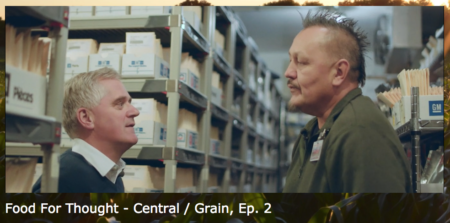
Art Napoleon is a Canadian “TV producer/songwriter/adventurer/wild game foodie…weekend shape-shifter & extreme berry picker,” which sounds like a pretty cool gig. You can watch him talk about Canadian agriculture, and the role the national genebanks plays in it, on the documentary Food for Thought. He visits the genebank about 16 minutes in, but watch the whole thing. In the screenshot below, one guy is Art, the other is the head of the genebank. I’ll leave you to guess which one is which.
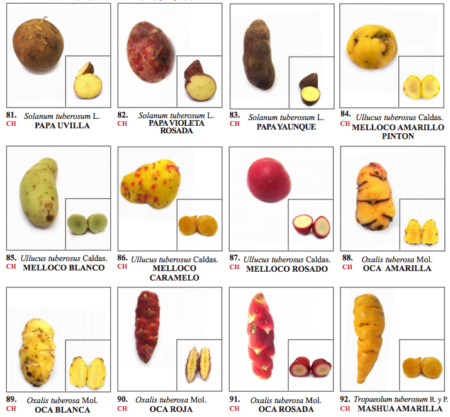
Illustrated guide to the landraces of Ecuador
The Field Museum’s 800-odd field guides cover a whole bunch of stuff, from the plants of the Araripe-Apodi National Park in Brazil to the bats of Mindanao. But I’m pretty sure there’s only one on landraces, and that covers Ecuador. It’s just out, and it includes photos of about a hundred traditional cereal, legume and root crop varieties.
Nibbles: Wild wheat & rice genomes, Lost American crops, Bread Lab, Tea symposium, Burping cows, Australian botanist, Ecuadorian landrace pics, Red listing, Fermentation PhD, Cheese rind microbes, HRH reception
- Goat grass genome to the rescue.
- No, some other weedy grass genomes to the rescue!
- Weeds could actually be lost crops.
- Clif Bar endows Bread Lab.
- Symposium on the future of tea. Mother-in-law alerted.
- You’ll need milk for that tea: breeding cattle for more production and less burping.
- Aunty Fran Bodkin: Australian botany hero.
- Field Museum field guide to Ecuadorian landraces. Of all things.
- Learn about red-listing.
- Study the microbial communities of cabbage leaves.
- Cheese rind has complex microbial communities too.
- So, anyways, this was fun.
Brainfood: Biodiversity trends, Banana viruses, Forest fragmentation, Apple cryo, NPGS, Brazilian goats, Turkish AnGR, Using agrobiodiversity, Genetic variation, Leaf rust loci, Leaf Doctor, Colombian cassava
- Is local biodiversity declining or not? A summary of the debate over analysis of species richness time trends. Better data needed.
- How endogenous plant pararetroviruses shed light on Musa evolution. Some banana plants have B genomes which are non-infective for potentially nasty viral integrants, making them good parents in breeding programmes.
- Late Holocene forest contraction and fragmentation in central Africa. From one horse’s mouth: “…this fragmentation 2500 years ago allowed the migration of the Bantu through the forests, who were able to exploit pioneering trees, such as energy rich oil palms which had colonized the gaps created, as well as being able to cultivate for the first times cereals in this newly created agricultural zone, notably pearl millet.”
- Cryobiotechnology of apple (Malus spp.): development, progress and future prospects. “…one of the most extensively studied plant genera with respect to cryopreservation.”
- Sustaining the Future of Plant Breeding: The Critical Role of the USDA-ARS National Plant Germplasm System. The next level: gap filling, more phenotyping and genotyping, better info systems, more pre-breeding, improved training for using PGR in breeding programs, expanded outreach. Could say the same about the rest of the world too.
- Role of Viral Diagnostics in Quarantine for Plant Genetic Resources and Preparedness. Calls for India to put in place a “National Plant Pests Diagnostic and Certification Network.” Maybe should be added to above.
- Threatened Goat Breeds from the Tropics: The Impact of Crossbreeding with Foreign Goats. You need to be careful with it, Brazilians say.
- Importance of native animal genetic resources. Turks too.
- Editorial: Harvesting plant and microbial biodiversity for sustainably enhanced food security. A whole Research Topic, no less. No animals though…
- Genotypic variability enhances the reproducibility of an ecological study. Because it buffers the effects of “environmental” differences in laboratory studies.
- Unlocking new alleles for leaf rust resistance in the Vavilov wheat collection. 13 new loci, maybe.
- Leaf Doctor: A New Portable Application for Quantifying Plant Disease Severity. Something to test the above with.
- Household Determinants of the Adoption of Improved Cassava Varieties using DNA Fingerprinting to Identify Varieties in Farmer Fields: A Case Study in Colombia. 434 samples from 217 farmers reveals 120 varieties, 9 of which were improved; farmers overestimate their use of new varieties, but in general those with more dependents, more land, and more access to extension have more improved varieties.