- Assessment of genetic diversity of sorghum [Sorghum bicolor (l.) Moench] germplasm in East and Central Africa. Each country is different.
- A Review of Living Collections with Special Emphasis on Sustainability and Its Impact on Research Across Multiple Disciplines. Crop genebanks are just the tip of the iceberg, but they all have the same problems.
- Why Oats Are Safe and Healthy for Celiac Disease Patients. Because of the avenins.
- 14,000-year-old seeds indicate the Levantine origin of the lost progenitor of faba bean. Eureka!
- Monitoring Changes in Genetic Diversity. Needs genetic data.
- An exploratory analysis on how geographic, socioeconomic, and environmental drivers affect the diversity of livestock breeds worldwide. More animals = more breeds.
- Cryopreservation and evaluations of vegetative growth, microtuber production and genetic stability in regenerants of purple-fleshed potato. Apparently the first time it was done for this colour of sweet potatoes.
- Sequencing of Australian wild rice genomes reveals ancestral relationships with domesticated rice. N. Australia is the centre of diversity of genome A.
- Genetic diversity and variability in Foxtail millet [Setaria italica (L.)] germplasm based on morphological traits. 51 Indian elites form non-geographic groups.
- The Bonsai as an alternative safety duplication system of the world cassava collection preserved at CIAT. So cool.
- Conservation of food tree species in Niger: towards a participatory approach in rural communities. Adansonia, Boscia and Maerua need watching.
Nibbles: Royal Soc discussion, Meyer Medal, Adopt-a-seed, Organic coffee, Seed book, CGIAR genebanks, Open source seeds, EUCARPIA conference, Vegetables, Geographic indications
- Prof. Brian Cox presents “Feeding the Future,” and it’s not entirely about GMOs. Worth sitting through the whole thing.
- Did we say that Cary Fowler recently received the Frank N. Meyer Medal for Plant Genetic Resources? This is what he had to say on a different recent occasion.
- Want to adopt a coffee seed? Kew will let you give a really cool Christmas gift.
- Or you could buy some Ethiopian coffee.
- Speaking of Christmas gifts…
- CIAT’s bean diversity collection gets its 15 minutes of fame. And ICARDA’s chickpea collection is not far behind.
- More on “open source seeds.”
- Mobilizing the green gold of plant genetic resources: maybe if they were open source…
- Not just green, though, right? Veggies come in all sorts of colours.
- Brexit may do for Wensleydale. I knew there must be a silver lining.
Indications of lack of progress on agrobiodiversity indicators
Over at the work blog, I’m busy jumping on the biodiversity mainstreaming bandwagon, but I wrote that piece before news came out this morning from the Convention on Biological Diversity meeting in Cancun of the disappointing lack of progress around the world in meeting the Aichi Targets.
You remember the Aichi Targets, don’t you? We’re supposed to be doing a lot of good things for biodiversity by 2020, including, in Target 13, for agro-biodiversity:
the genetic diversity of cultivated plants and farmed and domesticated animals and of wild relatives, including other socio-economically as well as culturally valuable species, is maintained, and strategies have been developed and implemented for minimizing genetic erosion and safeguarding their genetic diversity.
Here’s how we’re getting on, according to the just-published assessment. Spoiler alert: not very well. Green means “On track to meet or exceed the Aichi Target,” orange is “Progress to achieve the Aichi Target but at insufficient rate,” and red denotes “No progress, or a decline against the Aichi Target.” And remember that not all national targets are necessarily well aligned with the Aichi targets, for Target 13 75% being less ambitious or poorly aligned.
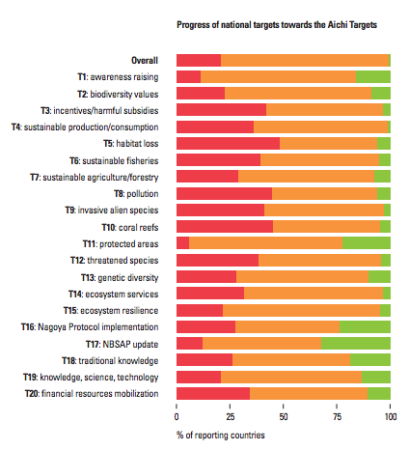
The assessment summarizes how countries say they’re doing. Or rather, how the CBD interprets how countries say they’re doing, in meeting the different targets:
101 parties submitted their National Biodiversity Strategy and Action Plans (NBSAPs) and 5th National Reports between 2011 and 2016. As of July 2016, 5th National Reports have been submitted by 90% of the Parties, and NBSAPs by 52%. These were collated, analysed and scored by the CBD Secretariat (SCBD).
Here’s the raw data, if you’re interested. How does Venezuela, say, know that it is “on track to achieve” Target 13? There are lots of possible indicators out there. The CBD itself suggested a couple early on in its “quick guide” to Target 13:
• Trends in genetic diversity of cultivated plants, and farmed and domesticated animals and their wild relatives
• Trends in genetic diversity of selected species
• Trends in number of effective policy mechanisms implemented to reduce genetic erosion and safeguard genetic diversity related to plant and animal genetic resources
And a little later, in 2016, in the 5th edition of the Global Biodiversity Outlook, National Reporting and Indicators for Assessing Progress towards the Aichi Biodiversity Targets (UNEP/CBD/SBSTTA/20/13), it came up with this little lot (click to read better):
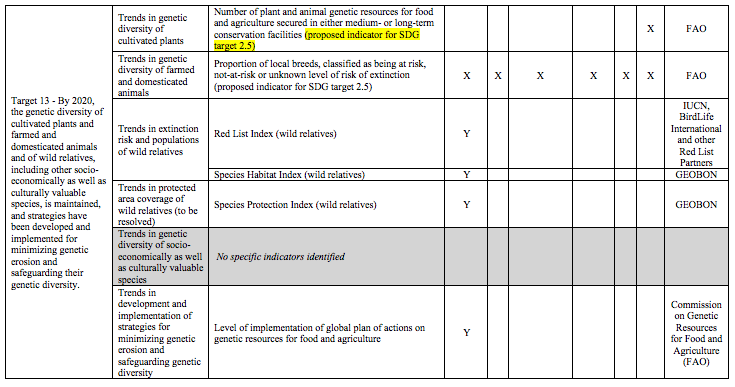
Note that a couple of indicators (number of accessions in genebanks, number of livestock breeds at risk) are also being proposed for SDG Target 2.5, which echoes the wording of Aichi 13. Note also that, as we blogged about yesterday, some progress is being made on the indicator on Red Listing crop wild relatives. And finally, the Commission on Genetic Resources for Food and Agriculture did come up with a very thorough assessment of global plans of action for plant genetic resources earlier this year.
But it’s not over, not by a long chalk. The Biodiversity Indicator Partnership seems to have ideas of its own (though it likes the breeds indicator)…
• Proportion of local breeds classified as being at risk, not-at-risk or at unknown level of risk of extinction
• Growth in species occurrence records accessible through GBIF
and it wants to hear from you if you’ve got better ones.
They may well hear from me eventually, because we’ve been thinking about this whole indicator thing at work too. Stay tuned… In the meantime, I don’t know which specific indicator(s) Venezuela (or any other country) used, I’m afraid. I’d have to look at its NBSAP, and maybe I will one day. Or more likely, get an intern to do it. But if we take the CBD assessment at face value, and it’s the best we have at the moment, we do have some work to do on Target 13. 2020 is not that far away. Lots more mainstreaming to do.
Red Listing crop wild relatives
It’s kind of buried in the IUCN press release, between giraffes and freshwater species, but there’s good news for researchers interested in crop wild relatives.
With this update, the first assessments of 233 wild relatives of crop plants such as barley, oats and sunflowers have been added to the IUCN Red List. Habitat loss, primarily due to agricultural expansion, is the major threat to many of these species. The assessments were completed as part of a partnership between Toyota Motor Corporation and IUCN, whose aim is to broaden the IUCN Red List to include the extinction risk of many species that are key food sources for a significant portion of the global population.
Crop wild relatives are a source of genetic material for new and existing crop species, allowing for increased disease and drought resistance, fertility, nutritional value and other desirable traits. Almost every species of plant that humans have domesticated and now cultivate has one or more crop wild relatives. However, these species have received little systematic conservation attention until now.
Four mango species have been listed as Endangered, and the Kalimantan mango (Mangifera casturi) has been listed as Extinct in the Wild. These species are relatives of the common mango (Mangifera indica) and are threatened by habitat loss. Native to South Asia, mangoes are now cultivated in many tropical and sub-tropical countries and they are one of the most commercially important fruits in these regions.
A relative of cultivated asparagus, hamatamabouki (Asparagus kiusianus), which is native to Japan, has been listed as Endangered due to habitat loss caused by urban expansion and agriculture. Loss of habitat is also the main threat to the Anomalus sunflower (Helianthus anomalus) which has been listed as Vulnerable and is a relative of the sunflower (H. annuus). Cicer bijugum, native to Iran and Turkey, is a wild relative of the chickpea (C. arietinum); it has been listed as Endangered due to habitat conversion to agriculture.
“Crop wild relative species are under increasing threat from urbanisation, habitat fragmentation and intensive farming, and probably climate change,” says Mr. Kevin Butt, General Manager, Regional Environmental Sustainability Director, Toyota Motor North America. “To conserve this vital gene pool for crop improvement we need to urgently improve our knowledge about these species. Toyota is pleased to provide support for the assessment of these and other species on The IUCN Red List.”
Unfortunately, there’s no way to search the Red List just for all crop wild relatives, but here’s the entry for Anomalous Sunflower for you, because I like the name.
Nibbles: Diversification, Street food, Forest genetic units, Citrus greening, COP22 roundup, Australian breeding, Temperate Orchard Society, Quinoa conference
- Diversifying crop production for the SDGs: the view from AVRDC.
- Local bread, in India and Istanbul.
- Foresters get all genetic.
- Winning the battle against citrus greening in Florida.
- Yeah, so what happened in Marrakech?
- Do chickpeas really have the nutritional value of cardboard?
- An apple genebank a day…
- Drawing the International Year of Quinoa to a decorous close.