- Lethal Yellowing doing for coconuts — and livelihoods — in Mozambique. And typhoons in the Philippines.
- Potted history of maize hybrids from 1998.
- Unusual rice and tomato species sequenced.
- The challenges of measuring the impact of nutrition interventions.
- Old interview with Michael Pollan on biodiversity and health resurfaces, maybe to coincide with the above.
- What will be the nutrition impact of replacing matooke with cassava, I wonder? Maybe if it was yellow cassava it would be ok?
- Maybe Shamba Shapeup will tell us.
- Well, there’s always wine. Even in Ethiopia.
- Or insects. Or roiboos. If you’re in South Africa.
- Chinese dumplings responsible for climate change.
- New Scoop.it page on downy mildews.
- And new Flipboard section on quinoa. And something to add to it.
- Eid Mubarak! Celebrate with mango kunafa.
- But which variety?
Nibbles: Pig genes, Eating pork, Mesoamerican crops, Apple family farming, Global food security, Wild food in Europe, Student crop videos, Important plants, Teff, Finger millet, Pacific NW grains, African veggies, Genius mangoes
- Asian genes in European pigs are a good thing.
- How about American pigs though?
- Great Spanish language cacao infographic. And more along the same lines.
- Innovative apple family farming in the Tyrol.
- Not sure that will be much use in terms of global food security, as per this recent review, but you never know. Because, you know, climate change?
- Well, there’s always wild food. Though in some places more than others.
- Student videos on the origin of food plants.
- But did any of them change their lives?
- Oxfam thinks teff can change lives.
- Different part of same continent, different grain to revitalize.
- Different continent, different grains to revitalize.
- Bah, who needs cereals when you have indigenous vegetables?
- Wait, what? Seedless mangoes? Why is this not first-page news?

Bambara groundnut goes online
A workshop on Bambara groundnut (Vigna subterranea L) was co-hosted by the Crop Research Institute of Ghana and the Crops for the Future Research Centre (CFFRC) last September in Accra. One of the recommendations was to re-establish an on-line forum for the crop. We’ve now heard from Sean Mayes of CFFRC that “(t)he first phase of this is now complete.”
The current material on the site is really illustrative and we would welcome contributions from far and wide. Please make sure that you own the copyright on anything you would like posted, but we would welcome anything from papers to Bambara groundnut researcher profiles, news, current research etc.
The aim of the site is to link together people working in similar areas so that the individual efforts on Bambara research can begin to add up to something greater. This will benefit everyone involved and help to provide hard scientific evidence of how Bambara can realistically contribute to food security and income generation. Integrating research from genomics through to socio-economic policy is a key aim for underutilised species which often suffer from a range of problems across the entire value chain, so we would welcome input and contribution from all disciplines.
The list of contacts we have is currently limited to those who have contacted us, so please feel free to forward the site address to colleagues and other you feel would be interested. If you would prefer to be removed from the list, please let Razlin know (Razlin (dot) Azman (at) cffresearch.org). If you could also send any contributions/questions/concerns to Razlin as she will be the main person responsible for updating and maintaining the site on a day-to-day basis.
Simply as a starting point, a number of international researchers have offered to act as a steering committee for the site to get things off the ground. However, we are hosting the site on behalf of the Bambara groundnut community, so would also welcome suggestions and offers to help develop the site as a focal point for Bambara groundnut research.
Feel free to use the comments here also to leave suggestions. We’ll make sure they reach their destination.
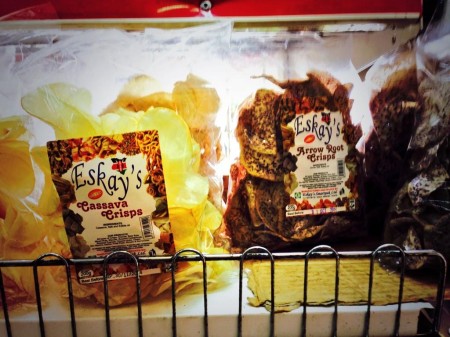
Incidentally, speaking of neglected crops, can’t resist posting this photo I took yesterday in a Nairobi supermarket.
Nibbles: Soil map, Dealing with pH, Egypt pix, Samoa taro & breadfruit, Fruit genomics, GM video, Twitter
- Need soil info? There’s an app for that!
- Like pH, for instance?
- Photographing Egypt’s farms.
- Frozen Samoan taro, anyone? Only the beginning…
- Also from Samoa, a landmark breadfruit deal.
- Alas, breadfruit is not one of the tree fruits included in the website Tree Fruit Genome Database Resources (tfGDR). Maybe they should get together with DivSeek? Or the guy growing 40 different fruits on one tree.
- Soybean genetic modification 101, with video goodness.
- While both Jeremy and I are otherwise engaged, blogging in general and Nibbling in particular might be a bit slow, but you can keep up with us on Twitter. If you dare.
Nibbles: BBC series, Pacific breadfruit & yams, Sustainable diets, Cuba atlas, MSB standards, Biofortification on radio, German food scandals, Mexican foods, Non-PC food, CWR interviews, Old Irish sources, ITPGRFA funding, Crop Trust presentations, ISHS, Neural crest and domestication, Wheat genome
- That BBC mega-doc on botany just started.
- PGR News from the Pacific: breadfruit and yams. My former colleagues keeping busy.
- How sustainable is your diet? Here comes the data.
- Cool historical atlas of Cuba has some agricultural stuff.
- The Millennium Seed Bank’s Seed Conservation Standards, final draft.
- Kojo Nnamdi Show on biofortification.
- German sausage and beer industries hit by scandal. What the hell will Luigi survive on?
- Maize beer, maybe. And amaranth.
- Thankfully neither of which have objectionable names.
- Nigel Maxted of University of Birmingham on crop wild relatives.
- His mate and mine Ehsan Dulloo of Bioversity, on the same thing.
- Ancient Irish apples, both wild and cultivated.
- Seed Treaty is short of funds, but they are working on it.
- The Crop Trust is on Slideshare!
- Banana symposium coming up in August.
- A theory of mammal domestication.
- First stab at the bread wheat genome. A tour de force.