Happy International Day for Biological Diversity

Once again, May 22 rolls around as an opportunity “to increase understanding and awareness of biodiversity issues,” as the Convention on Biological Diversity puts it. This year the focus is on marine biodiversity. So we’re going to look at rainforests. And agriculture.

The Copenhagen Consensus is an interesting attempt to have a bunch of economists (usually) work out where to find the best return on investments in development. The deal is that people write a paper examining interventions designed to tackle a development problem (nutrition, AIDS, clean water …) and a bunch of other experts decide which interventions make most economic sense, given a limited pot of money. The big list of “16 investments worthy of investment” came out a week ago, with better nutrition at No. 1. At No. 6 is “creating an increase in agricultural productivity through research and development,” one of three policy options offered in response to the challenge to reduce the loss of biodiversity.

Here is Copenhagen Consensus Capo Bjorn Lomborg’s summary of the value of that:

The authors estimate that with a $14.5 billion annual infusion into research we can achieve 20 percent higher annual growth rates for crops and 40 percent higher growth rates for livestock, which over the next 40 years will significantly reduce pressures on nature and hence help biodiversity.

The other favoured option to reduce biodiversity loss is to “prevent all dense forests from being converted to agriculture”. Preventing deforestation has a benefit:cost ratio of between 3 and 30, while the benefit:cost ratio for increased agricultural R&D is between 3 and 20. (A third option — “increasing the amount of protected areas globally to around 20 percent” — is barely worth trying because it seldom reaches break-even, with benefit:cost ratios of between 0.2 and 1.4)

There’s a lot one could (but won’t) say about the Conpenhagen Consensus approach and assumptions; it is odd that investing in agriculture is part of the solution to biodiversity loss, although it is not a big part of solutions to undernutrition. And the value of agricultural biodiversity specifically is nowhere to be seen.

Which will do as our contribution to increasing understanding and awareness of biodiversity issues.

Tracking down those sodium exclusion genes in wheat: Part 2

The story thus far: Our plucky heroes have traced Triticum monococcum C68-101, the wild parent of a tetraploid wheat (Line 149) with interesting salinity tolerance genes, to the University of Sydney. Maybe. Kinda. Sort of. But they keep digging, and their perseverance is not long in being rewarded. We hear again from Ray Hare.

You may remember that you asked me back in March to track down the source details of the T. monococcum used as the donor of the sodium exclusion genes Nax1 and 2. At last after some detective work I have a fairly good set of identifiers that match up.

The original seed, that was obtained by the University of Sydney, came as part of a collection of monococcums from Dr Ralph Riley of the Plant Breeding Institute, Cambridge. Prof. Eldrid Baker assembled this collection of Triticum species back in the 1960’s. C68-101 is an accession identifier in the University of Sydney Wheat register with the accession number NS 3637. It is also known as “Triticum aegilopoides – 3″. All of the entries in the University species collection have now been lodged with the Australian Winter Cereals Collection where this monococcum accession has the AUS number 98382.

I have not been able to trace the original collection location. It is likely to be Israel or a neighbouring country. PBI Cambridge had links with the Hebrew University. I have seen no shortage of all manner of Triticum species in Syria, Lebanon, Jordan and Israel.

I would be fairly confident that other monococcums have these Nax genes. We checked out two others from this set and each one showed Na exclusion activity. We simply had to select one accession to conduct our studies.

As I said before, the A genome diploids remain rather under researched. Who knows what may come from this ploidy level. It is quite possible that few diploids were involved in the original formation of the progenitor tetraploids and some of this A genome variation has been lost in the formation of the hexaploids. The total variation in the A genome in hexaploids is likely to be small when referenced back to that in the monococcums. I have seen good isozyme variation evidence that clearly supports this belief, in the order of a few orders of magnitude.

I am happy to be of additional assistance.

D Landreth not so important to seed diversity

Thanks to the very good offices of our friends at Seed Savers Exchange, I now have a copy of the most recent (6th) edition of the Garden Seed Inventory. I wanted this in order to see whether the loss of The D. Landreth Seed Company, America’s oldest, as it happens, while tragic for the business and its customers, would also be a great loss for agricultural biodiversity. Long answer short: not so much.

The Garden Seed Inventory is a catalogue of catalogues, listing all the varieties available from all the catalogues SSE can get its hands on. That makes it a very useful snapshot of what is out there (in the US), how widely available it is, and the ebbs and flows in comercially-available diversity of crops and varieties. The Introduction to the book contains lots of analysis of this type, and I thought I remembered that it listed all the varieties that are available only from a single supplier and each supplier’s “unique” varieties. It doesn’t.

It does, however, list the 27 companies (10% of the total number covered by the inventory) that list the most unique varieties. D. Landreth is not among them. It also lists the companies that had introduced the most “new unique varieties”. Perhaps unexpectedly, there’s quite an overlap with the “most uniques”. and D Landreth isn’t in that list either. All of which suggests to me that while the passing of D Landreth would indeed be sad for its owners and customers, it would not be an immediate disaster for commercially-available agricultural biodiversity in the United States.

Does D Landreth have any varieties not available elsewhere? That one is difficult to answer using the Inventory. More than 450 pages of closely spaced entries is a lot to look through, searching for those with a single source coded La1. It ought to be a doddle from the database that stores the original records, but I’m sure SSE has much else on its mind at the moment. Mind you, if 45 owners of the Inventory were to scan 10 pages each …

Nibbles: Esquinas-Alcázar, Legumes, Neolithic, FAO data, Fisheries, Fish pix, Another old goat, Kew campaign, Bees

  • Pepe gets a prize from a queen.
  • The Princess of the Pea gives no prizes, though.
  • Oldest farming village in a Mediterranean island found on Cyprus. No royalty, alas.
  • The Emperor of Agricultural Statistical Handbooks is out. Oh, and the online source of the raw data has just got some new clothes.
  • Fish are in trouble. Well, not all. Kingfish, queenfish, king mackerel and emperor angelfish all unavailable for comment.
  • No royalty connected with these beautiful pictures of Asian fish either. Does a former Dutch consul count?
  • Quite a crown on this wild goat.
  • The Royal (geddit?) Botanic Gardens Kew’s Breathing Planet Campaign: The Video.
  • ICIMOD on the role bees (including, presumably, their queens) in mountain agriculture.

Finding your way in the agricultural spatial data jungle

The recent announcement of a major rethink for the HarvestChoice website sent me on a voyage of discovery. Remember that HarvestChoice, “a partnership between IFPRI and the University of Minnesota, generates knowledge products that help guide strategic investments to improve the well-being of poor people in Sub-Saharan Africa through more productive and profitable farming.” That classically includes maps. And there are definitely a lot of spatial datasets on the site. And in Mappr there is a potentially useful online tool for combining different layers and summarizing the results. No doubt a valuable site.

But let me focus here on a separate issue, and that is whether the resources available globally to develop and present such data, in such sites, are being used, er, optimally. The question occurred to me when, in exploring the maps available at HarvestChoice, I came across a dataset labelled “Cattle population (head) (2005).” The source for the data is helpfully provided:

HarvestChoice/IFPRI 2010/FAO. 2007. Gridded livestock of the world 2007, by G.R.W. Wint and T.P. Robinson. Rome, pp 131.

The funding agency is given as the Bill and Melinda Gates Foundation, and data availability is described as follows:

Data available for download in CSV format. Spatial data layer may be explored using MAPPR and downloaded in geoTIFF and ASCII raster formats.

Now, the 2007 FAO publication referenced as the source of the data is downloadable as a pdf from FAO. But the data are also available in a variety of formats from the FAO Animal Production and Health Division website. Among the formats FAO (and only FAO) offers is a Google Earth file, which is probably going to be the most useful for the average user.

And then there’s ILRI. Map 4 in their monumental Mapping Poverty and Livestock in the Developing World of 2002 does not look too dissimilar to the above, though it may be based on older data. It’s a pdf, of course, but for all I know the data are also available in a more useable format somewhere on the ILRI website. I can’t be sure because their database of GIS datasets is just too clunky to spend any significant time struggling with, frankly. Which is not to say that I didn’t…

So what exactly has HarvestChoice added to the sum total of human happiness by making “Cattle population (head) (2005)” available on its website, above and beyond FAO’s contribution? I’m really hard put to say. The datasets are easier to use in Google Earth from FAO’s website than in any format provided by IFPRI, in my opinion. And the basic analyses available in Mappr will probably be useful to some, sure, but since sharing the map itself is tricky from there, you still have to got to FAO for that.

So the poor user probably has to navigate at least two separate and quite different websites to get all she needs. One wonders whether the donors behind all of these different efforts to provide data on cattle population numbers around the world (if indeed there were more than one, apart from the aforementioned Gates Foundation) considered that before green-lighting the projects. And, of course, that’s just cattle numbers. Life is just way too short for me to plough through all the other datasets at HarvestChoice looking for overlaps like these, but I’d be willing to bet this is not an isolated example. We know that crop distribution data is also out there in all sorts of different places, forms and formats. And, in fact, there’s some evidence of balkanization in other types of livestock data too. I’m not saying it’s hell out there for spatial data in agriculture, on a par with Genebank Database Hell. But it is definitely a bit of a jungle.

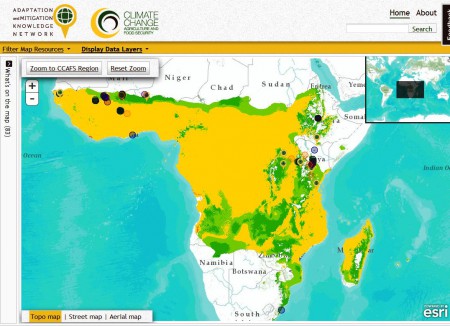
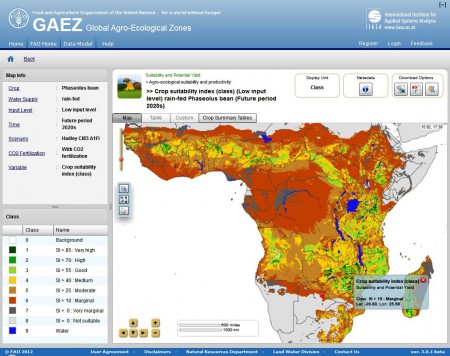
Does it matter? I don’t know. Maybe the users of these types of data really like having multiple websites to visit for downloading and visualization. Maybe the funds involved in developing all these different datasets and websites are minimal anyway. I’d really like to hear from the people involved at HarvestChoice, FAO and ILRI (are there other players?). But is there even a forum in which these guys meet to discuss data issues? Because if there were, and I by some miracle were to be invited to it, what I would say is that what I would prefer is a single place to go for cattle population numbers maps and the like (e.g. crop production data), with lots of options for exporting the raw data for use in my own GIS, the ability to import and combine my own datasets online, and some elegant ways of sharing the results. 1 That, for me, would be value for money. And I can’t believe I’m alone in that.