- Big grant for TC Dublin to create DNA matrix of ancient livestock, will identify parchments too.
- Kew unites Augustine Henry’s letters with the objects and specimens he collected; agrobiodiversity included.
How they make cheese
This Sunday, an estimated 58 percent of Americans will order pizza for Super Bowl parties around the country. To celebrate Game Day classics like pizza, cheese dips and nachos, we went to Wisconsin — the American dairyland that produces 35 percent of the country’s cheese — to find out the chemistry behind cheesemaking.
The “we” in this case is the American Chemical Society, and having been to the University of Wisconsin and sampled the delights of the Babcock Hall experimental ice-cream shop, I was anxious to see the ACS video. Alas, it is as dull as factory cheese. And in light of that “58% will order pizza” statistic, I wish instead the ACS — or the University of Wisconsin-Madison — had investigated the whole business of analog, imitation substitute cheese which, and I’m guessing here, probably feature prominently, and possibly exclusively, on 98.2% of the pizzas those 58% of Americans are going to order.
Mapping America
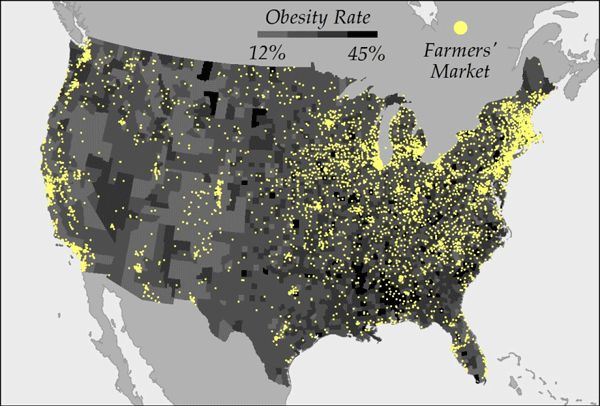
So there I was Scooping away, and what should turn up among the stuff I follow, and almost side by side on the screen to boot? Well, this map of obesity rates and farmer markets in the USA:
And, I kid you not, this map of food insecurity in, you guessed it, the USA.
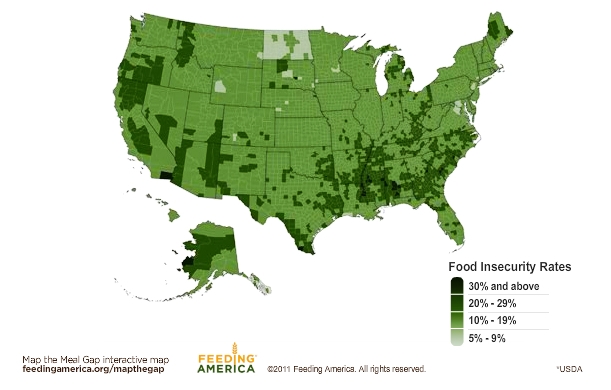
Eyeballing does suggest a certain association between obesity and food insecurity, doesn’t it? Talk about the double burden of malnutrition. Oh the fun one could have mixing and matching such maps, and the no doubt dozens of others that also exist out there, documenting the geographic distribution of McDonald’s, organic farms, drunkenness, gyms, pet ownership, house prices, fizzy drink consumption, weed busts…
How to react to emergencies
From early 2000, various agencies and individuals involved in livestock relief work began to question the quality and professionalism of their interventions.
Wow, thanks for sharing. Anyway, out of that crisis of self-esteem was LEGS born, the Livestock Emergency Guidelines and Standards. It’s not immediately clear to me after a brief browse of the website to what extent agrobiodiversity considerations come into these standards and guidelines, but I’ll explore some more and get back to you. Anyone out there aware of a similarly formalized initiative for seeds? It’s not as if guidelines for seed interventions are not needed. But they may be there already for all I know, embedded in the WFP and FAO seed relief playbooks.
LATER: And indeed they are. Good to know. Thanks to Tom Osborn from FAO.
Nibbles: Educashun, Landscapes, Botany, AnGR, Tourism, Ham museum, Native American seeds, Ancient Egyptian grain storage, Ancient beer
- Want to teach about agrobiodiversity? Help is at hand.
- Want to learn about agrobiodiversity? Stay here.
- Want to know what’s going on in biodiversity conservation at Cambridge? Here’s how. Tell us if agriculture gets a look-in. If it doesn’t, come back here. But I bet there’ll be something about landscapes.
- What is a landscape? “The answer … differs tremendously depending on the respondent,” it says here. Wow, those Cambridge boffins will be so shocked.
- Want to know about the plants in that landscape whose definition is so much in the hands of respondents? Most were discovered by just a few botanical superstars. But how many women?
- And if that landscape is Turkish and there are (is?) livestock in it, this is what you’ll see.
- Want to tour the world’s top evolution sites? Here’s the first stop. Now, how about crop evolution (and domestication, natch) sites. Like some livestock- and crop-wild-relative-discovered-by-a-botanical-superstar-filled Turkish landscape, perhaps.
- Or what about sites connected with food production and marketing more generally, for that matter. No, that list would be too long. Interesting, but too long. Would need to prioritize ruthlessly.
- One thing for certain, though, it should include a couple of community genebanks.
- Where it is not inconceivable that seeds would be protected following age-old practices. Which may or may not be taught in fancy courses.
- Oh, and beer.