- Ancient DNA from an Early Neolithic Iberian population supports a pioneer colonization by first farmers. People, not just crops, moved.
- Genetic consequences of using seed mixtures in restoration: A case study of a wetland plant Lychnis flos-cuculi. After a few generations of use for seed production, it’s best to abandon ex situ stocks and go back to the wild populations.
- Creative Commons licenses and the non-commercial condition: Implications for the re-use of biodiversity information. It’s complicated. I wonder if the multi-headed hounds who guard the gates to GBDBH are aware of this. Here’s a blog post.
- Is diversification history of maize influencing selection of soil bacteria by roots? Kinda.
- A horizon scan of global conservation issues for 2012. Perennial cereals make the cut.
- How pristine are tropical forests? An ecological perspective on the pre-Columbian human footprint in Amazonia and implications for contemporary conservation. It doesn’t matter.
- Genetic diversity of carrot (Daucus carota L.) cultivars revealed by analysis of SSR loci. Western and Asian groups, the latter more diverse, because of landraces. But 88 accessions does seem a bit few. And no wilds.
- Mapping of earthworm distribution for the British Isles and Eire highlights the under-recording of an ecologically important group. 28 species! But many gaps. No diversity map. Will send them DIVA-GIS for Christmas.
Nibbles: Statuary, Confusion, Unheard from, Kava
- A statue of Norman Borlaug. Artists invited to submit ideas.
- A diversity of Junior Ministers of Agriculture in Italy.
- Feeling left out of the EU’s survey on the state of its biodiversity work? Join Patrick and make your voice heard. But not necessarily listened too.
- Fiji cracks down on yaqona, which we know as kava. Say it isn’t so!
Nibbles: Plant conservation, AnGR training materials, ICTs in agriculture, CWR and GIS
- Don’t understand the Global Strategy for Plant Conservation? Fear not, help is at hand.
- Don’t understand livestock genetics? Fear not, help is at hand.
- Don’t understand how ICTs could assist agricultural development? Fear not, help is at hand.
- Don’t understand how climate change affects vegetable genetic resources. Fear not, do this postdoc at Wageningen and you will.
Ornamental banana pix
You may remember a little Brainfood item about the Brazilian collection of ornamental bananas. Ok, now thanks to ProMusa you can see some of these cool plants.
Getting to grips with hairy vetch
A post over at Biofortified entitled “Will cover crops feed the world?” asked an intriguing question:
Why not take a survey of red clover and hairy vetch germplasm, looking for those that fix nitrogen at high rates, have good winter survival, and decay at a reasonable rate to provide fertilizer for crops the following year, and then combine those traits? (And while you’re at it, you could try to do something about hairy vetch’s horrendous seed yield. Non-shattering trait, anyone?)
Well, I thought to myself, maybe you can find those traits already combined. So I looked on Genesys to see what germplasm of Vicia villosa, or hairy vetch, we have to play with. Quite a bit as it turns out: 1374 accessions from 60-odd countries, conserved in 30-odd genebanks. These are the accessions which have georeferences:
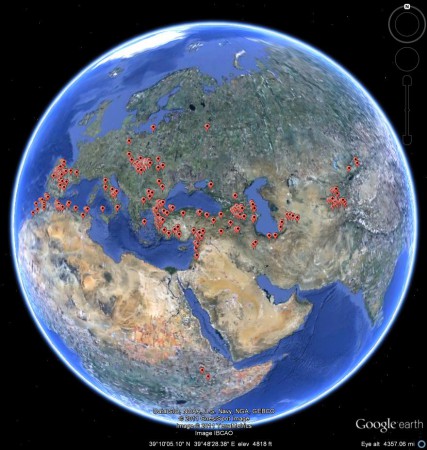
I looked in a little more detail at the USDA collection over at GRIN. As luck would have it, there are data on 40-odd accessions from a 2001 evaluation trial. Among the descriptors recorded are N content and winter survival. I downloaded the Excel spreadsheet, and some quick sorting revealed a couple of accessions which are both high in N and have decent winter survival, eg PI 232958 from Hungary and PI 220880 from Belgium. Another dataset shows that some accessions in the collection are non-shattering. Alas, neither of the previous two accessions were characterized for that trait, or at least I couldn’t find the data online, but I was intrigued to see that PI 220879, also from Belgium, is non-shattering.
I posted Biofortified’s question on Facebook too and Dirk Enneking came back almost immediately with more advice:
Provorov and Tikhonovich suggest that the recently domesticated species such as Vicia villosa are better at N-fix. For non-shattering, try the named cultivars such as Ostsaat etc. and grow them where there is sufficient humidity at harvest time to reduce shattering.
Now, where’s my finder’s fee?