- Bioinformatics for Dummies. Not that anyone I know needs it.
- Are there simpler ways to close the yield gaps in developing countries? Indeed, there are, but they’re not very sexy.
- And speaking of low-hanging fruit: How the apple took over the planet.
- Tuber diversity. Miss Hathorn is showing off the progeny of some true potato seed. And by true, I also mean truly potato.
- USDA ARS ♥ CGIAR ♥ USDA ARS
- And Trinidad & Tobago ♥ CFC, ICCO and Bioversity.
- Nigeria pins green revolution hopes on cassava. Is it ever a good idea to pin your hopes on just one thing?
- NERICA’s Striga problem deconstructed.
Nibbles: Coffee pix, Afghanistan pix, #GROW, #GORTA
- It’s been coffee week at Old Picture of the Day.
- More pictures. Afghanistan’s silk industry this time.
- It’s been #GROW Week too.
- Jess at Gorta. Follow #gorta for live updates.
New uses for meat and veg

Do play with your food. It could make you rich and famous, as it has English photographer Carl Warner. There’s a slideshow at La Repubblica, where the interview breathlessly gushes that “The Arcimbolo of the new millennium is sexy, speaks English, and uses his art to fight against obesity”. We’ve seen some edible landscapes before; I’m linking to these partly because Warner has used some very unusual species in his images. I’m sure you’ll be able to find them …
Nibbles: Mad treeman, Amazon ag, Conference, Nitrogen
- Profile of Yacouba Sawadogo: “people in his village thought he was mad”. A new metanarrative for our time.
- Pre-Columbian agriculture in the Amazon. Maize, not manioc, rules.
- Less than a week to go until the big CIALCA conference in Kigali, Uganda.
- Soil nitrogen from rocks? Really?
Solving broomcorn millet
 Broomcorn millet is a bit of a puzzle. You start to get archaeobotanical evidence for cultivated Panicum miliaceum in both China and Europe at about the same time before 7000 BP.
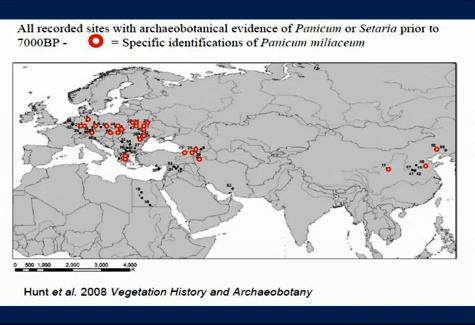
Independent domestication or transmission along the fabled Silk Road (like wheat)? And if the latter, in which direction? You can hear the conundrum set out in more eloquent terms by the eminent archaeologist Prof. Colin Renfrew in this talk from last March, from which I’ve nicked the figure. You can just go to about 20 minutes in. But do yourself a favour and watch the whole thing.
Anyway, Prof. Renfrew mentions that genetic work is underway on Panicum which promises eventually to clarify the situation. And here it is. And, alas, interesting as it is, it doesn’t, not much. The paper in Molecular Ecology by Harriet Hunt and others looks at new microsatellite data on 98 landraces from across Eurasia obtained from genebanks in Russia, the US and Japan, and from new fieldwork in Inner Mongolia. 1
The researchers find evidence for two largely distinct genetic clusters, or genepools, one centered on China and one in Europe. And indeed of sub-clusters within each genepool. But they can’t use any of these data, even when combined with the archaeobotanical data, to distinguish between the separate domestication and Silk Road hypotheses. 2
The archaeobotanical and genetic data thus currently present a set of signals that are not wholly consistent with either a single or multiple domestication centres for P. miliaceum. Analyses to determine the direction of migration were uninformative for our data set.
Bummer. Ah, but there is hope: the wild relative!
The genetic picture would be clarified by comparison of landrace genetic diversity with that of the wild ancestor of broomcorn millet. Analysis of microsatellite diversity in P. miliaceum subsp. ruderale could determine whether this subspecies is indeed the wild ancestor of the domesticated form, in which case the former would be expected to maintain a more diverse genepool, or a derived feral type, whose genetic diversity is a subset of domesticated P. miliaceum.
So what’s stopping them?
We did not include any samples of P. miliaceum subsp. ruderale in the current study: Although morphotypes fitting the description of this taxon are reported as being widespread across the Eurasian steppe (Zohary & Hopf 2000), detailed information or samples are not easy to find. For example, P. miliaceum subsp. ruderale is not listed on the http://www.agroatlas.ru website, and no specimens are identified as belonging to this taxon in the extensive herbarium collection of P. miliaceum at the Royal Botanic Gardens, Kew. Appropriate field collections of weedy forms of P. miliaceum for genetic comparison with cultivated types are needed, but the necessary fieldwork across vast areas of Eurasia, to give a sample set from which reliable conclusions could be drawn, would require a major international collaborative project. Our demonstration of strong phylogeographic patterning in cultivated P. miliaceum makes fieldwork and sampling of P. miliaceum subsp. ruderale a high priority for further investigation.
Well, I know what they mean, but it’s not quite as bad as that. There are in fact 10 accessions labelled P. miliaceum subsp. ruderale in Genesys, originating from 8 countries and conserved in 4 genebanks in Europe and the USA. 3 Not a great haul, but a “major international collaborative project” has to start somewhere.