Berry go Round part deux

Kate over at Beyond the Brambles put out an exuberant floristic Berry-go-round a few days ago. Her blog, her choices, although it did seem a little light on actual botany, to me. So once again I’m abusing a position of privilege to share some of the other submissions to July’s carnival. And if you would like to leave a submission for next month’s effort, hosted by Dave Coulter at Osage and Orange, well, just pop on over and fill in the submission form.

Speaking of Dave, he draws attention to a little known aspect of Detroit’s green renaissance. Sure, we’ve all heard about the urban ag and stuff, but he points to the birth of an amazing maze.

Mazes are stripes, and some plant leaves have stripes. On, then, to Part 2 of Joseph Tychonievich’s account of variegation at Greensparrow Gardens. I remember a great exhibit at Chelsea on variegation …

Greensparrows lead inexorably to rose gentians, of the square-stemmed sort. JSK has the lowdown on Sabatia angularis. And, for what they’re worth, Green Comet Milkweed (Asclepias viridiflora), thought to have been a victim of a nasty road accident, and Clasping Milkweed (Asclepias amplexicaulis). Herpetologists will recognize the specific epithet, but will they know what’s clasping what.

You want taxonomy? We’ve got taxonomy. And evolution. And links between the two. Joseph Craine at Wild Plants Post goes into the evolutionary history of the grasses and the forces that might have driven their adaptive radiation.

It’s all a question of niche exploitation. Or is it? Sarcozona goes all biblical on us as she attempts to untangle the knots surrounding invasive species. I’ve almost given up trying to control the ones that invade my terrace.

We’ve been a bit busy ourselves here at The Agricultural Biodiversity Weblog, hosting a guest post on the food that fed a thousand canoes and wondering whether Katherine of Aragon could possibly have been handing her pet a highly appropriate monkeynut (Arachis hypogaea)? The jury is still out.

And finally, a salute to the man without whom … Daniel does Gregor, and so did Google.

Have fun.

Old specimen is new melon crop wild relative

ResearchBlogging.org Taxonomy is not the most glamorous of subjects. Taxonomists who venture to suggest that well-loved Latin names might be changed to reflect new knowledge are roundly denounced. Prefer Latin names over “common” names and you are considered a bit of a dork. But taxonomy matters, becuse only if we know we use the same name for the same thing do we know that we are indeed talking about one thing and not two. And that can have important consequences, not least for plant breeding.

Mueller ferdinandA new paper takes a close look at some old herbarium specimens, originally collected in 1856 by Ferdinand von Mueller. 1 Mueller was born in Germany in 1825 and went to Australia in 1845, for his health. There, in addition to being a geographer and physician, he became a prominent botanist. He collected extensively, including a long expedition to northern Australia in 1855-6. There he collected many specimens that turned out to be new to science, including two new melons that he called Cucumis jucundus and C. picrocarpus. The two of them are preserved on this herbarium sheet at Kew.
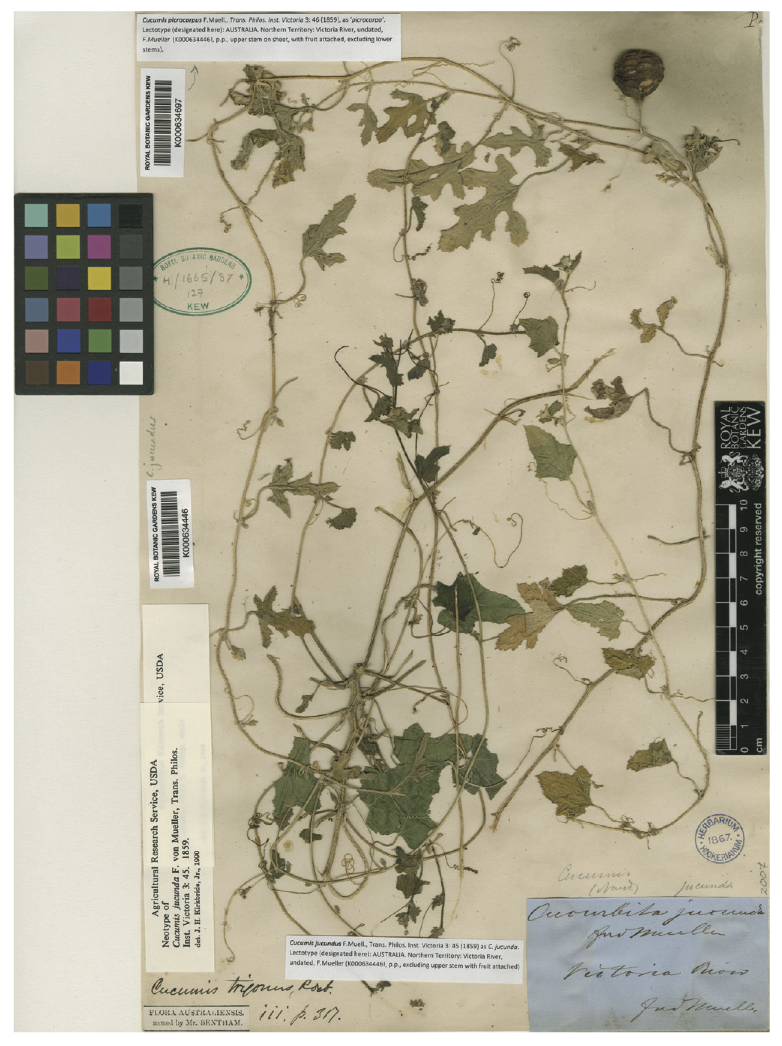
The Kew sheet K000634697 and K000634446 with the mixed collection of two species of Cucumis collected by Ferdinand von Mueller in Australia. The stem with the deeply lobed yellowish leaves and the attached fruit is the lectotype of Cucumis picrocarpus F. Muell., while the branch with the more green and much less lobed leaves is the lectotype of Cucumis jucundus F. Muell.

Fast forward 160 years or so, past a few older taxonomic revisions, and you get to one based on molecular analysis that splits the two previously recognized species of Cucumis in Asia, the Malesian region and Australia into 25 species. By this analysis Australia harbours seven species of Cucumis, five of them new to science. C. picrocarpus is one of the two previously recognized species, and the molecular analysis reveals that it is actually the closest wild relative of the cultivated melon, C. melo.

So what? Quite apart from the necessity to call things by their correct names, cultivated melons are besieged by many economically important pests and diseases. It seems likely that, as so often, resistance will come from a wild relative. Which means it is good to know exactly which plant is the closest wild relative. So what’s the status of C. picrocarpus in the wild? I have no idea, alas. I couldn’t find any entries in GBIF (possibly because they are all subsumed under C. melo) and with Luigi gone temporarily to ground I’m not sure where else to look. It seems a fair bet that it might need protection, although I’d be delighted to be wrong.

Brainfood: Genetic isolation and climate change, Not a Sicilian grape variety, Sicilian oregano, Good wine and climate, Italian landraces, Amazonian isolation, Judging livestock, Endosymbionts and CCD, Herbal barcodes, Finnish barley, Wild pigeonpea, Protected areas, Tree hybrids