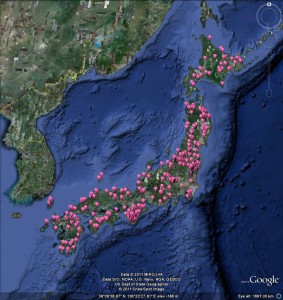
 While looking for something else, I happened across a paper describing the Japanese genebank’s new(ish) information system, NIASGBdb. I have some issues about the downloading options (e.g., there are annoying limits to the number of accessions), but it is nice to be able to search both characterization and evaluation data. I know you want to know, so I’ll tell you that the average culm height of accessions with very high resistance to sheath blight is 104cm, whereas that of those with very low resistance is 81cm. And no, I didn’t calculate any standard errors, or do any fancy multivariate statistics. But there’s nothing to stop you doing so.
Brainfood: Baby’s veggies, Chickpea and drought, Vine cactus breeding, Paleolithic rabbits, California protected areas, Wild pigeonpea, Pecorino classification, Milk composition, Phenotyping, Wild peas
- Vegetables by Stealth: an exploratory study investigating the introduction of vegetables in the weaning period. Sneaking them into the diet is the most common strategy used by mothers to introduce their kids to vegetables. Reeeeeally?
- Assessment of Iranian chickpea (Cicer arietinum L.) germplasms for drought tolerance. Four out of 150 local landraces showed promise. It really is a numbers game, isn’t it?
- In situ induction of chromosome doubling in vine cacti (Cactaceae). Potentially valuable autopolyploids were produced. Not that it was easy or anything.
- Who brought in the rabbits? Taphonomical analysis of Mousterian and Solutrean leporid accumulations from Gruta Do Caldeirão (Tomar, Portugal). People did, that’s who, but only during the later Upper Paleolithic. Before that it was mainly owls.
- Protected areas in climate space: What will the future bring? Nothing good. Both novel and disappearing climates are over-represented in current protected areas, at least in California.
- Progress in the utilization of Cajanus platycarpus (Benth.) Maesen in pigeonpea improvement. Baby steps.
- Classification of pecorino cheeses using electronic nose combined with artificial neural network and comparison with GC-MS analysis of volatile compounds. Wait, there are different kinds of pecorino?
- The need for country specific composition data on milk. Well, you’ve got me convinced.
- Rate-distortion tradeoff to optimize high-throughput phenotyping systems. Application to X-ray images of seeds. So, let me get this straight, basically, gauging the optimal trade-off between speed and accuracy in high-throughput phenotyping systems depends on what you’re measuring? Who writes these grant applications?
- Experimental growing of wild pea in Israel and its bearing on Near Eastern plant domestication. First pea growers were either very patient or very quick workers.
Nibbles: Tamil genebank, Econutrition, Sweet perception, Salmon, Texas culinary diversity, Amaranth, Nepal hermarium video, Restoration
- Provincial Indian university gets a genebank.
- Nutritionists go all ecological on us.
- But does that include taking into account human variation in taste perception? I’m betting no.
- The case against GM salmon.
- Going crazy in Austin’s market.
- Amaranth touted in Kenya. Sorghum and local millets unavailable for comment.
- Take a virtual trip around Nepal’s herbarium.
- Society for Ecological Restoration opens online Early Registration for the 4th World Conference on Ecological Restoration, to be held in August in Mérida, Mexico. You guys need a blogger?
NY Botanical Garden…er…garden in the news
The New York Botanical Garden is following its Edible Garden thing of a couple of years back with a Family Garden, aimed at schoolchildren. And it has made it to the network news. No information on whether the tykes are being brainwashed about heirlooms and sustainable agriculture. But I hope so.
LATER: And Michelle Obama gets in on the act too.
Nibbles: Whiskey fungus, Ecological imperialism, Value chains, Mexican blog, Mexican maize and gender
- Newly-named urban extremophile fungus survives on angels’ share.
- 1493. An oldie but goodie. And the book version is on its way.
- AVRDC lists the 6 principles of food value chain research.
- El cuexcomate, un nuevo blog en español, acerca de “agricultura, plantas útiles, etnobotánica, comida … desde México.” Bienvenido!
- Women more interested than men in better-tasting maize. Maybe El cuexcomate will comment.