- ILRI annual programme meeting thing gets Twitter treatment. Web 2.0 seizes up.
- Via EcoagriculturePartners newsletter, news that agroBiodiversity has a new website. Web 1.0 surrenders.
- And the prize for the weirdest name for a tree-planting initiative goes to…
- The water footprint of pasta is greater than that of pizza. Still no cure for cancer.
- Microbes good for soil. I see that, and I raise you termites. Take that, Dirt Diva.
- Fish farming in dryland Kenya. Must get out to see one of these next time I’m there, maybe set one up on mother-in-law’s farm. And get her one of these funky backpacks while I’m at it. Wouldn’t want her to laze about.
- Farmer Brown (sic) from Ghana talks about his grasscutters.
- Ever wonder how one cultivates truffles? Wonder no more.
- FAO librarian answers agroclimatological query. Lots of databases for you to explore is the result.
- And also from FAO, the latest on the state of the world’s forests. More databases no doubt involved.
- Damn, you mean diversity can be good for disease?
- Study says that to “be effective plant breeders, … should also be equipped with strong critical thinking and time management skills, and a well-founded work ethic.” Still no cure for cancer.
- Climate change to affect beer? Now it’s personal!
- Wonder how Ugandans feel about that? Guide to Ugandan Beer, Part 1.
- Pollinators do the Harlem Flutter.
Nibbles: Museums, Urban trees, Maya, Research, Sisal
- Better late than never, but tubes kinda dead today.
- CNN rounds up food museums.
- Extremely cool iPhone app maps NYC’s trees. And yet we still have genebank database hell.
- The Maya buried their history in their homes. Now, can the boffins find seeds, do their whole aDNA thing?
- French research boss explains What it will take to feed the world.
- The history of sisal in Tanzania.
An Atlas of Global Conservation goes (partially) online
The Nature Conservancy is publishing an Atlas of Global Conservation . 1 Some of the maps are online, though not the one below, which I got from a slideshow over at the Washington Post accompanying an article on the atlas.
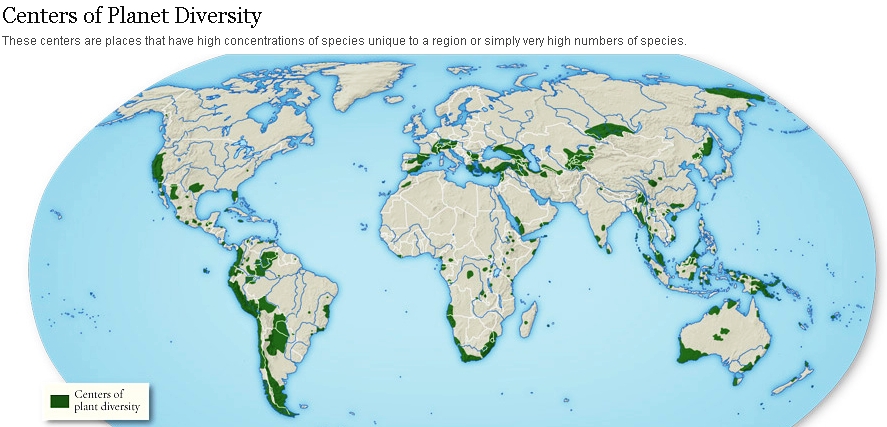
Why not, though? Surely, if someone is really going to buy the hardcopy version, they are not going to be put off by the fact that all the maps are on the internet. I left a comment to that effect on the Conservancy’s Facebook post announcing the atlas, and they very kindly got back to me saying that more maps will indeed eventually be made available online.
What’s that you say? Any agriculture? A map of centres of crop diversity to go with the above? The list of data sources is not encouraging. But I could be wrong. I’ll keep you posted.
Nibbles: Aubergines, Opuntia, Amazonian ag, Kenya, Swiflets, Coconut and Web 2.0, PROTA, Mexico, Fruit wild relatives
- More either-or stuff from the Guardian on the Indian GM brijal story.
- The USDA prickly pear cactus germplasm collection gets some exposure. And how many times can one say that.
- Much better title from Discover on that ancient northern Amazonian earthworks story.
- Kenyan foresters tell people to eat bamboo. Luigi’s mother-in-law politely demurs. On the other hand, she might like this.
- Swiflet farming? Swiflet farming.
- Really heated exchange on paper on coconut lethal yellowing in Yucatan develops on Google Groups. I love the internet.
- PROTA publishes expensive book on promising African plants. Promises, promises. NASA promised us the personal jetpack. Where are we with that?
- Nice summary of that Mesoamerican agricultural origins story we blogged briefly about a few days ago. So what exactly do you call hunter-gatherers who also grow crops?
- First International Symposium on Wild Relatives of Subtropical and Temperate Fruit and Nut Crops will be held March 19-23, 2011 in Davis, California on the campus of the University of California, Davis. Book early.
CGIAR Science Forum 2009 papers go online
Crop Science is publishing papers from the CGIAR Science Forum 2009. Lots of interesting stuff, including on biofortification and diet diversification, perennial favourites here of course. And all open access! Thanks, Jeff.