- Sensitivity of grain yields to historical climate variability in India. Other cereals are less sensitive than rice.
- Monitoring Changes in the Cultivation of Pigeonpea and Groundnut in Malawi Using Time Series Satellite Imagery for Sustainable Food Systems. Pigeonpea cultivation has expanded so much in response to Asian markets you can track it from space. But for how long?
- The relationship between forests and freshwater fish consumption in rural Nigeria. Fish need forests.
- Temporal patterns of seed quality development, decline, and timing of maximum quality during seed development and maturation. “…when maximum quality is first attained, and for how long it is maintained during seed development and maturation, varies with genotype and environment.” Oh, great.
- Modeling Crop Genetic Resources Phenotyping Information Systems. Managing meta-data on characterization and evaluation data.
- In vivo human-like robotic phenotyping of leaf traits in maize and sorghum in greenhouse. Yes, characterization and evaluation data like this.
- Ten quick tips for effective dimensionality reduction. How to analyze all that C&E data.
- Mutation of a bHLH transcription factor allowed almond domestication. A point mutation is all it took.
- Chilling accumulation in fruit trees in Spain under climate change. Some fruit trees, even in generally warm places, need a certain amount of cold to develop properly, and might not get it in the future. Maybe a point mutation will come to the rescue.
- Smart forage selection could significantly improve soil health in the tropics. Could.
- Evaluation of linkage disequilibrium, population structure, and genetic diversity in the U.S. peanut mini core collection. Can’t really use for GWAS. What a tragedy.
- Implications of climate change to the design of protected areas: The case study of small islands (Azores). The current PA system will still be ok on one island, but not on another. Has someone done this globally?
- Urbanisation, dietary change and traditional food practices in Indonesia: A longitudinal analysis. Westernization of diets is limited to Jakarta.
- Orphan crops: their importance and the urgency of improvement. They seem to be doing ok in Indonesia?
- Reconstructing Asian faunal introductions to eastern Africa from multi-proxy biomolecular and archaeological datasets. Chickens and black rats went from Asia to the coast of E Africa in the mid-first millennium CE.
- Archaeological and biometric perspectives on the development of chicken landraces in the Horn of Africa. Or maybe earlier for chicken after all.
Brainfood: Molecular characterization, Ancient weed, Patagonian berries, Strawberry origins controversy, Potato & nutrition, European potatoes, Extension, Cacao, Maize & wheat breeding history, Rural employment, Production stability, Amazonian Neolithic, Fairtrade wages
- Genebank genomics bridges the gap between the conservation of crop diversity and plant breeding. What do we want? An accurate genotype-to-phenotype map for all seeds stored in the genebank. When do we want it? As soon as we have the money to ensure their conservation.
- The origins of cannabis smoking: Chemical residue evidence from the first millennium BCE in the Pamirs. Well, that’s like your opinion, man. Residues in incense burners used for mortuary rituals, if you must know.
- Patagonian berries as native food and medicine. Good, and good for you.
- Revisiting the Origin of the Octoploid Strawberry. Not 4 separate diploid progenitors, as another paper recently found, but rather 2 extant ones, once you re-do the math.
- The Nutritional Contribution of Potato Varietal Diversity in Andean Food Systems: a Case Study. It’s great, but it’s not enough.
- The origins and adaptation of European potatoes reconstructed from historical genomes. Sequencing of old herbarium specimens, including Darwin’s, shows that early introductions to Europe were from the Andes, and later admixed there with Chilean and wild material, forming a sort of secondary centre of diversity.
- Effect of Intensive Agriculture-Nutrition Education and Extension Program Adoption and Diffusion of Biofortified Crops. Breeding is not enough.
- Morphological characterisation and evaluation of cacao (Theobroma cacao L.) in Trinidad to facilitate utilisation of Trinitario cacao globally. Now we know which ones are the best, for different reasons.
- Evolution of US maize (Zea mays L.) root architectural and anatomical phenes over the past 100 years corresponds to increased tolerance of nitrogen stress. There has been unconscious selection for root traits resulting in better N use efficiency. An old paper, resurrected because of the next one.
- Breeding improves wheat productivity under contrasting agrochemical input levels. Breeding wheat in Europe for good performance under high input levels has not markedly affected its performance under more challenging conditions. Diversity has held up too.
- Positive outcomes between crop diversity and agricultural employment worldwide. Irrespective of input levels and economic growth rates.
- National food production stabilized by crop diversity. Crop diversity is not just good for rural employment (see above), but for year-on-year production stability too.
- Climate change and cultural resilience in late pre-Columbian Amazonia. And it was sort of the same in ancient Amazonia.
- Effects of Fairtrade on the livelihoods of poor rural workers. Fairtrade improves wages of workers in cooperatives, but not on small farms.
CGIAR gets its data together
GARDIAN, the Global Agricultural Research Data Innovation & Acceleration Network, is the CGIAR flagship data harvester. GARDIAN enables the discovery of publications and datasets from the thirty-odd institutional publications and data repositories across all CGIAR Centers to enable value addition and innovation via data reuse.
Among the goodies that GARDIAN harvests are two geo-referenced datasets: genebank accession localities from Genesys and 2005 crop production, harvested area and yield. I’ve often advocated here for the mashing up of these datasets. Here, for example, is irrigated harvested area (grey-black) and genebanks accessions (dark green) for rice in part of Asia.
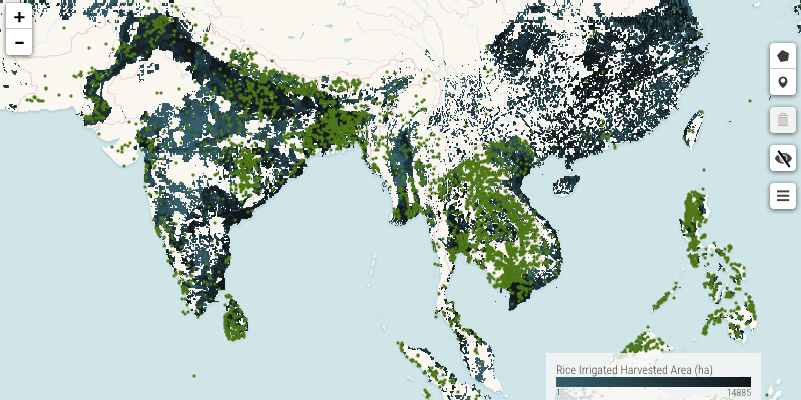
The colour scheme needs work, I guess, but it’s a start.
There are also about 250 documents featuring the word “genebank” for you to explore.
GARDIAN is a product of the CGIAR Platform for Big Data in Agriculture.
Brainfood: Macadamia domestication, Middle Eastern wheat, ART virus, Open science, Red Queen, Food system change, Chinese Neolithic booze, Dough rings, Making maps, Biofortification, Endophytes, African maize, Switchgrass diversity, Ancestral legume
- Wild Origins of Macadamia Domestication Identified Through Intraspecific Chloroplast Genome Sequencing. One tree is the basis of the industry.
- The Israeli Palestinian wheat landraces collection: restoration and characterization of lost genetic diversity. Bringing it all back home.
- Using high‐throughput sequencing in support of a plant health outbreak reveals novel viruses in Ullucus tuberosus (Basellaceae). There’s always something…
- Plant health emergencies demand open science: Tackling a cereal killer on the run. …but openness will get us through it.
- Rapid evolution in plant–microbe interactions – a molecular genomics perspective. Until the next one.
- Understanding food systems drivers: A critical review of the literature. Spoiler alert: urbanization, raise in consumer income, population growth, attention paid to diet & health issues, technological innovations, intensification and homogenization of the agricultural sector, increase in frequency and intensity of extreme events, general degradation in soils and agro-ecological conditions, improved access to infrastructure and information, trade policies and other processes influencing trade expansion, internationalization of private investments, concerns for food safety. I guess diversity is in there somewhere.
- The origins of specialized pottery and diverse alcohol fermentation techniques in Early Neolithic China. So good, they invented fermentation twice.
- The Hoard of the Rings. “Odd” annular bread-like objects as a case study for cereal-product diversity at the Late Bronze Age hillfort site of Stillfried (Lower Austria). Unbaked, tarallini-like dried wheat/barley dough rings may have been used ritualistically. No, not like that.
- EviAtlas: a tool for visualising evidence synthesis databases. Everybody likes a map.
- Editorial: Improving the Nutritional Content and Quality of Crops: Promises, Achievements, and Future Challenges. A review of reviews of biofortification, and more.
- Fungal endophyte diversity from tropical forage grass Brachiaria. 38 fungi isolated from 9 Brachiaria species, but unclear if any are beneficial.
- Characteristics of maize cultivars in Africa: How modern are they and how many do smallholder farmers grow? Out of 500 samples in 13 countries, about half were in some way improved, covering about half of the surveyed planted area.
- QTL × environment interactions underlie adaptive divergence in switchgrass across a large latitudinal gradient. You can combine alleles which are locally advantageous in different places to get a
super-biofuel. - Reconstruction of ancestral genome reveals chromosome evolution history for selected legume species. The wild ancestor of peanut, pigeonpea, soybean, beans, mungbean, chickpea, lotus and medics was closest to wild peanuts. Maybe they can synthesize it?
Europeans working on European crop working groups
The European crop conservation network — ECPGR — has a couple of new crop working groups, on maize and on berries. All the working groups have very informative pages on the ECPGR website, including details of all members and a mailing list, a link to relevant germplasm, and meeting and project reports. Worth exploring, if you’re interested in those crops. Start with berries.
A reminder that you can explore data from the European genebank network on the Eurisco website, and also mashed up with genebanks from other parts of the world on Genesys. As an example, here’s the Eurisco Ribes data on Genesys. Unclick the “EURISCO” tab to see what’s available in genebanks outside Europe.
LATER: Oh, and by the way, European genebanks have also started to review each other. The CGIAR genebanks have also all been reviewed by external experts in the past few years.