- Ex Situ Conservation of Potato [Solanum Section Petota (Solanaceae)] Genetic Resources in Genebanks. The only review of the subject you’ll need. Until the next one.
- Editorial Essay: An update on progress towards Aichi Biodiversity Target 11. Not bad, but the difficult stuff remains difficult. One of several interesting papers.
- The History of Farm Foxes Undermines the Animal Domestication Syndrome. Those Russian foxes were already pretty tame. Here’s a Twitter tread from one of the authors that lays it all out.
- Developing fruit tree portfolios that link agriculture more effectively with nutrition and health: a new approach for providing year-round micronutrients to smallholder farmers. 11 species can address micronutrient gaps.
- Plant Polyploidy: Origin, Evolution, and Its Influence on Crop Domestication. Extreme events and disasters drive polyploidy, which drives diversification at various levels, which facilitates domestication.
- Spectral Reflectance Indices and Physiological Parameters in Quinoa under Contrasting Irrigation Regimes. Phenotyping for drought tolerance from space.
- Asian Crop Dispersal in Africa and Late Holocene Human Adaptation to Tropical Environments. Via NE Africa always something new.
- Invited review: Intergovernmental Panel on Climate Change, agriculture, and food — A case of shifting cultivation and history. The IPCC could have done a better job of synthesizing the data on the impact of climate change on crops and livestock.
- Seed comparative genomics in three coffee species identify desiccation tolerance mechanisms in intermediate seeds. Whole bunch of genes involved.
- Capturing genetic diversity – an assessment of the nation’s gene bank in securing Duroc pigs. Genebank doing a pretty good job in this case.
- Genetic diversity of oolong tea (Camellia sinensis) germplasms based on the nanofluidic array of single-nucleotide polymorphism (SNP) markers. It’s not all the same.
- Tapping Pennisetum violaceum, a wild relative of pearl millet (Pennisetum glaucum), for resistance to blast (caused by Magnaporthe grisea) and rust (caused by Puccinia substriata var. indica). Out of 305 accessions, one was resistant to both diseases. IP21711 if you must know. A few more were resistant to one or the other disease.
- Can Diets Be Healthy, Sustainable, and Equitable? No, and they’ll be difficult to change, but the “burden of change should not be solely placed on the consumer’s ability to make healthy choices.”
Culture, Agriculture, Food & Environment, and genebanks
Dr Helen Anne Curry, Peter Lipton Lecturer in History of Modern Science and Technology at the University of Cambridge, guest edited a special issue on “The Collection and Conservation of Plant Genetic Resources” for the journal Culture, Agriculture, Food & Environment in December.
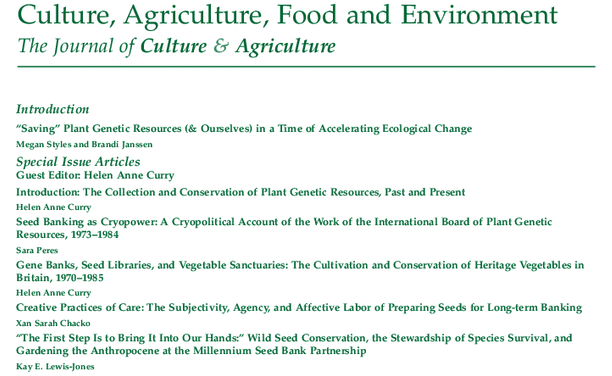
Looks good. A couple of the papers are even open access. I admit I haven’t read them yet, but I will, and report back.
And watch out for Dr Curry’s new project “From Collection to Cultivation: Historical Perspectives on Crop Diversity and Food Security,” which is launching this year with support from a Wellcome Trust Investigator Award.
Brainfood: Food system, Fish cryo, Bromeliad maps, Ag risk, Grass pollination, Gendered cassava, Sorghum salinity, Soybean subsetting, Reverse speciation, Legume data, Livestock diseases, Buckwheat diversity, Wild barley genome, Wild sorghums, Wheat gap
- Impacts of Global Food Systems on Biodiversity and Water: The Vision of Two Reports and Future Aims. It’s all connected, and not in a good way.
- On‐Site Capabilities of a Mobile Laboratory for Aquatic Germplasm Cryopreservation. Not so easy for plants, alas.
- Biogeography and conservation status of the pineapple family (Bromeliaceae). The Atlantic Forest, the northern Andes and Central America.
- A review of types of risks in agriculture: What we know and what we need to know. Very few studies look beyond production risk, largely ignoring four other types of risk, and the prevalence of multiple risks.
- Visual and olfactory floral cues related to ambophilous pollination systems in Poaceae. Insects can facilitate pollination in some grasses.
- Cassava Trait Preferences of Men and Women Farmers in Nigeria: Implications for Breeding. Women select on quality, men on agronomy.
- Phenotypic and physiological responses to salt exposure in Sorghum reveal diversity among domesticated landraces. Salinity tolerance was acquired early in domestication and then maintained or lost depending on prevalent soil conditions.
- Combining Focused Identification of Germplasm and Core Collection Strategies to Identify Genebank Accessions for Central European Soybean Breeding. Pre-core FIGS subset based on adaptation to high-latitude cold regions, followed by coring using genotype data: from >17,000 to 366 accessions.
- Adaptive introgression during environmental change can weaken reproductive isolation. Reverse speciation is upon us.
- The future of legume genetic data resources: Challenges, opportunities, and priorities. Centralize and standardise. Good luck with that.
- Application of Mixed Methods to Identify Small Ruminant Disease Priorities in Ethiopia. National disease controls programmes may be on the wrong track.
- Tartary buckwheat (Fagopyrum tataricum Gaertn.) landraces cultivated by Yi people in Liangshan, China. 13 landraces, but not very well differentiated as to use.
- The draft genome of a wild barley genotype reveals its enrichment in genes related to biotic and abiotic stresses compared to cultivated barley. More genes, more alleles in known genes.
- The endemic ‘sugar canes’ of Madagascar (Poaceae, Saccharinae: Lasiorhachis) are close relatives of sorghum. Closer than some actual Sorghum spp.
- Large genetic yield potential and genetic yield gap estimated for wheat in Europe. Long way to go to match the potential, modelled yield of ideotypes.
Nibbles: Sacred forests, Morning glory, Organic cereals, Sorghum diversity, Phoenix studentship
- The church forests of Ethiopia.
- Monumental monographic study of Ipomoea.
- New project on breeding cereals for organic farming in Europe.
- Sorghum genetic resources in the USA.
- Fun studentship on date palm diversity.
Deconstructing crop TED
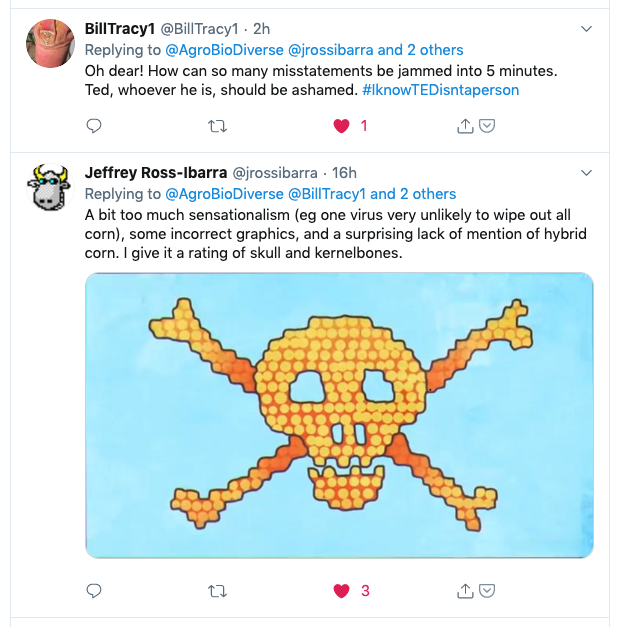 TED-Ed has a bunch of videos on the history of different crops: cacao, tea, and maize for a start. They’re cute, and do provide some interesting information. But a pinch of salt is recommended with your corn on the cob.